


Yersinia pestis: new evidence for an old infection
- PMID: 23209603
- PMCID: PMC3509097
- DOI: 10.1371/journal.pone.0049803
Yersinia pestis: new evidence for an old infection
Abstract
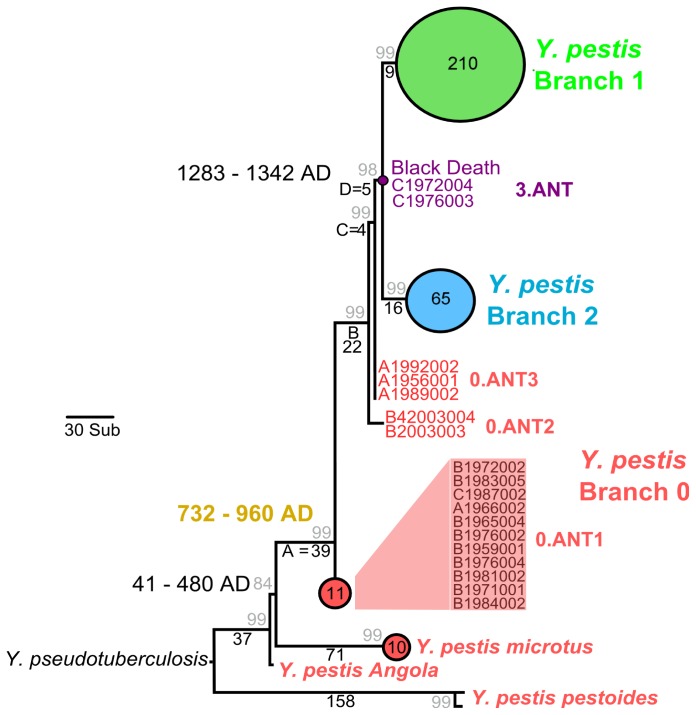
The successful reconstruction of an ancient bacterial genome from archaeological material presents an important methodological advancement for infectious disease research. The reliability of evolutionary histories inferred by the incorporation of ancient data, however, are highly contingent upon the level of genetic diversity represented in modern genomic sequences that are publicly accessible, and the paucity of available complete genomes restricts the level of phylogenetic resolution that can be obtained. Here we add to our original analysis of the Yersinia pestis strain implicated in the Black Death by consolidating our dataset for 18 modern genomes with single nucleotide polymorphism (SNP) data for an additional 289 strains at over 600 positions. The inclusion of this additional data reveals a cluster of Y. pestis strains that diverge at a time significantly in advance of the Black Death, with divergence dates roughly coincident with the Plague of Justinian (6(th) to 8(th) century AD). In addition, the analysis reveals further clues regarding potential radiation events that occurred immediately preceding the Black Death, and the legacy it may have left in modern Y. pestis populations. This work reiterates the need for more publicly available complete genomes, both modern and ancient, to achieve an accurate understanding of the history of this bacterium.
Conflict of interest statement
Figures
References
-
- Sherman IW (2006) The Power of Plagues. Washington, D.C: ASM Press. 431p.
Publication types
MeSH terms
LinkOut - more resources
Full Text Sources
