


What drives the US and Peruvian HIV epidemics in men who have sex with men (MSM)?
- PMID: 23209768
- PMCID: PMC3510067
- DOI: 10.1371/journal.pone.0050522
What drives the US and Peruvian HIV epidemics in men who have sex with men (MSM)?
Erratum in
- PLoS One. 2013;8(7). doi: 10.1371/annotation/9a6a0c8e-2d01-4f36-9ab8-f9fdfce6497b doi: 10.1371/annotation/9a6a0c8e-2d01-4f36-9ab8-f9fdfce6497b
Abstract
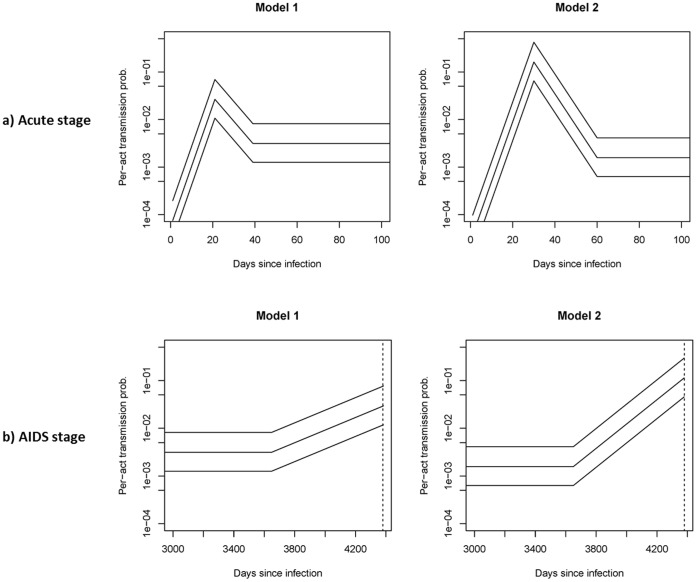
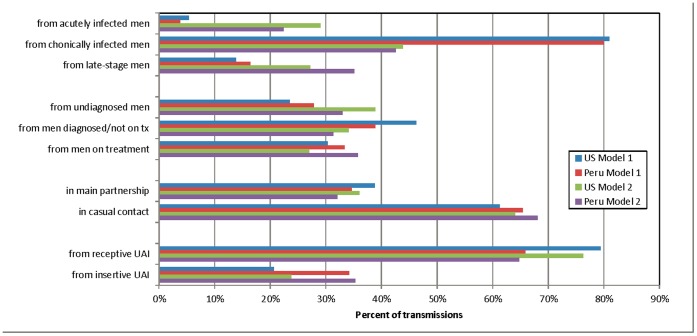
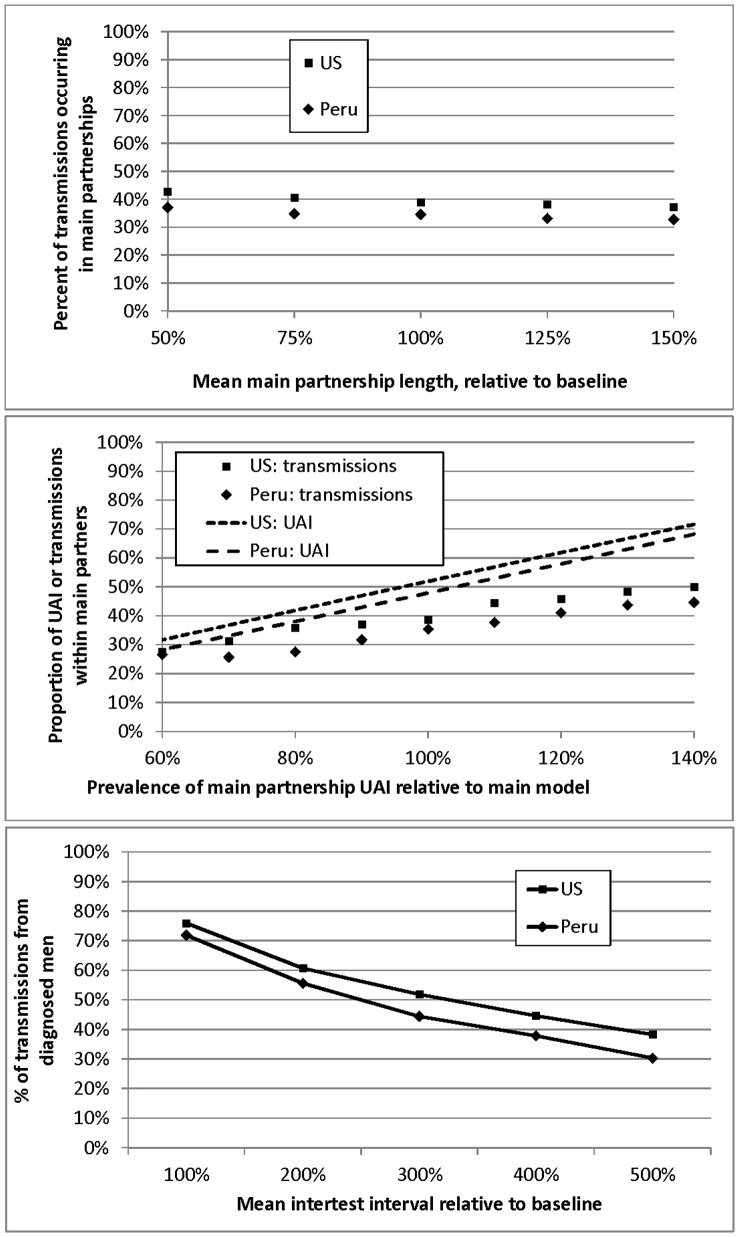
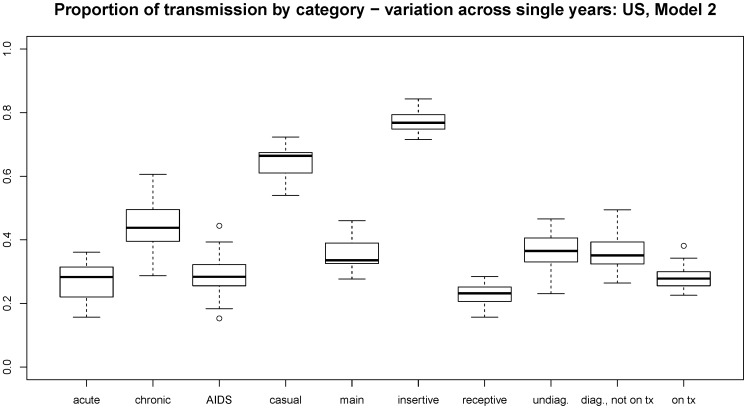
In this work, we estimate the proportions of transmissions occurring in main vs. casual partnerships, and by the sexual role, infection stage, and testing and treatment history of the infected partner, for men who have sex with men (MSM) in the US and Peru. We use dynamic, stochastic models based in exponential random graph models (ERGMs), obtaining inputs from multiple large-scale MSM surveys. Parallel main partnership and casual sexual networks are simulated. Each man is characterized by age, race, circumcision status, sexual role behavior, and propensity for unprotected anal intercourse (UAI); his history is modeled from entry into the adult population, with potential transitions including HIV infection, detection, treatment, AIDS diagnosis, and death. We implemented two model variants differing in assumptions about acute infectiousness, and assessed sensitivity to other key inputs. Our two models suggested that only 4-5% (Model 1) or 22-29% (Model 2) of HIV transmission results from contacts with acute-stage partners; the plurality (80-81% and 49%, respectively) stem from chronic-stage partners and the remainder (14-16% and 27-35%, respectively) from AIDS-stage partners. Similar proportions of infections stem from partners whose infection is undiagnosed (24-31%), diagnosed but untreated (36-46%), and currently being treated (30-36%). Roughly one-third of infections (32-39%) occur within main partnerships. Results by country were qualitatively similar, despite key behavioral differences; one exception was that transmission from the receptive to insertive partner appears more important in Peru (34%) than the US (21%). The broad balance in transmission contexts suggests that education about risk, careful assessment, pre-exposure prophylaxis, more frequent testing, earlier treatment, and risk-reduction, disclosure, and adherence counseling may all contribute substantially to reducing the HIV incidence among MSM in the US and Peru.
Conflict of interest statement
Figures
References
-
- Beyrer C, Wirtz AL, Walker D, Johns B, Sifakis F, et al... (2011) The global HIV epidemics among men who have sex with men. Washington, DC: World Bank. p. p.
-
- Beyrer C, Baral SD, Walker D, Wirtz AL, Johns B, et al. (2010) The Expanding Epidemics of HIV Type 1 Among Men Who Have Sex With Men in Low- and Middle-Income Countries: Diversity and Consistency. Epidemiologic Reviews 32: 137–151. - PubMed
Publication types
MeSH terms
Grants and funding
LinkOut - more resources
Full Text Sources
Medical
