Review
. 2012 Dec;19(12):1218-27.
doi: 10.1038/nsmb.2436.

Perceiving the epigenetic landscape through histone readers

Affiliations
Review

Perceiving the epigenetic landscape through histone readers

Catherine A Musselman et al. Nat Struct Mol Biol. 2012 Dec.

Abstract

Post-translational modifications (PTMs) of histones provide a fine-tuned mechanism for regulating chromatin structure and dynamics. PTMs can alter direct interactions between histones and DNA and serve as docking sites for protein effectors, or readers, of these PTMs. Binding of the readers recruits or stabilizes various components of the nuclear signaling machinery at specific genomic sites, mediating fundamental DNA-templated processes, including gene transcription and DNA recombination, replication and repair. In this review, we highlight the latest advances in characterizing histone-binding mechanisms and identifying new epigenetic readers and summarize the functional significance of PTM recognition.


Conflict of interest statement

COMPETING FINANCIAL INTERESTS

The authors declare no competing financial interests.

Figures
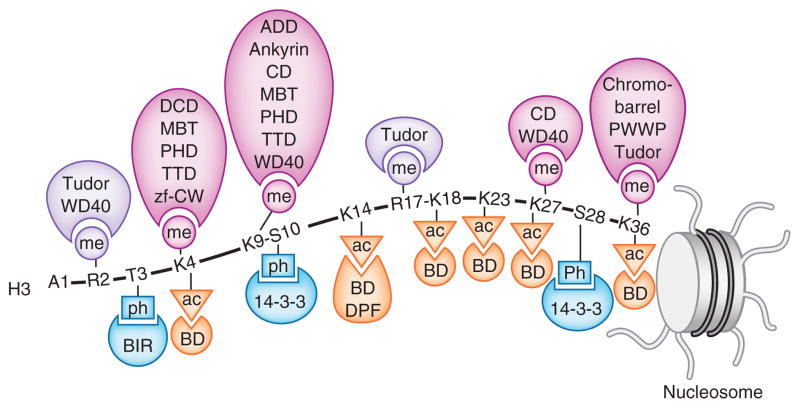
Figure 1
Figure 1
Readers of histone PTMs. Recognition of the methylated (me) lysine, methylated (me) arginine, acetylated (ac) lysine and phosphorylated (ph) serine and threonine residues of the N-terminal histone H3 tail by indicated readers.
Figure 2
Figure 2
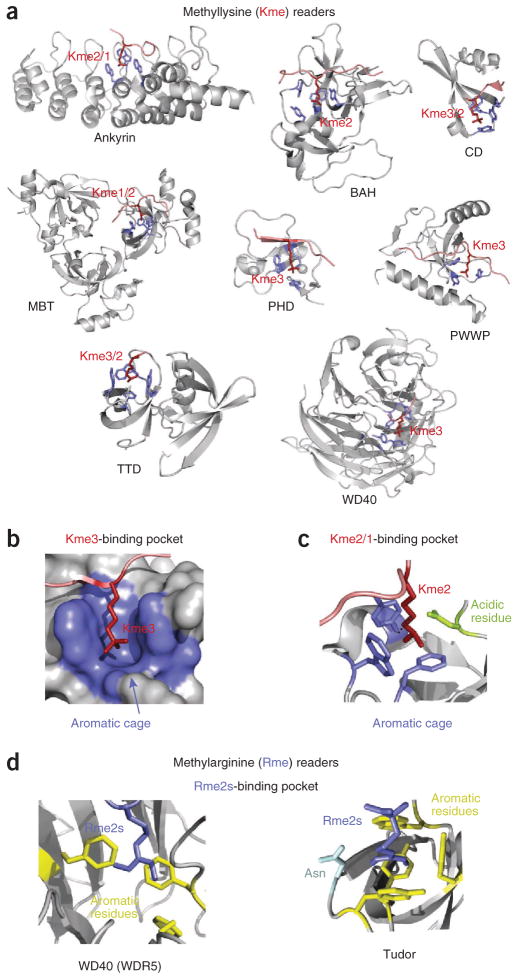
Molecular mechanisms for the recognition of methyllysine and methylarginine. (a) Structures of the readers in complex with histone peptides methylated at lysine residues. The aromatic cage residues and the histone peptides are colored blue and red, respectively. (bd) The binding sites for trimethylated lysine (Kme3) (b), dimethylated lysine (Kme2) (c) and symmetrically dimethylated arginine (Rme2s) (d). PDB codes: 3B95, 4DOW, 1KNE, 2PQW, 2G6Q, 2X4X, 2IG0, 3IIW, 2F6J, 4A7J and 4A4E.
Figure 3
Figure 3
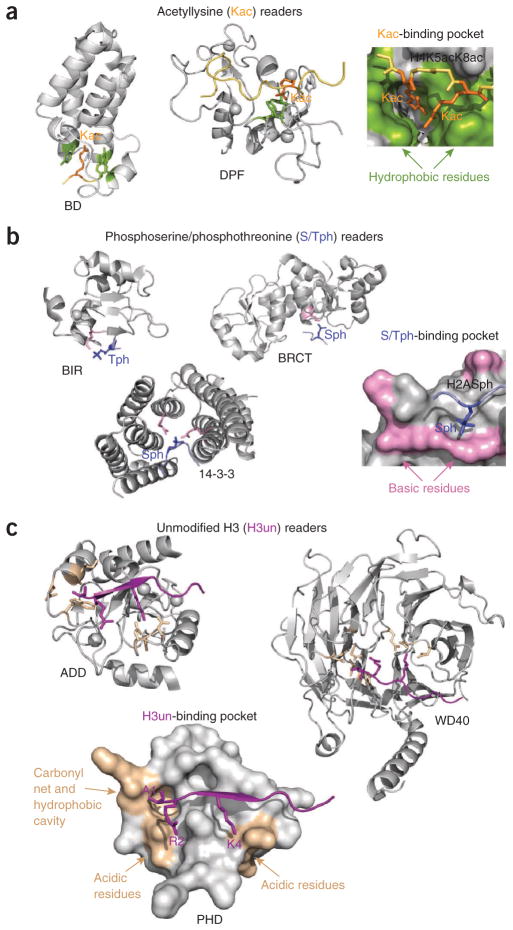
Molecular mechanisms for the recognition of acetyllysine, phosphoserine or phosphothreonine and unmodified histone H3. (ac) Structures of the readers bound to histone peptides that are acetylated at lysine residues (a), phosphorylated at serine or threonine residues (b) and unmodified (c). Binding-site residues are colored green (a), pink (b) and wheat (c) with the corresponding peptides in orange, blue and purple, respectively. PDB codes: 1E6I, 2KWJ, 2WP2, 4A0N, 2AZM, 2C1N, 3L41, 3A1B, 2YBA and 2PUY.
Figure 4
Figure 4
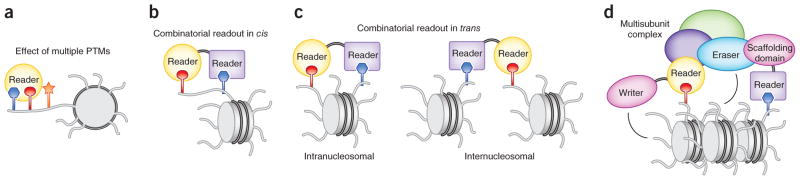
Combinatorial readout of PTMs. (ac) Recognition of a target PTM is influenced by adjacent PTMs on the same histone tail (a) and the combined action of multiple readers within the same protein (b,c). (d) Multivalent engagement of readers within individual subunits of the complex. The reader-harboring proteins can also contain the catalytic domains (which act as writers and erasers) or scaffolding domains that bridge their host proteins with other subunits of the complex. Readers can recognize PTMs on a single histone tail (cis mechanism) or different histone tails (trans mechanism).

References

    1. Luger K, Mader AW, Richmond RK, Sargent DF, Richmond TJ. Crystal structure of the nucleosome core particle at 2.8-Å resolution. Nature. 1997;389:251–260. - PubMed
    1. Kouzarides T. Chromatin modifications and their function. Cell. 2007;128:693–705. - PubMed
    1. Portela A, Esteller M. Epigenetic modifications and human disease. Nat Biotechnol. 2010;28:1057–1068. - PubMed
    1. Dawson MA, Kouzarides T. Cancer epigenetics: from mechanism to therapy. Cell. 2012;150:12–27. - PubMed
    1. Robison AJ, Nestler EJ. Transcriptional and epigenetic mechanisms of addiction. Nat Rev Neurosci. 2011;12:623–637. - PMC - PubMed

Publication types