. 2013 Mar;110(3):277-82.
doi: 10.1038/hdy.2012.83. Epub 2012 Dec 5.

Chicken domestication: an updated perspective based on mitochondrial genomes

Affiliations

Chicken domestication: an updated perspective based on mitochondrial genomes

Y-W Miao et al. Heredity (Edinb). 2013 Mar.

Abstract

Domestic chickens (Gallus gallus domesticus) fulfill various roles ranging from food and entertainment to religion and ornamentation. To survey its genetic diversity and trace the history of domestication, we investigated a total of 4938 mitochondrial DNA (mtDNA) fragments including 2843 previously published and 2095 de novo units from 2044 domestic chickens and 51 red junglefowl (Gallus gallus). To obtain the highest possible level of molecular resolution, 50 representative samples were further selected for total mtDNA genome sequencing. A fine-gained mtDNA phylogeny was investigated by defining haplogroups A-I and W-Z. Common haplogroups A-G were shared by domestic chickens and red junglefowl. Rare haplogroups H-I and W-Z were specific to domestic chickens and red junglefowl, respectively. We re-evaluated the global mtDNA profiles of chickens. The geographic distribution for each of major haplogroups was examined. Our results revealed new complexities of history in chicken domestication because in the phylogeny lineages from the red junglefowl were mingled with those of the domestic chickens. Several local domestication events in South Asia, Southwest China and Southeast Asia were identified. The assessment of chicken mtDNA data also facilitated our understanding about the Austronesian settlement in the Pacific.


Figures

Figure 1
Figure 1
The samples selected for mtDNA genome sequencing were based on the neighbour-joining network of 409 haplotypes. MtDNAs with haplotypes selected for complete sequencing are indicated with circles. Numbers in the circles correspond to the sequences in Figure 2 and Supplementary dataset 3. Numbers in red and black refer to the red junglefowl and domestic chickens, respectively. The geographic sources of the samples are represented by different colors. The discordances in the phylogeny between based on CR and complete mtDNA genome are noted by the red ellipse with dash line.
Figure 2
Figure 2
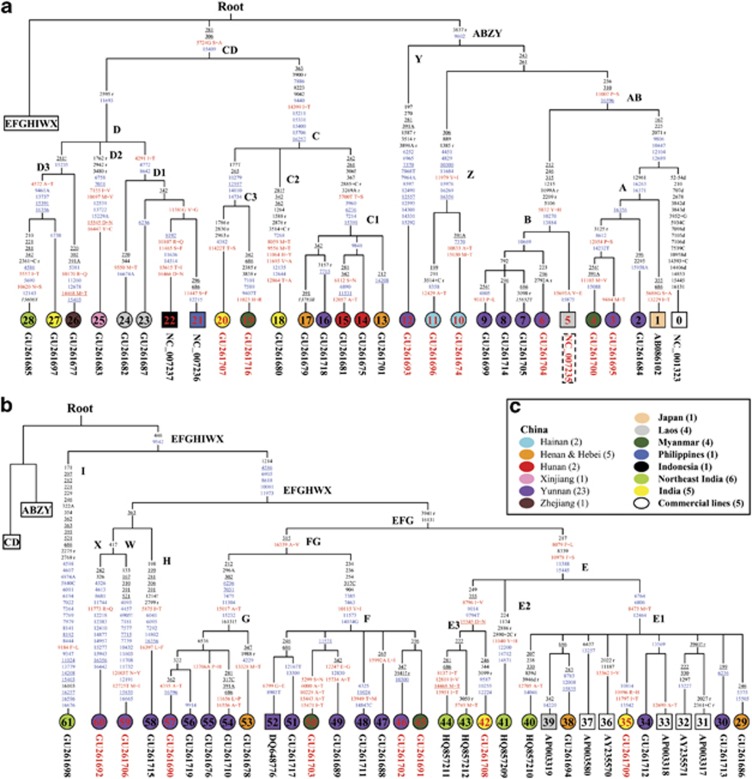
The haplogroup classification tree of 61 complete mtDNA sequences (a, b). The nucleotide positions in the sequences were scored relative to the reference sequence NC_007235 which is noted by the dashes. Transitions are shown on the branches and transversions are further annotated by adding suffixes. Deletions and insertions are indicated by ‘d' and ‘+', respectively. Amino-acid replacements are in red and marked by a single-letter code, whereas synonymous replacements are in blue. Changes in ribosomal RNA genes are denoted by ‘r'. The exclamation mark ‘!' designates back mutation and recurrent variants are underlined. ‘R' and ‘Y' specify the heteroplasmic status of A/G and C/T at a certain site, respectively. All heteroplasmic variants are excluded in the analyses and are marked in italics. ‘0' represents the previous reference sequence NC_001323 which was excluded in subsequent analyses because of potential sequence errors. Labels of sequences are in accordance with Figure 1. (c) The geographic origin of samples as shown by different colors.
Figure 3
Figure 3
The hierarchical phylogenetic relationships and distributions of the haplogroups observed in global domestic chickens. The diagnostic mutational motifs for each of the haplogroups are shown on the branches. ‘Un' means the unclassified sequences within this phylogeny. The sample sizes are in parentheses. The regions of China follow the traditional definitions (see Supplementary dataset 1).
Figure 4
Figure 4
mtDNA haplogroup profile for 206 red junglefowl.

References

    1. Achilli A, Bonfiglio S, Olivieri A, Malusa A, Pala M, Kashani BH, et al. The multifaceted origin of taurine cattle reflected by the mitochondrial genome. PLoS One. 2009;4:e5753. - PMC - PubMed
    1. Achilli A, Olivieri A, Pellecchia M, Uboldi C, Colli L, Al-Zahery N, et al. Mitochondrial genomes of extinct aurochs survive in domestic cattle. Curr Biol. 2008;18:R157–R158. - PubMed
    1. Achilli A, Olivieri A, Soares P, Lancioni H, Hooshiar KB, Perego UA, et al. Mitochondrial genomes from modern horses reveal the major haplogroups that underwent domestication. Proc Natl Acad Sci USA. 2012;109:2449–2454. - PMC - PubMed
    1. Behar DM, van Oven M, Rosset S, Metspalu M, Loogväli EL, Silva NM, et al. A ‘copernican' reassessment of the human mitochondrial DNA tree from its root. Am J Hum Genet. 2012;90:675–684. - PMC - PubMed
    1. Bellwood P.1976Prehistoric plant and animal domestication in AustronesiaIn: GdG Sieveking, Longworth IH, Wilson ED, (eds)Problems in Economic and Social Archaeology Westview Press Boulder, CO; 153–168.

Publication types

Substances

Associated data

LinkOut - more resources