. 2012 Dec 4;2(12):e201.
doi: 10.1038/tp.2012.125.

Molecular characteristics of Human Endogenous Retrovirus type-W in schizophrenia and bipolar disorder

Affiliations

Molecular characteristics of Human Endogenous Retrovirus type-W in schizophrenia and bipolar disorder

H Perron et al. Transl Psychiatry. .

Erratum in

  • Transl Psychiatry. 2013;3:e226. Moins-Teiserenc, H [corrected to Moins-Teisserenc, H]

Abstract

Epidemiological and genome-wide association studies of severe psychiatric disorders such as schizophrenia (SZ) and bipolar disorder (BD), suggest complex interactions between multiple genetic elements and environmental factors. The involvement of genetic elements such as Human Endogenous Retroviruses type 'W' family (HERV-W) has consistently been associated with SZ. HERV-W envelope gene (env) is activated by environmental factors and encodes a protein displaying inflammation and neurotoxicity. The present study addressed the molecular characteristics of HERV-W env in SZ and BD. Hundred and thirty-six patients, 91 with BD, 45 with SZ and 73 healthy controls (HC) were included. HERV-W env transcription was found to be elevated in BD (P<10-4) and in SZ (P=0.012) as compared with HC, but with higher values in BD than in SZ group (P<0.01). The corresponding DNA copy number was paradoxically lower in the genome of patients with BD (P=0.0016) or SZ (P<0.0003) than in HC. Differences in nucleotide sequence of HERV-W env were found between patients with SZ and BD as compared with HC, as well as between SZ and BD. The molecular characteristics of HERV-W env also differ from what was observed in Multiple Sclerosis (MS) and may represent distinct features of the genome of patients with BD and SZ. The seroprevalence for Toxoplasma gondii yielded low but significant association with HERV-W transcriptional level in a subgroup of BD and SZ, suggesting a potential role in particular patients. A global hypothesis of mechanisms inducing such major psychoses is discussed, placing HERV-W at the crossroads between environmental, genetic and immunological factors. Thus, particular infections would act as activators of HERV-W elements in earliest life, resulting in the production of an HERV-W envelope protein, which then stimulates pro-inflammatory and neurotoxic cascades. This hypothesis needs to be further explored as it may yield major changes in our understanding and treatment of severe psychotic disorders.


Figures
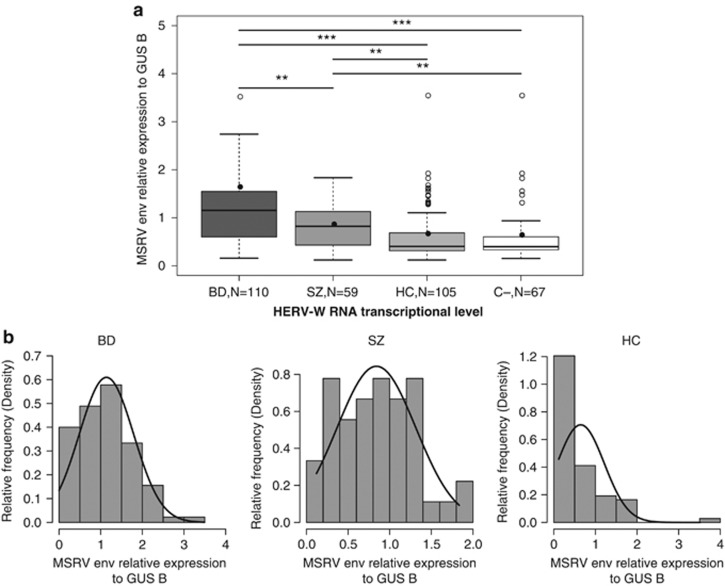
Figure 1
Figure 1
Human Endogenous Retrovirus type-W (HERV-W) RNA transcriptional level. (a) HERV-W env RNA expression in patients and control groups. The relative transcription of Multiple Sclerosis-associated Retroviral element (MSRV)-env RNA to the housekeeping gene GUS B is indicated on the y axis; it measures the standardized and relative transcriptional activity in all peripheral mononuclear cells samples defined as 2E(Ct GUS B−Ct MSRV-env) (See Patients and methods). Patients and control groups are indicated on the x axis: BD, bipolar disorder; SZ, schizophrenia; HC, healthy controls without psychiatric history; C-, subset of HC group with C-reactive protein below the normal threshold in serum. **P⩽0.01 ***P⩽0.0001. (b) Distribution of HERV-W RNA expression levels in patients and control groups. y axis represents the density of corresponding HERV-W env RNA relative expression values on the x axis, giving a description of their distribution in each group (BD, SZ, HC). Density curve: the area under a density curve (between the curve and the horizontal axis) is always defined as 1 unit. The area under the density curve between two values is the proportion of observations in the data set that fall between those two values. Histogram: the distribution frequency of results between two values is represented by bars.
Figure 2
Figure 2
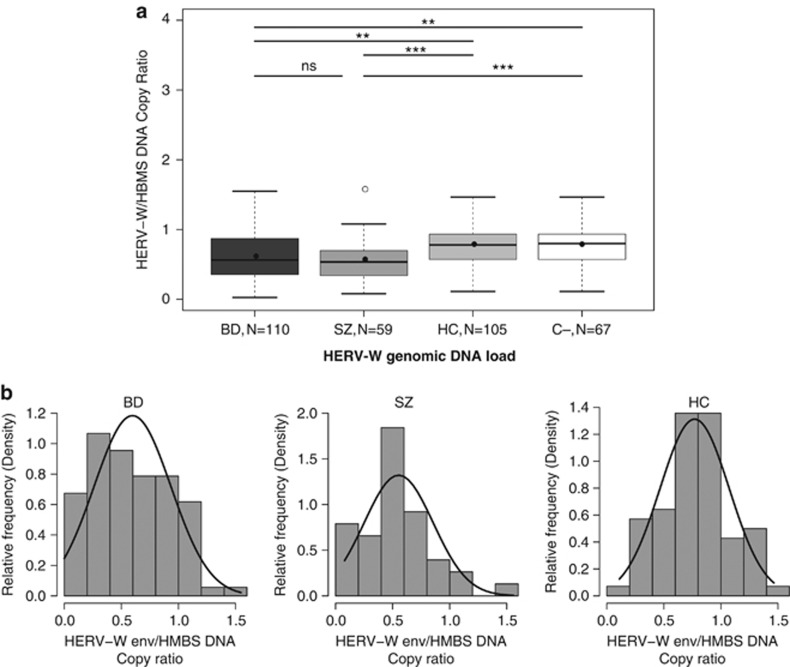
Human Endogenous Retrovirus type-W (HERV-W) genomic DNA load. (a) Relative HERV-W DNA copy number in patients and controls. The ratio between the DNA copy number of HERV-W env gene Multiple Sclerosis-associated Retroviral element (MSRV)-subtype and the hydroxymethylbilane synthase housekeeping gene is indicated on the y axis. This measures the relative quantification of copy numbers from the MSRV subtype, detected by the MSRV-env probe with the quantitative PCR technical conditions used here on total blood leukocytes. Patients and control groups are indicated on the x axis: BD, bipolar disorder; SZ, schizophrenia; HC, healthy controls without psychiatric history; C-, subset of HC group without C-reactive protein above the normal threshold in serum. **P⩽0.01 ***P⩽0.0001. (b) Distribution of HERV-W env DNA copy number in patients and controls. y Axis represents the frequency and the density of corresponding HERV-W env DNA copy values on the x axis, giving a description of their distribution in each group (BD, SZ, HC). Density curve: the area under a density curve (between the curve and the horizontal axis) is always defined as 1 unit. The area under the density curve between two values is the proportion of observations in the data set that fall between those two values. Histogram: the distribution frequency of results between two values is represented by bars.

References

    1. Van Winkel R, Esquivel G, Kenis G, Wichers M, Collip D, Peerbooms O, et al. REVIEW: genome-wide findings in schizophrenia and the role of gene-environment interplay. CNS Neurosci Ther. 2010;16:e185–e192. - PMC - PubMed
    1. Lichtenstein P, Yip BH, Bjork C, Pawitan Y, Cannon TD, Sullivan PF, et al. Common genetic determinants of schizophrenia and bipolar disorder in Swedish families: a population-based study. Lancet. 2009;373:234–239. - PMC - PubMed
    1. Brown AS, Derkits EJ. Prenatal infection and schizophrenia: a review of epidemiologic and translational studies. Am J Psychiatry. 2010;167:261–280. - PMC - PubMed
    1. Pearce BD, Kruszon-Moran D, Jones JL. The relationship between Toxoplasma Gondii infection and mood disorders in the third National Health and Nutrition Survey. Biol Psychiatry. 2012;72:290–295. - PMC - PubMed
    1. Mortensen PB, Norgaard-Pedersen B, Waltoft BL, Sorensen TL, Hougaard D, Torrey EF, et al. Toxoplasma gondii as a risk factor for early-onset schizophrenia: analysis of filter paper blood samples obtained at birth. Biol Psychiatry. 2007;61:688–693. - PubMed

Publication types

MeSH terms