Nonallelic homologous recombination between retrotransposable elements is a driver of de novo unbalanced translocations
- PMID: 23212949
- PMCID: PMC3589530
- DOI: 10.1101/gr.145631.112
Nonallelic homologous recombination between retrotransposable elements is a driver of de novo unbalanced translocations
Abstract
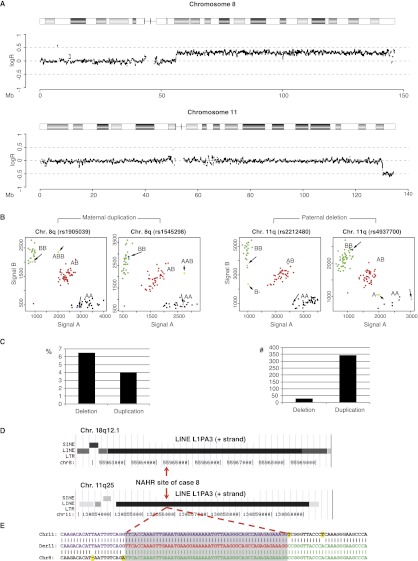
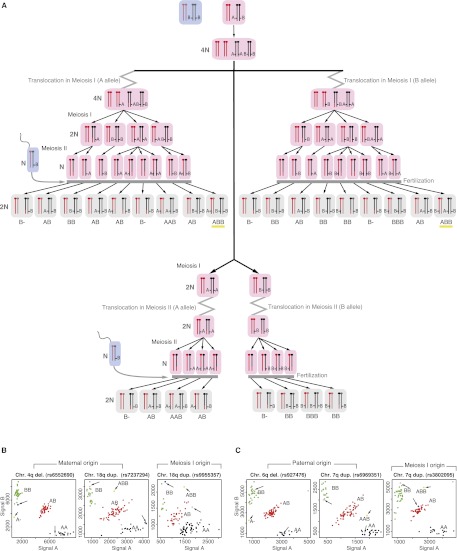
Large-scale analysis of balanced chromosomal translocation breakpoints has shown nonhomologous end joining and microhomology-mediated repair to be the main drivers of interchromosomal structural aberrations. Breakpoint sequences of de novo unbalanced translocations have not yet been investigated systematically. We analyzed 12 de novo unbalanced translocations and mapped the breakpoints in nine. Surprisingly, in contrast to balanced translocations, we identify nonallelic homologous recombination (NAHR) between (retro)transposable elements and especially long interspersed elements (LINEs) as the main mutational mechanism. This finding shows yet another involvement of (retro)transposons in genomic rearrangements and exposes a profoundly different mutational mechanism compared with balanced chromosomal translocations. Furthermore, we show the existence of compound maternal/paternal derivative chromosomes, reinforcing the hypothesis that human cleavage stage embryogenesis is a cradle of chromosomal rearrangements.
Figures
References
-
- Ballif BC, Sulpizio SG, Lloyd RM, Minier SL, Theisen A, Bejjani BA, Shaffer LG 2007. The clinical utility of enhanced subtelomeric coverage in array CGH. Am J Med Genet A 143A: 1850–1857 - PubMed
-
- Bauters M, Van Esch H, Friez MJ, Boespflug-Tanguy O, Zenker M, Vianna-Morgante AM, Rosenberg C, Ignatius J, Raynaud M, Hollanders K, et al. 2008. Nonrecurrent MECP2 duplications mediated by genomic architecture-driven DNA breaks and break-induced replication repair. Genome Res 18: 847–858 - PMC - PubMed
-
- Branzei D, Foiani M 2010. Maintaining genome stability at the replication fork. Nat Rev Mol Cell Biol 11: 208–219 - PubMed
-
- Burwinkel B, Kilimann MW 1998. Unequal homologous recombination between LINE-1 elements as a mutational mechanism in human genetic disease. J Mol Biol 277: 513–517 - PubMed
Publication types
MeSH terms
Substances
LinkOut - more resources
Full Text Sources
Molecular Biology Databases