


Development and application of microsatellites in candidate genes related to wood properties in the Chinese white poplar (Populus tomentosa Carr.)
- PMID: 23213110
- PMCID: PMC3576656
- DOI: 10.1093/dnares/dss031
Development and application of microsatellites in candidate genes related to wood properties in the Chinese white poplar (Populus tomentosa Carr.)
Abstract
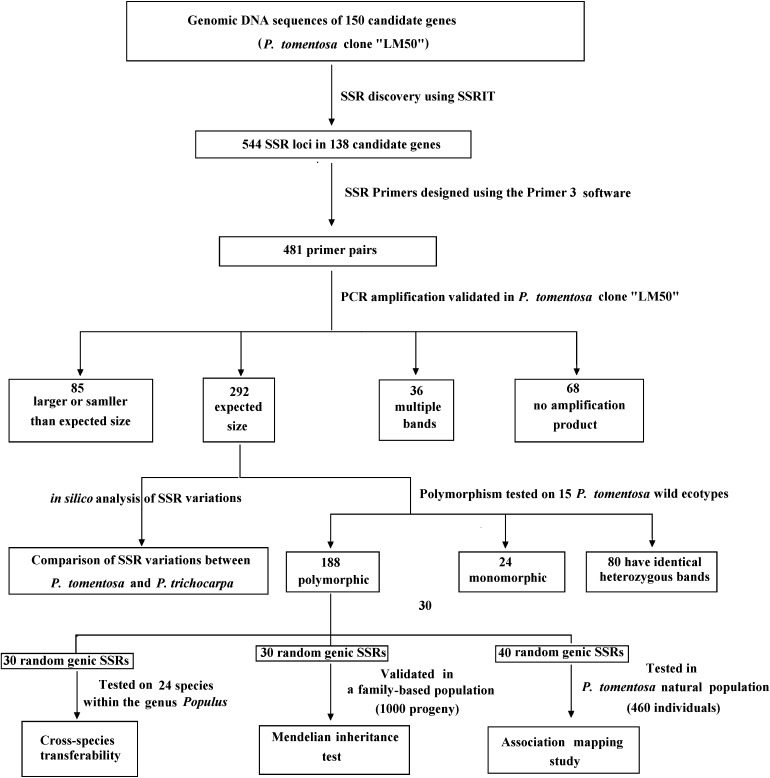
Gene-derived simple sequence repeats (genic SSRs), also known as functional markers, are often preferred over random genomic markers because they represent variation in gene coding and/or regulatory regions. We characterized 544 genic SSR loci derived from 138 candidate genes involved in wood formation, distributed throughout the genome of Populus tomentosa, a key ecological and cultivated wood production species. Of these SSRs, three-quarters were located in the promoter or intron regions, and dinucleotide (59.7%) and trinucleotide repeat motifs (26.5%) predominated. By screening 15 wild P. tomentosa ecotypes, we identified 188 polymorphic genic SSRs with 861 alleles, 2-7 alleles for each marker. Transferability analysis of 30 random genic SSRs, testing whether these SSRs work in 26 genotypes of five genus Populus sections (outgroup, Salix matsudana), showed that 72% of the SSRs could be amplified in Turanga and 100% could be amplified in Leuce. Based on genotyping of these 26 genotypes, a neighbour-joining analysis showed the expected six phylogenetic groupings. In silico analysis of SSR variation in 220 sequences that are homologous between P. tomentosa and Populus trichocarpa suggested that genic SSR variations between relatives were predominantly affected by repeat motif variations or flanking sequence mutations. Inheritance tests and single-marker associations demonstrated the power of genic SSRs in family-based linkage mapping and candidate gene-based association studies, as well as marker-assisted selection and comparative genomic studies of P. tomentosa and related species.
Figures


References
-
- Tuskan G.A., Difazio S., Jansson S., et al. The genome of black cottonwood, Populus trichocarpa (Torr. & Gray) Science. 2006;313:1596–604. - PubMed
-
- Brunner A.M., Busov V.B., Strauss S.H. Poplar genome sequence: functional genomics in an ecologically dominant plant species. Trends Plant Sci. 2004;9:49–56. - PubMed
-
- Li L., Lu S., Chiang V.L. A genomic and molecular view of wood formation. Crit. Rev. Plant Sci. 2006;25:213–33.
-
- Zhang D.Q., Du Q.Z., Xu B.H., Zhang Z.Y., Li B.L. The actin multigene family in Populus: organization, expression and phylogenetic analysis. Mol. Genet. Genomics. 2010;284:105–19. - PubMed
-
- Zhu Z., Zhang Z. The status and advances of genetic improvement of Populus tomentosa Carr. J. Beijing Forestry Univ. 1997;6:1–7.
Publication types
MeSH terms
Substances
LinkOut - more resources
Full Text Sources
Other Literature Sources
