


Assessing exercise limitation using cardiopulmonary exercise testing
- PMID: 23213518
- PMCID: PMC3506917
- DOI: 10.1155/2012/824091
Assessing exercise limitation using cardiopulmonary exercise testing
Abstract
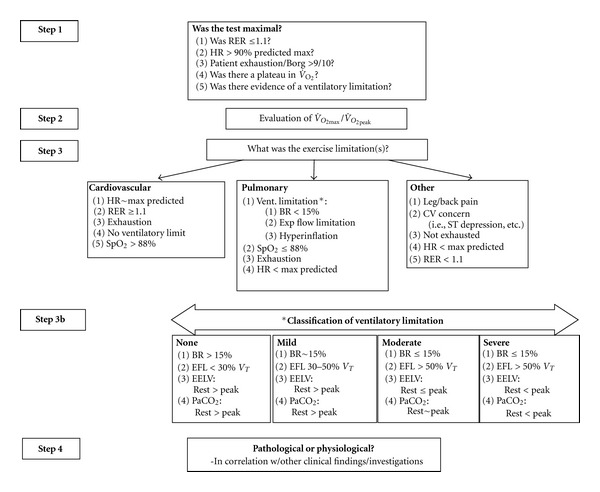
The cardiopulmonary exercise test (CPET) is an important physiological investigation that can aid clinicians in their evaluation of exercise intolerance and dyspnea. Maximal oxygen consumption ([Formula: see text]) is the gold-standard measure of aerobic fitness and is determined by the variables that define oxygen delivery in the Fick equation ([Formula: see text] = cardiac output × arterial-venous O(2) content difference). In healthy subjects, of the variables involved in oxygen delivery, it is the limitations of the cardiovascular system that are most responsible for limiting exercise, as ventilation and gas exchange are sufficient to maintain arterial O(2) content up to peak exercise. Patients with lung disease can develop a pulmonary limitation to exercise which can contribute to exercise intolerance and dyspnea. In these patients, ventilation may be insufficient for metabolic demand, as demonstrated by an inadequate breathing reserve, expiratory flow limitation, dynamic hyperinflation, and/or retention of arterial CO(2). Lung disease patients can also develop gas exchange impairments with exercise as demonstrated by an increased alveolar-to-arterial O(2) pressure difference. CPET testing data, when combined with other clinical/investigation studies, can provide the clinician with an objective method to evaluate cardiopulmonary physiology and determination of exercise intolerance.
Figures
References
-
- ATS/ACCP. Statement on cardiopulmonary exercise testing. American Journal of Respiratory and Critical Care Medicine. 2003;167(2):211–277. - PubMed
-
- Palange P, Ward SA, Carlsen KH, et al. Recommendations on the use of exercise testing in clinical practice. European Respiratory Journal. 2007;29(1):185–209. - PubMed
-
- DePaso WJ, Winterbauer RH, Lusk JA, Dreis DF, Springmeyer SC. Chronic dyspnea unexplained by history, physical examination, chest roentgenogram, and spirometry; Analysis of a seven-year experience. Chest. 1991;100(5):1293–1299. - PubMed
-
- Pratter MR, Curley FJ, Dubois J, Irwin RS. Cause and evaluation of chronic dyspnea in a pulmonary disease clinic. Archives of Internal Medicine. 1989;149(10):2277–2282. - PubMed
-
- Balady GJ, Arena R, Sietsema K, et al. Clinician’s guide to cardiopulmonary exercise testing in adults: a scientific statement from the American heart association. Circulation. 2010;122(2):191–225. - PubMed
LinkOut - more resources
Full Text Sources
Medical
