


Phosphatidylserine-induced factor Xa dimerization and binding to factor Va are competing processes in solution
- PMID: 23214401
- PMCID: PMC3544317
- DOI: 10.1021/bi301239z
Phosphatidylserine-induced factor Xa dimerization and binding to factor Va are competing processes in solution
Erratum in
-
Correction to Phosphatidylserine-Induced Factor Xa Dimerization and Binding to Factor Va Are Competing Processes in Solution.Biochemistry. 2016 Mar 15;55(10):1554. doi: 10.1021/acs.biochem.6b00112. Epub 2016 Mar 4. Biochemistry. 2016. PMID: 26943353 No abstract available.
Abstract
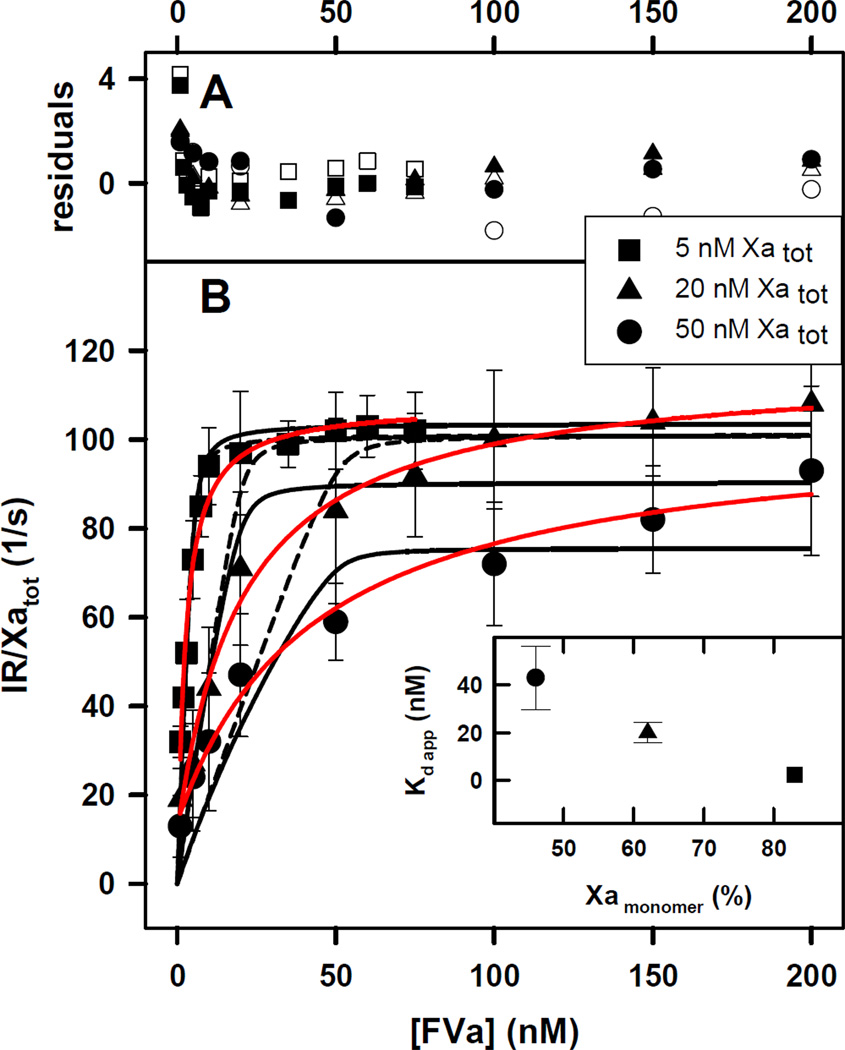
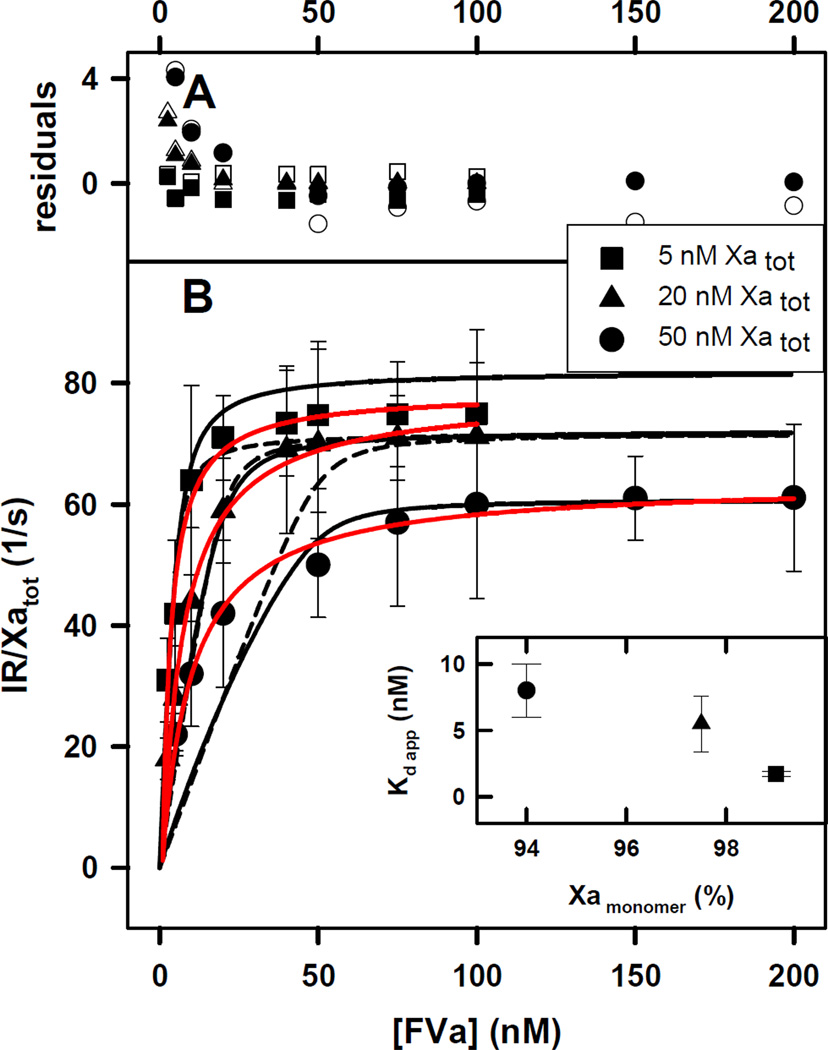
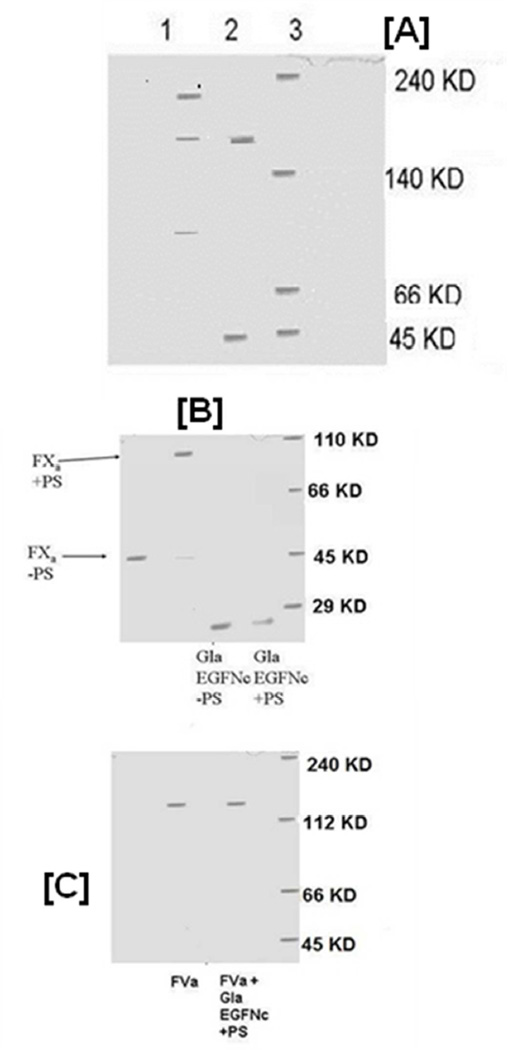
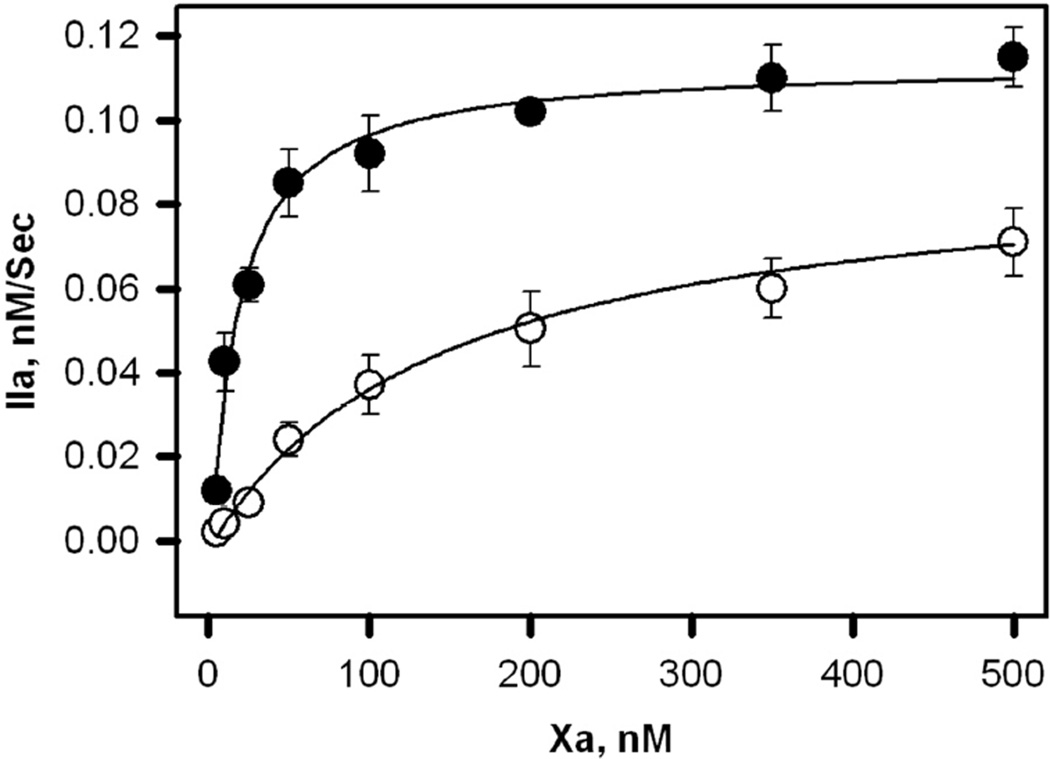
A soluble, short chain phosphatidylserine, 1,2-dicaproyl-sn-glycero-3-phospho-l-serine (C6PS), binds to discrete sites on FXa, FVa, and prothrombin to alter their conformations, to promote FXa dimerization (K(d) ~ 14 nM), and to enhance both the catalytic activity of FXa and the cofactor activity of FVa. In the presence of calcium, C6PS binds to two sites on FXa, one in the epidermal growth factor-like (EGF) domain and one in the catalytic domain; the latter interaction is sensitive to Na(+) binding and probably represents a protein recognition site. Here we ask whether dimerization of FXa and its binding to FVa in the presence of C6PS are competitive processes. We monitored FXa activity at 5, 20, and 50 nM FXa while titrating with FVa in the presence of 400 μM C6PS and 3 or 5 mM Ca(2+) to show that the apparent K(d) of FVa-FXa interaction increased with an increase in FXa concentration at 5 mM Ca(2+), but the K(d) was only slightly affected at 3 mM Ca(2+). A mixture of 50 nM FXa and 50 nM FVa in the presence of 400 μM C6PS yielded both Xa homodimers and Xa·Va heterodimers, but no FXa dimers bound to FVa. A mutant FXa (R165A) that has reduced prothrombinase activity showed both weakened dimerization (K(d) ~ 147 nM) and weakened FVa binding (apparent K(d) values of 58, 92, and 128 nM for 5, 20, and 50 nM R165A FXa, respectively). Native gel electrophoresis showed that the GLA-EGF(NC) fragment of FXa (lacking the catalytic domain) neither dimerized nor formed a complex with FVa in the presence of 400 μM C6PS and 5 mM Ca(2+). Our results demonstrate that the dimerization site and FVa-binding site are both located in the catalytic domain of FXa and that these sites are linked thermodynamically.
Figures
References
-
- Fenton Jn. Thrombin. Ann NY Acad Sci. 1986;485:5–15. - PubMed
-
- Jackson CM, Nemerson Y. Blood coagulation. Annu Rev Biochem. 1980;49:765–811. - PubMed
-
- Mann KG, Jenny RJ, Krishnaswamy S. Cofactor proteins in the assembly and expression of blood clotting enzyme complexes. Annu Rev Biochem. 1988;57:915–956. - PubMed
-
- Bevers EM, Comfurius P, Zwaal RF. Changes in membrane phospholipid distribution during platelet activation. Biochim Biophys Acta. 1983;736:57–66. - PubMed
-
- Jones ME, Lentz BR, Dombrose FA, Sandberg H. Comparison of the abilities of synthetic and platelet-derived membranes to enhance thrombin formation. Thromb Res. 1985;39:711–724. - PubMed
Publication types
MeSH terms
Substances
Grants and funding
LinkOut - more resources
Full Text Sources
Miscellaneous
