


A systematic review of mosquito coils and passive emanators: defining recommendations for spatial repellency testing methodologies
- PMID: 23216844
- PMCID: PMC3549831
- DOI: 10.1186/1756-3305-5-287
A systematic review of mosquito coils and passive emanators: defining recommendations for spatial repellency testing methodologies
Abstract
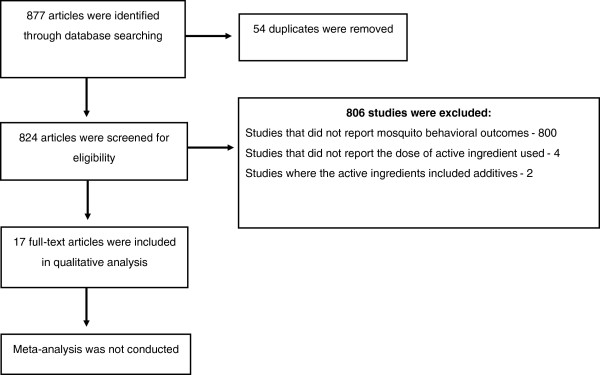
Mosquito coils, vaporizer mats and emanators confer protection against mosquito bites through the spatial action of emanated vapor or airborne pyrethroid particles. These products dominate the pest control market; therefore, it is vital to characterize mosquito responses elicited by the chemical actives and their potential for disease prevention. The aim of this review was to determine effects of mosquito coils and emanators on mosquito responses that reduce human-vector contact and to propose scientific consensus on terminologies and methodologies used for evaluation of product formats that could contain spatial chemical actives, including indoor residual spraying (IRS), long lasting insecticide treated nets (LLINs) and insecticide treated materials (ITMs). PubMed, (National Centre for Biotechnology Information (NCBI), U.S. National Library of Medicine, NIH), MEDLINE, LILAC, Cochrane library, IBECS and Armed Forces Pest Management Board Literature Retrieval System search engines were used to identify studies of pyrethroid based coils and emanators with key-words "Mosquito coils" "Mosquito emanators" and "Spatial repellents". It was concluded that there is need to improve statistical reporting of studies, and reach consensus in the methodologies and terminologies used through standardized testing guidelines. Despite differing evaluation methodologies, data showed that coils and emanators induce mortality, deterrence, repellency as well as reduce the ability of mosquitoes to feed on humans. Available data on efficacy outdoors, dose-response relationships and effective distance of coils and emanators is inadequate for developing a target product profile (TPP), which will be required for such chemicals before optimized implementation can occur for maximum benefits in disease control.
Figures
References
-
- Gillies MT, Smith A. Effect of a residual house-spraying campaign on species balance in the Anopheles funestus group: The replacement of Anopheles gambiae Giles with Anopheles rivulorum Leeson. Bull Entomol Res. 1960;51:248–252.
-
- Smith A, Webley DJ. A verandah trap for studying the house-frequenting habits of mosquitoes and for assessing insecticides. Part III. The effect of DDT on behaviour and mortality. Bull Entomol Res. 1968;59:33–46. - PubMed
-
- Sadasivaiah S, Tozan Y, Breman JG. Dichlorodiphenyltrichloroethane (DDT) for indoor residual spraying in Africa: how can it be used for malaria control? Am J Trop Med Hyg. 2007;77:249–263. - PubMed
Publication types
MeSH terms
Substances
LinkOut - more resources
Full Text Sources
Medical
