


Weight loss on stimulant medication: how does it affect body composition and bone metabolism? - A prospective longitudinal study
- PMID: 23216890
- PMCID: PMC3549744
- DOI: 10.1186/1687-9856-2012-30
Weight loss on stimulant medication: how does it affect body composition and bone metabolism? - A prospective longitudinal study
Abstract
Objective: Children treated with stimulant medication for attention deficit hyperactivity disorder (ADHD) often lose weight. It is important to understand the implications of this during growth. This prospective study was designed to quantify the changes in body composition and markers of bone metabolism on starting treatment.
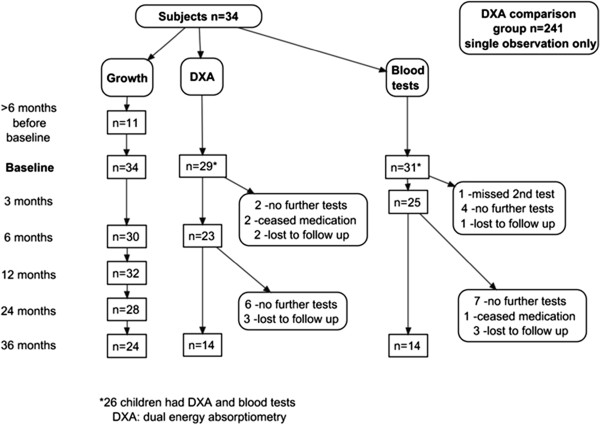
Methods: 34 children (29 boys) aged 4.7 to 9.1 years newly diagnosed with ADHD were treated with dexamphetamine or methylphenidate, titrating the dose to optimise the therapeutic response. Medication was continued for as long as clinically indicated. Body composition and bone density (dual-energy X-ray absorptiometry) were measured at baseline, 6 months and 3 years; changes were analysed in Z-scores based on data from 241 healthy, local children. Markers of bone turnover were measured at baseline, 3 months and 3 years.
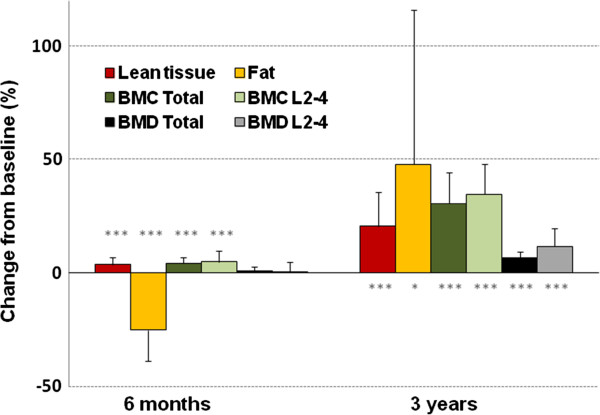
Results: Fat loss of 1.4±0.96kg (total fat 5.7±3.6 to 4.3±3.1kg, p<0.001) occurred in the first 6 months. There were significant reductions over 3 years in the sex and height corrected Z-scores for lean tissue, bone mineral content, bone mineral density and ratio of central to total fat (-0.84±0.86, p=0.003; -0.55±0.31, p<0.0001; -0.41±0.28, p<0.0001 and -0.55±0.62, p=0.006 respectively). Propeptide of type I collagen indicated a significant reduction in bone turnover after 3 months (564±202 to 458±96ng/ml, p=0.019), which was fully recovered after 3 years (619±276ng/ml).
Conclusions: Stimulant medication was associated with early fat loss and reduced bone turnover. Lean tissue including bone increased more slowly over 3 years of continuous treatment than would be expected for growth in height. There was long-term improvement in the proportion of central fat for height. This study shows that relatively minor reductions in weight on stimulant medication can be associated with long-term changes in body composition. Further study is required to determine the effects of these changes on adult health.
Figures

References
-
- Faraone SV, Biederman J, Morley CP, Spencer TJ. Effect of stimulants on height and weight: a review of the literature. J Am Acad Child Adolesc Psychiatry. 2008;47(9):994–1009. - PubMed
-
- Lisska MC, Rivkees SA. Daily methylphenidate use slows the growth of children: a community based study. J Pediatr Endocrinol Metab. 2003;16(5):711–718. - PubMed
-
- American Psychiatric Association. Diagnostic and statistical manual of mental disorders IV. Washington, DC: American Psychiatric Association; 1994.
LinkOut - more resources
Full Text Sources
