


Comment
doi: 10.1016/j.cmet.2012.11.008.
Let the sensor fit the diet
Affiliations
- PMID: 23217252
- PMCID: PMC3601738
- DOI: 10.1016/j.cmet.2012.11.008
Item in Clipboard
Comment
Let the sensor fit the diet
Cell Metab.
.
Abstract
Metabolic sensing neurons are conserved across multiple animal species and allow the organism to monitor nutrient availability to maintain energy homeostasis. Miyamoto et al. (2012) describe fly neurons that are highly tuned to fructose availability and are critical determinants of ingestive behavior on a diet of simple sugars.
Copyright © 2012 Elsevier Inc. All rights reserved.
Figures
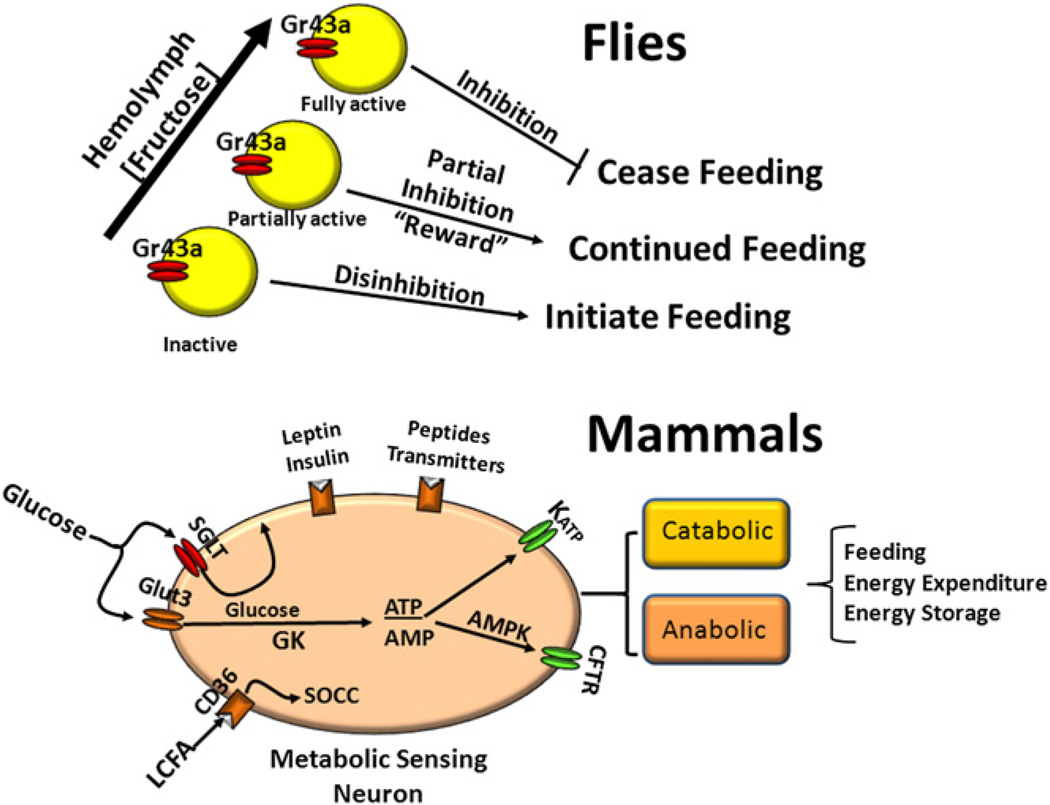
In flies, hemolymph concentrations of fructose are detected in the brain
by fructose-sensing neurons expressing Gr43a (yellow). The neurons are inactive
at low and activated at high fructose concentrations. This negative feedback
system promotes feeding when neurons are inactive and halts feeding above a
critical fructose concentration. At intermediate concentrations, activation of
Gr43a neurons also provides a reward function that promotes continued feeding.
In mammals, there is a complex set of nutrient (glucose, long-chain fatty acid
[LCFA]), hormonal (leptin, insulin) and neural inputs from the periphery, which
are integrated at the level of membrane potential and alter neuronal activity in
different sets of catabolic and anabolic neurons. Glucose is sensed by transport
through the Glut3 transporter, phosphorylation by glucokinase (GK) followed by
production of ATP, which acts on the ATP-sensitive K+
(KATP) channel to activate glucose excited neurons. When glucose
levels fall, AMP is produced, activating neuronal AMP-activated kinase (AMPK)
and the cystic fibrosis transmembrane receptor (CFTR), which then stimulates
glucose-inhibited neurons. The sodium-glucose cotransporter (SGLT) generates an
electrogenic potential that activates glucose excited neurons independently of
glucose metabolism. LCFA interact with the fatty-acid translocator/CD36 receptor
(CD36) to activate store-operated calcium channels (SOCC), leading to inhibition
or excitation of subsets of metabolic sensing neurons (MSN).
Comment on
-
A fructose receptor functions as a nutrient sensor in the Drosophila brain.Cell. 2012 Nov 21;151(5):1113-25. doi: 10.1016/j.cell.2012.10.024. Cell. 2012. PMID: 23178127 Free PMC article.
References
Publication types
Grants and funding
LinkOut - more resources
Full Text Sources
