Failure to learn from feedback underlies word learning difficulties in toddlers at risk for autism
- PMID: 23217290
- PMCID: PMC3518974
- DOI: 10.1017/S0305000912000086
Failure to learn from feedback underlies word learning difficulties in toddlers at risk for autism
Abstract
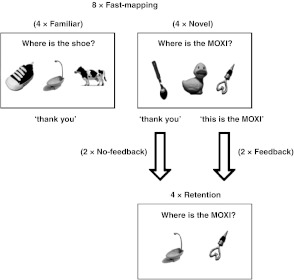
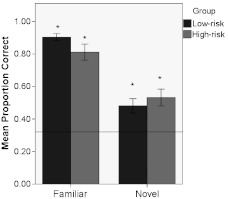
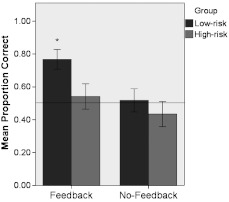
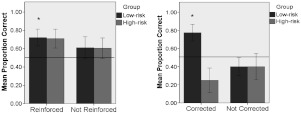
Children's assignment of novel words to nameless objects, over objects whose names they know (mutual exclusivity; ME) has been described as a driving force for vocabulary acquisition. Despite their ability to use ME to fast-map words (Preissler & Carey, 2005), children with autism show impaired language acquisition. We aimed to address this puzzle by building on studies showing that correct referent selection using ME does not lead to word learning unless ostensive feedback is provided on the child's object choice (Horst & Samuelson, 2008). We found that although toddlers aged 2;0 at risk for autism can use ME to choose the correct referent of a word, they do not benefit from feedback for long-term retention of the word-object mapping. Further, their difficulty using feedback is associated with their smaller receptive vocabularies. We propose that difficulties learning from social feedback, not lexical principles, limits vocabulary building during development in children at risk for autism.
Figures
References
-
- Baron-Cohen S., Baldwin D. A. & Crowson M. (1997). Do children with autism use the speaker's direction of gaze strategy to crack the code of language? Child Development 68(1), 48–57 - PubMed
-
- Bolton P., Macdonald H., Pickles A., Rios P., Goode S., Crowson M., et al. (1994). A case-control family history study of autism. Journal of Child Psychology and Psychiatry 35(5), 877–900 - PubMed
-
- Carey S. & Bartlett E. (1978). Acquiring a single new word. Paper presented at the Stanford Child Language Conference.
-
- Charman T., Drew A., Baird C. & Baird G. (2003). Measuring early language development in preschool children with autism spectrum disorder using the MacArthur Communicative Development Inventory (Infant Form). Journal of Child Language 30(1), 213–36. - PubMed
Publication types
MeSH terms
Grants and funding
LinkOut - more resources
Full Text Sources