


Increased serotonin transporter gene (SERT) DNA methylation is associated with bullying victimization and blunted cortisol response to stress in childhood: a longitudinal study of discordant monozygotic twins
- PMID: 23217646
- PMCID: PMC4231789
- DOI: 10.1017/S0033291712002784
Increased serotonin transporter gene (SERT) DNA methylation is associated with bullying victimization and blunted cortisol response to stress in childhood: a longitudinal study of discordant monozygotic twins
Abstract
Background: Childhood adverse experiences are known to induce persistent changes in the hypothalamic-pituitary-adrenal (HPA) axis reactivity to stress. However, the mechanisms by which these experiences shape the neuroendocrine response to stress remain unclear. Method We tested whether bullying victimization influenced serotonin transporter gene (SERT) DNA methylation using a discordant monozygotic (MZ) twin design. A subsample of 28 MZ twin pairs discordant for bullying victimization, with data on cortisol and DNA methylation, were identified in the Environmental Risk (E-Risk) Longitudinal Twin Study, a nationally representative 1994-1995 cohort of families with twins.
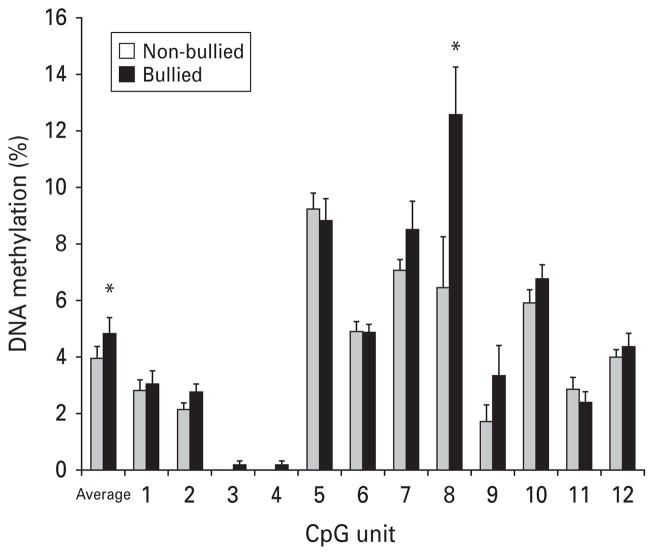
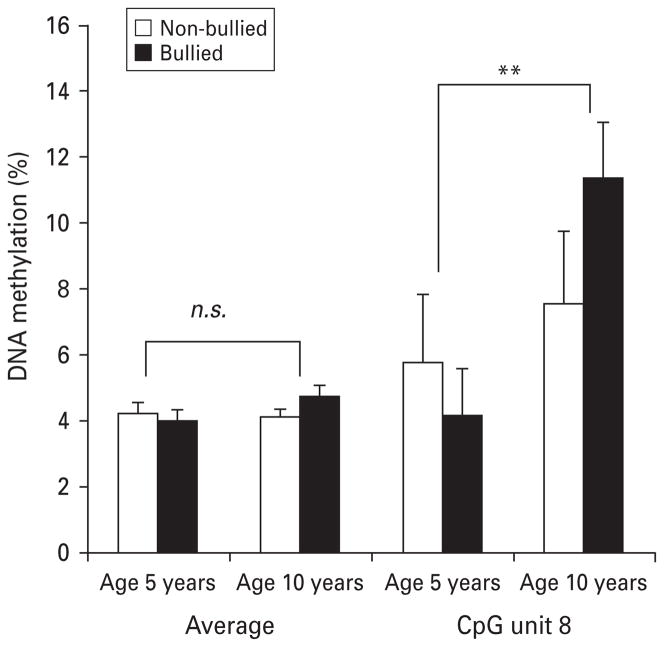
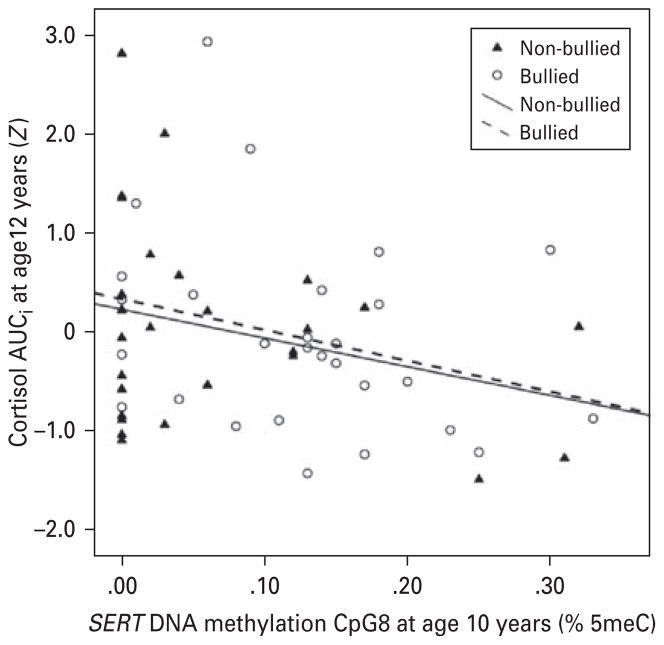
Results: Bullied twins had higher SERT DNA methylation at the age of 10 years compared with their non-bullied MZ co-twins. This group difference cannot be attributed to the children's genetic makeup or their shared familial environments because of the study design. Bullied twins also showed increasing methylation levels between the age of 5 years, prior to bullying victimization, and the age of 10 years whereas no such increase was detected in non-bullied twins across time. Moreover, children with higher SERT methylation levels had blunted cortisol responses to stress.
Conclusions: Our study extends findings drawn from animal models, supports the hypothesis that early-life stress modifies DNA methylation at a specific cytosine-phosphate-guanine (CpG) site in the SERT promoter and HPA functioning and suggests that these two systems may be functionally associated.
Conflict of interest statement
None.
Figures
References
-
- Alexander N, Kuepper Y, Schmitz A, Osinsky R, Kozyra E, Hennig J. Gene–environment interactions predict cortisol responses after acute stress: implications for the etiology of depression. Psychoneuroendocrinology. 2009;34:1294–1303. - PubMed
-
- Arseneault L, Bowes L, Shakoor S. Bullying victimization in youths and mental health problems: ‘Much ado about nothing’? Psychological Medicine. 2010;40:717–729. - PubMed
-
- Bagot RC, Meaney MJ. Epigenetics and the biological basis of gene x environment interactions. Journal of the American Academy of Child and Adolescent Psychiatry. 2010;49:752–771. - PubMed
-
- Bakermans-Kranenburg MJ, van IJzendoorn MH. The first 10,000 Adult Attachment Interviews: distributions of adult attachment representations in clinical and non-clinical groups. Attachment and Human Development. 2009;11:223–263. - PubMed
