


Chronic bronchial infection in COPD. Is there an infective phenotype?
- PMID: 23218452
- PMCID: PMC7126218
- DOI: 10.1016/j.rmed.2012.10.024
Chronic bronchial infection in COPD. Is there an infective phenotype?
Abstract
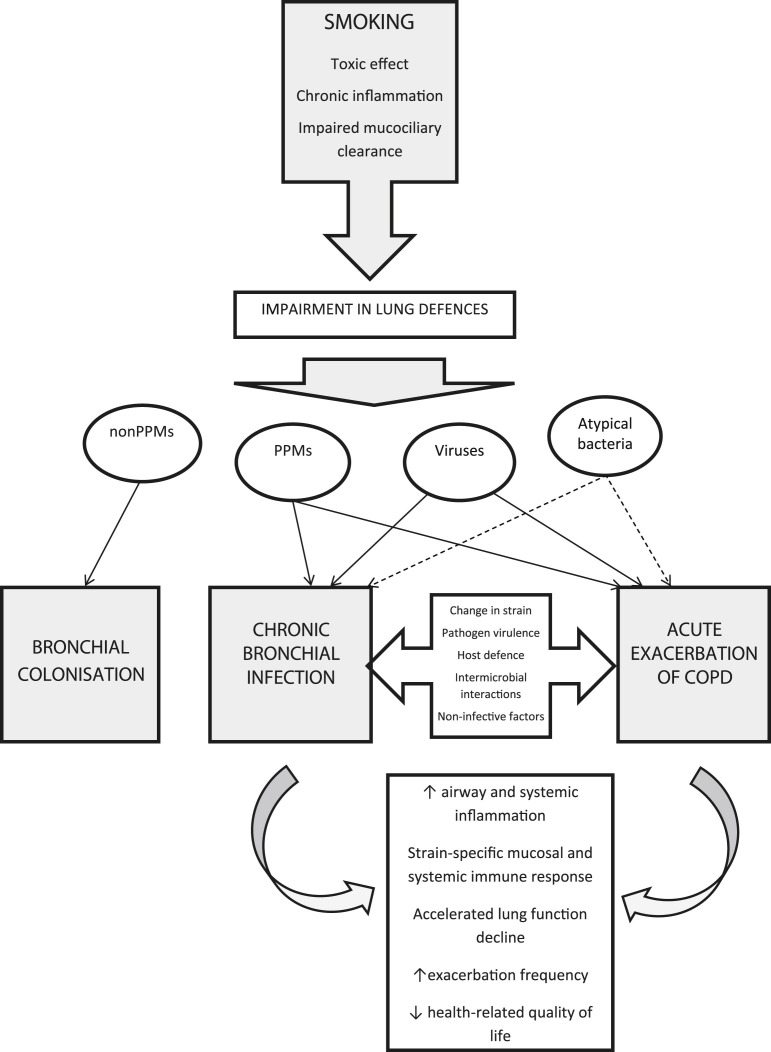
Microorganisms, particularly bacteria, are frequently found in the lower airways of COPD patients, both in stable state and during exacerbations. The host-pathogen relationship in COPD is a complex, dynamic process characterised by frequent changes in pathogens, their strains and loads, and subsequent host immune responses. Exacerbations are detrimental events in the course of COPD and evidence suggests that 70% may be caused by microorganisms. When considering bacterial exacerbations, recent findings based on molecular typing have demonstrated that the acquisition of new strains of bacteria or antigenic changes in pre-existing strains are the most important triggers for exacerbation onset. Even in clinically stable COPD patients the presence of microorganisms in their lower airways may cause harmful effects and induce chronic low-grade airway inflammation leading to increased exacerbation frequency, an accelerated decline in lung function and impaired health-related quality of life. Besides intraluminal localisation in the distal airways, bacteria can be found in the bronchial walls and parenchymal lung tissue of COPD patients. Therefore, the isolation of pathogenic bacteria in stable COPD should be considered as a form of chronic infection rather than colonisation. This new approach may have important implications for the management of patients with COPD.
Copyright © 2012 Elsevier Ltd. All rights reserved.
Figures
References
-
- Papi A., Bellettato C.M., Braccioni F., Romagnoli M., Casolari P., Caramori G., Fabbri L.M., Johnston S.L. Infections and airway inflammation in chronic obstructive pulmonary disease severe exacerbations. Am J Respir Crit Care Med. 2006;173:1114–1121. - PubMed
-
- Rosell A., Monso E., Soler N., Torres F., Angrill J., Ruse G., Zalacain R., Morera J., Torres A. Microbiologic determinants of exacerbation in chronic obstructive pulmonary disease. Arch Intern Med. 2005;165:891–897. - PubMed
-
- Sethi S., Evans N., Grant B.J.B., Murphy T.F. New strains of bacteria and exacerbations of chronic obstructive pulmonary disease. N Engl J Med. 2002;347:465–471. - PubMed
-
- Sethi S., Muscarella K., Evans N., Klingman K.L., Grant B.J.B., Murphy T.F. Airway inflammation and etiology of acute exacerbations of chronic bronchitis. Chest. 2000;118:1557–1565. - PubMed
Publication types
MeSH terms
LinkOut - more resources
Full Text Sources
Other Literature Sources
Medical
