


Radiographic outcomes of volar locked plating for distal radius fractures
- PMID: 23218558
- PMCID: PMC3581353
- DOI: 10.1016/j.jhsa.2012.10.007
Radiographic outcomes of volar locked plating for distal radius fractures
Abstract
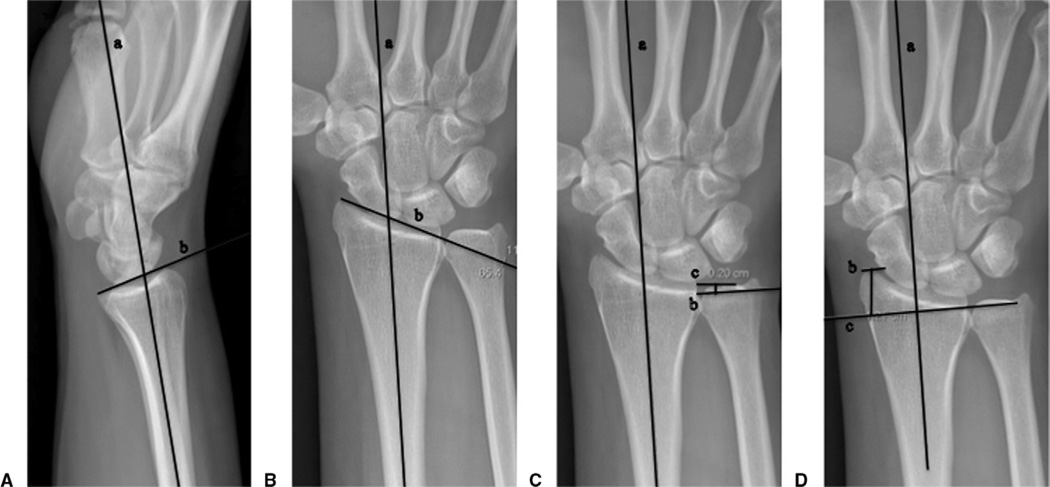
Purpose: To assess the ability of volar locked plating to achieve and maintain normal radiographic parameters for articular stepoff, volar tilt, radial inclination, ulnar variance, and radial height in distal radius fractures.
Methods: We performed a retrospective review of 185 distal radius fractures that underwent volar locked plating with a single plate design over a 5-year period. We reviewed radiographs and recorded measurements for volar tilt, radial inclination, ulnar variance, radial height, and articular stepoff. We used logistic regression to determine the association between return to radiographic standard norms and fracture type.
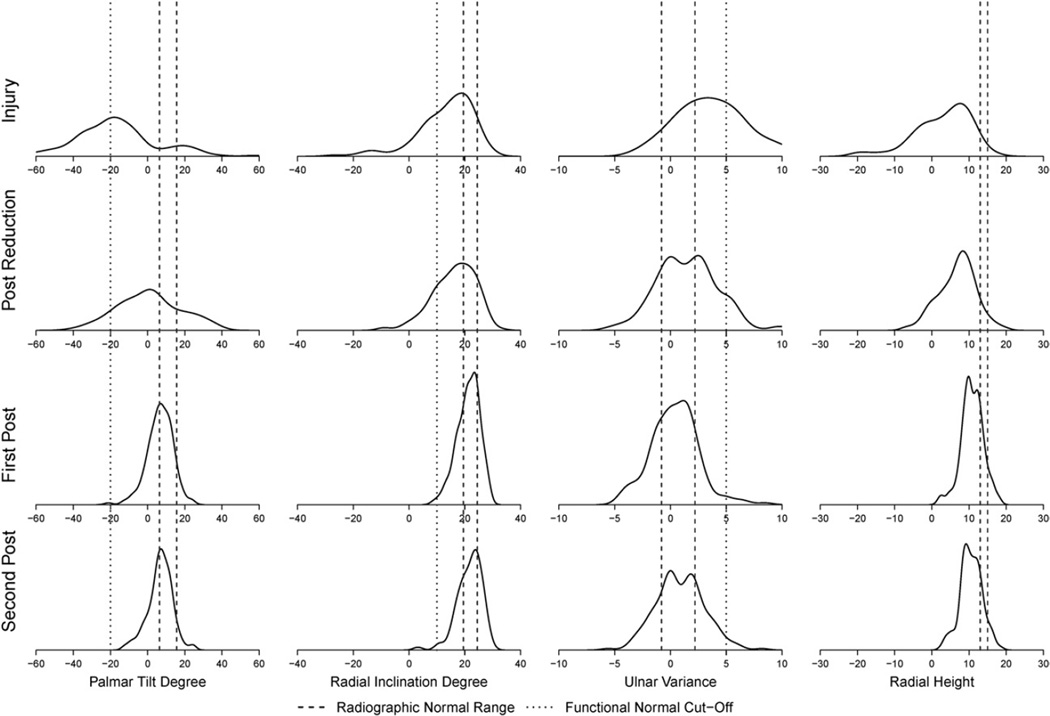
Results: At the first and final postoperative follow-up visits, we observed articular congruence less than 2 mm in 92% of fractures at both times. Normal volar tilt (11°) was restored in 46% at the first follow-up and 48% at the final one. Radial inclination (22°) was achieved in 44% at the first follow-up and 43% at the final one, and ulnar variance (01 ± 2 mm) was achieved in 53% at the first follow-up and 53% at the final one. In addition, radial height (14 ± 1mm) was restored in 14% at the first follow-up and 12% at the final one. More complex, intra-articular fractures (AO class B and C and Frykman types 3, 4, 7, and 8) were less likely to be restored to normal radiographic parameters. However, because of the small sample size for some fracture types, it was difficult to discover significant associations between fracture type and radiographic outcome.
Conclusions: Volar locked plating for distal radius fractures achieved articular stepoff less than 2 mm in most fractures but only restored and maintained normal radiographic measurements for volar tilt, radial inclination, and ulnar variance in 50% of fractures. The ability of volar locked plating to restore and maintain ulnar variance and volar tilt decreased with more complex intra-articular fracture types.
Type of study/level of evidence: Therapeutic IV.
Copyright © 2013 American Society for Surgery of the Hand. Published by Elsevier Inc. All rights reserved.
Figures
References
-
- Gliatis JD, Plessas SJ, Davis TR. Outcome of distal radial fractures in young adults. J Hand Surg Br. 2000;25(6):535–543. - PubMed
-
- Konrath GA, Bahler S. Open reduction and internal fixation of unstable distal radius fractures: results using the trimed fixation system. J Orthop Trauma. 2002;16(8):578–585. - PubMed
-
- Lenoble E, Dumontier C, Goutallier D, Apoil A. Fracture of the distal radius: a prospective comparison between trans-styloid and Kapandji fixations. J Bone Joint Surg Br. 1995;77(4):562–567. - PubMed
-
- Martineau PA, Berry GK, Harvey EJ. Plating for distal radius fractures. Orthop Clin North Am. 2007;38(2):193–201. - PubMed
-
- Rikli DA, Regazzoni P. The double plating technique for distal radius fractures. Tech Hand Up Extrem Surg. 2000;4(2):107–114. - PubMed
Publication types
MeSH terms
Grants and funding
LinkOut - more resources
Full Text Sources
Other Literature Sources
Medical
Research Materials
