


Diffusion of technologies for the care of older adults with exudative age-related macular degeneration
- PMID: 23219066
- PMCID: PMC3632297
- DOI: 10.1016/j.ajo.2012.10.003
Diffusion of technologies for the care of older adults with exudative age-related macular degeneration
Abstract
Purpose: To determine patterns of diffusion of diagnostic tests and therapeutic interventions in the United States through 2010 for patients with newly diagnosed exudative macular degeneration (AMD).
Design: Retrospective longitudinal cohort analysis.
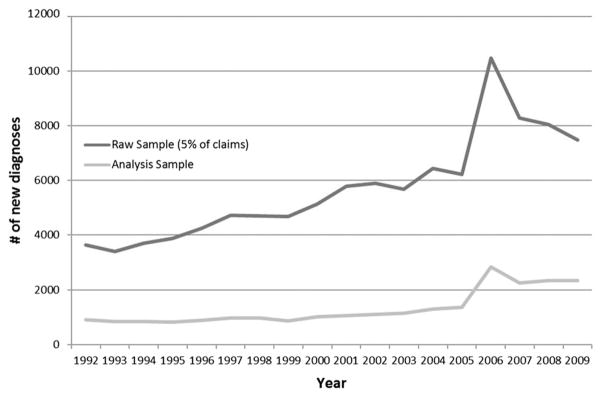
Methods: SETTING AND PATIENT POPULATION: A total of 23 941 Medicare beneficiaries with exudative AMD newly diagnosed during 1992-2009.
Observation procedures: Current Procedural Technology (CPT-4) billing codes were used to identify use of diagnostic tests (optical coherence tomography, fluorescein angiography, and fundus photography) and therapeutic interventions (argon laser photocoagulation, photodynamic therapy, intravitreal corticosteroids, and anti-vascular endothelial growth factor [VEGF] agents) used by these beneficiaries during the first year following diagnosis.
Main outcome measures: Rates of use of study diagnostic and therapeutic procedures.
Results: Diffusion was rapid for each successive new diagnostic and treatment modality, with use of newer procedures quickly replacing existing ones. The number of beneficiaries treated with anti-VEGF agents for exudative AMD was considerably greater than for prior innovations, rising from use in 4.0% of beneficiaries in 2004-05 to 62.7% in 2009-10. In each year from first diagnosis years 2006-2009 and in different practice settings, use of bevacizumab exceeded that of ranibizumab (60%-78% vs 33%-47%, respectively). Rates of diffusion of the various therapies were relatively similar in communities throughout the United States irrespective of presence of a major teaching hospital in the vicinity.
Conclusions: Newer, more effective therapeutic interventions for exudative AMD diffused rapidly throughout the United States, quickly replacing older, less effective interventions. Although improving patient outcomes, rapid diffusion raises important public policy issues for Medicare and other payers to consider.
Copyright © 2013 Elsevier Inc. All rights reserved.
Conflict of interest statement
ALL AUTHORS HAVE COMPLETED AND SUBMITTED THE ICMJE FORM FOR DISCLOSURE OF POTENTIAL CONFLICTS OF INTEREST. No conflicting relationship exists for any author. Contributions of authors: involved in design and conduct of the study (F.S., J.S., B.H.); collection, management, analysis, and interpretation of the data (F.S., J.S., B.H.); and preparation, review, or approval of the manuscript (F.S., J.S., B.H., G.C.).
Figures
References
-
- Klein R, Wang Q, Klein BEK, Moss SE, Meuer SM. The relationship of age-related maculopathy, cataract, and glaucoma to visual-acuity. Invest Ophthalmol. 1995;36(1):182–191. - PubMed
-
- Ferris FL, Fine SL, Hyman L. Age-related macular degeneration and blindness due to neovascular maculopathy. Arch Ophthalmol. 1984;102(11):1640–1642. - PubMed
-
- Macular Photocoagulation Study Group. Argon laser photocoagulation for neovascular maculopathy three-year results from randomized clinical trials. Arch Ophthalmol. 1986;104(5):694–701. - PubMed
-
- Macular Photocoagulation Study Group. Laser photocoagulation of subfoveal neovascular lesions in age-related macular degeneration: Results of a randomized clinical trial. Arch Ophthalmol. 1991;109(9):1220–1231. - PubMed
-
- Macular Photocoagulation Study Group. Argon laser photo coagulation for idiopathic neovascularization results of a randomized clinical trial. Arch Ophthalmol. 1983;101(9):1358–1361. - PubMed
Publication types
MeSH terms
Substances
Grants and funding
LinkOut - more resources
Full Text Sources
Other Literature Sources
