


From essential to persistent genes: a functional approach to constructing synthetic life
- PMID: 23219343
- PMCID: PMC3642372
- DOI: 10.1016/j.tig.2012.11.001
From essential to persistent genes: a functional approach to constructing synthetic life
Abstract
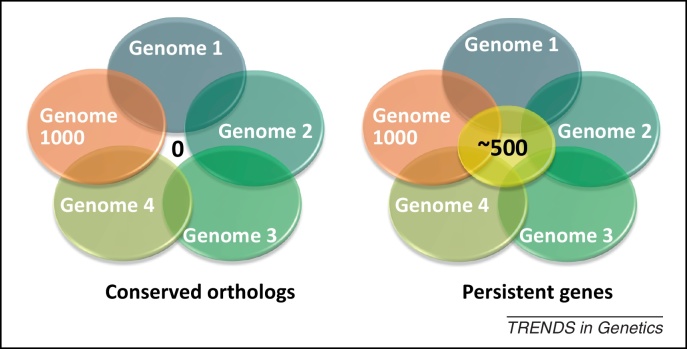
A central undertaking in synthetic biology (SB) is the quest for the 'minimal genome'. However, 'minimal sets' of essential genes are strongly context-dependent and, in all prokaryotic genomes sequenced to date, not a single protein-coding gene is entirely conserved. Furthermore, a lack of consensus in the field as to what attributes make a gene truly essential adds another aspect of variation. Thus, a universal minimal genome remains elusive. Here, as an alternative to defining a minimal genome, we propose that the concept of gene persistence can be used to classify genes needed for robust long-term survival. Persistent genes, although not ubiquitous, are conserved in a majority of genomes, tend to be expressed at high levels, and are frequently located on the leading DNA strand. These criteria impose constraints on genome organization, and these are important considerations for engineering cells and for creating cellular life-like forms in SB.
Copyright © 2012 Elsevier Ltd. All rights reserved.
Figures
References
-
- Vickers C.E. Grand challenge commentary: chassis cells for industrial biochemical production. Nat. Chem. Biol. 2010;6:875–877. - PubMed
-
- Yus E. Impact of genome reduction on bacterial metabolism and its regulation. Science. 2009;326:1263–1268. - PubMed
-
- Juhas M. Essence of life: essential genes of minimal genomes. Trends Cell Biol. 2011;21:562–568. - PubMed
-
- Yu B.J. Minimization of the Escherichia coli genome using a Tn5-targeted Cre/loxP excision system. Nat. Biotechnol. 2002;20:1018–1023. - PubMed
Publication types
MeSH terms
Grants and funding
LinkOut - more resources
Full Text Sources
Other Literature Sources
Molecular Biology Databases
