


Etiologies of bilateral pleural effusions
- PMID: 23219348
- PMCID: PMC5421548
- DOI: 10.1016/j.rmed.2012.10.004
Etiologies of bilateral pleural effusions
Abstract
Background: To evaluate the safety, etiology and outcomes of patients undergoing bilateral thoracentesis.
Methods: This is a prospective cohort study of 100 consecutive patients who underwent bilateral thoracenteses in an academic medical center from July 2009 through November 2010. Pleural fluid characteristics and etiologies of the effusions were assessed. Mean differences in levels of fluid characteristics between right and left lungs were tested. Associations between fluid characteristics and occurrence of bilateral malignant effusions were evaluated. The rate of pneumothorax and other complications subsequent to bilateral thoracentesis was determined.
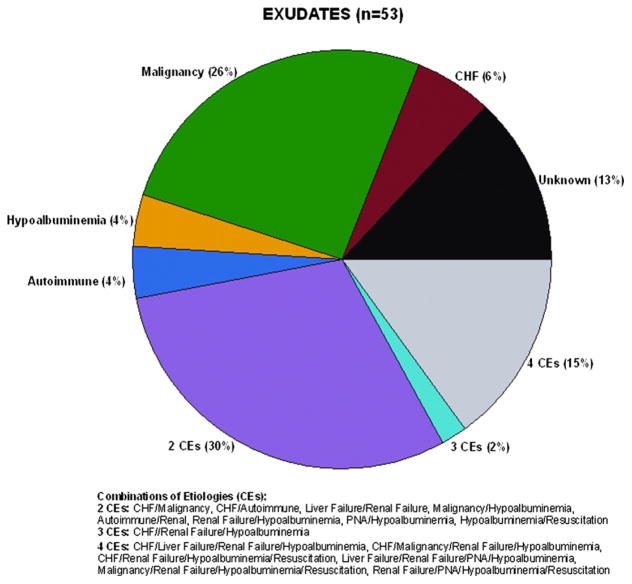
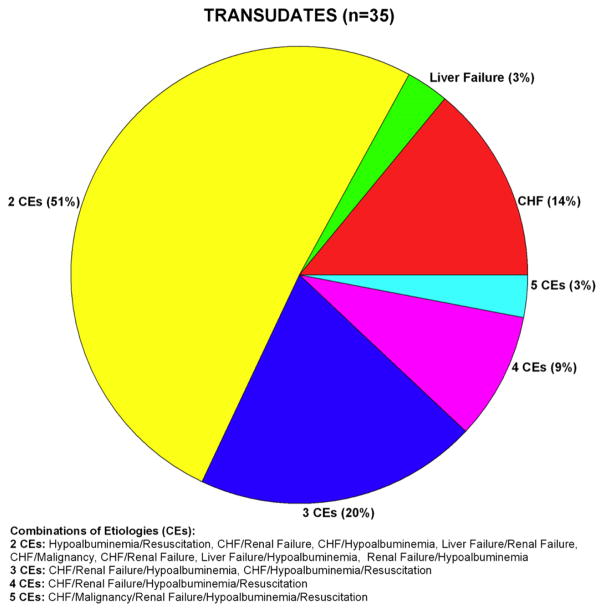
Results: Exudates were more common than transudates, and most effusions had multiple etiologies, with 83% having two or more etiologies. Bilateral malignant effusions occurred in 19 patients, were the most common single etiology of exudative effusions, and were associated with higher levels of protein and LDH in the pleural fluid. Among 200 thoracenteses performed with a bilateral procedure, seven resulted in pneumothoraces, three of which required chest tube drainage and four were ex vacuo.
Conclusions: More often than not, there are multiple etiologies that contribute to pleural fluid formation, and of the combinations of etiologies observed congestive heart failure was the most frequent contributor. Exudative effusions are more common than transudates when bilateral effusions are present. Malignancy is a common etiology of exudative effusions. This study suggests that the overall complication rate following bilateral thoracentesis is low and the rate of pneumothorax subsequent to bilateral thoracentesis is comparable to unilateral thoracentesis.
Copyright © 2012 Elsevier Ltd. All rights reserved.
Conflict of interest statement
None.
Figures
References
-
- Blackman NS, Rabin CB. Bilateral pleural effusion; its significance in association with a heart of normal size. J Mt Sinai-Hosp NY. 1957;24(1):45–53. - PubMed
-
- Kalomenidis I, Rodriguez M, Barnette R, et al. Patient with bilateral pleural effusion: are the findings the same in each fluid? Chest. 2003;124(1):167–76. - PubMed
-
- Gordon CE, Feller-Kopman D, Balk EM, Smetana GW. Pneumothorax following thoracentesis: a systematic review and meta-analysis. Arch Intern Med. 2010;170(4):332–9. - PubMed
-
- Feller-Kopman D, Berkowitz D, Boiselle P, Ernst A. Large-volume thoracentesis and the risk of reexpansion pulmonary edema. Ann Thorac Surg. 2007;84(5):1656–61. - PubMed
Publication types
MeSH terms
Grants and funding
LinkOut - more resources
Full Text Sources
Other Literature Sources
Medical
