


Obesity and prostate cancer: weighing the evidence
- PMID: 23219374
- PMCID: PMC3597763
- DOI: 10.1016/j.eururo.2012.11.013
Obesity and prostate cancer: weighing the evidence
Abstract
Context: Obesity and prostate cancer (PCa) affect substantial proportions of Western society. Mounting evidence, both epidemiologic and mechanistic, for an association between the two is of public health interest. An improved understanding of the role of this modifiable risk factor in PCa etiology is imperative to optimize screening, treatment, and prevention.
Objective: To consolidate and evaluate the evidence for an epidemiologic link between obesity and PCa, in addition to examining the proposed underlying molecular mechanisms.
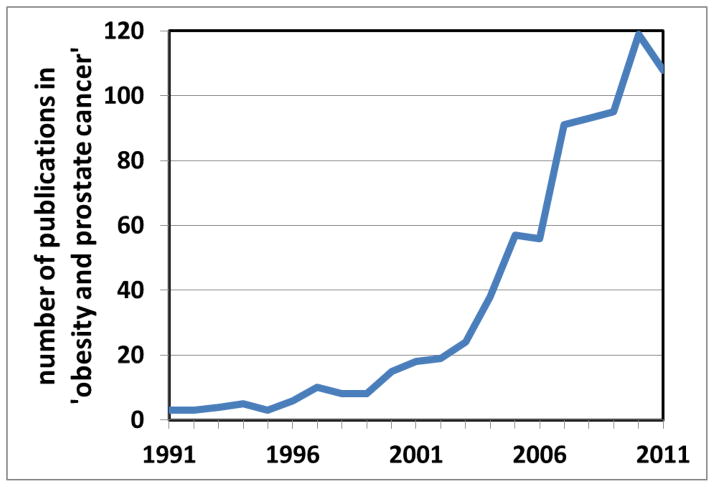
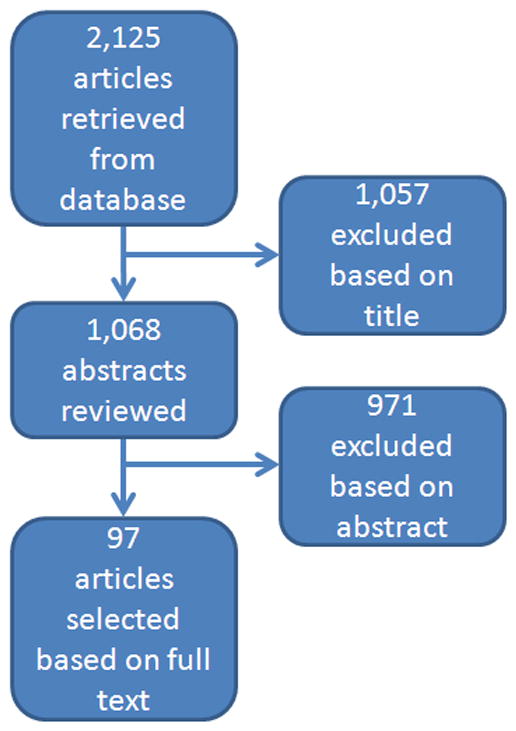
Evidence acquisition: A PubMed search for relevant articles published between 1991 and July 2012 was performed by combining the following terms: obesity, BMI, body mass index and prostate cancer risk, prostate cancer incidence, prostate cancer mortality, radical prostatectomy, androgen-deprivation therapy, external-beam radiation, brachytherapy, prostate cancer and quality of life, prostate cancer and active surveillance, in addition to obesity, BMI, body mass index and prostate cancer and insulin, insulin-like growth factor, androgen, estradiol, leptin, adiponectin, and IL-6. Articles were selected based on content, date of publication, and relevancy, and their references were also searched for relevant articles.
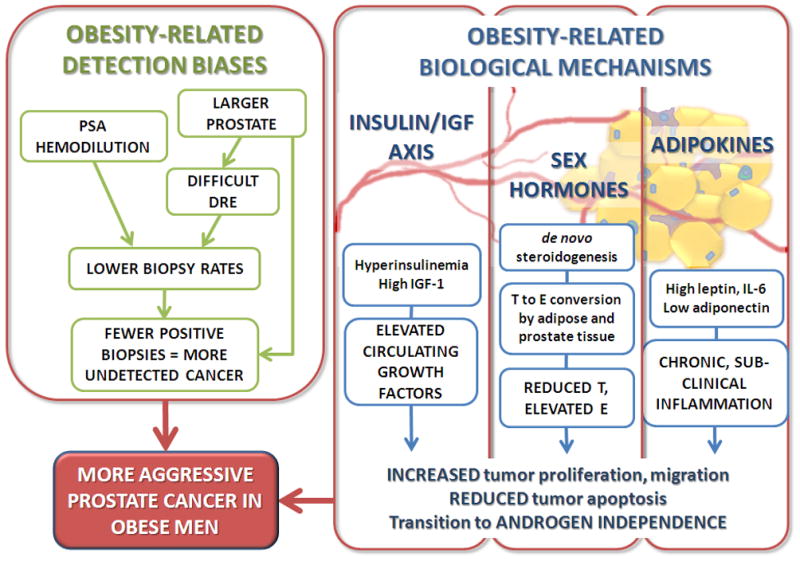
Evidence synthesis: Increasing evidence suggests obesity is associated with elevated incidence of aggressive PCa, increased risk of biochemical failure following radical prostatectomy and external-beam radiotherapy, higher frequency of complications following androgen-deprivation therapy, and increased PCa-specific mortality, although perhaps a lower overall PCa incidence. These results may in part relate to difficulties in detecting and treating obese men. However, multiple molecular mechanisms could explain these associations as well. Weight loss slows PCa in animal models but has yet to be fully tested in human trials.
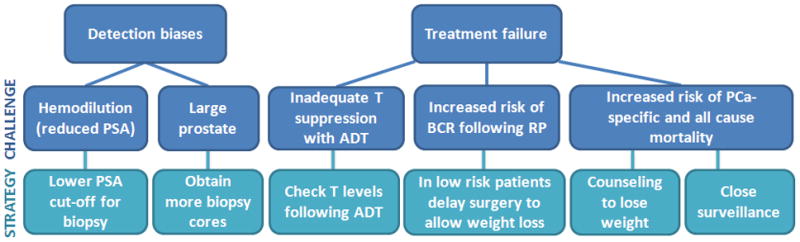
Conclusions: Obesity appears to be linked with aggressive PCa. We suggest clinical tips to better diagnose and treat obese men with PCa. Whether reversing obesity slows PCa growth is currently unknown, although it is an active area of research.
Copyright © 2012 European Association of Urology. Published by Elsevier B.V. All rights reserved.
Figures
References
-
- Center MM, Jemal A, Lortet-Tieulent J, et al. International variation in prostate cancer incidence and mortality rates. Eur Urol. 2012;61:1079– 92. - PubMed
-
- Calle EE, Rodriguez C, Walker-Thurmond K, Thun MJ. Overweight, obesity, and mortality from cancer in a prospectively studied cohort of U.S. adults. N Engl J Med. 2003;348:1625–38. - PubMed
-
- Renehan AG, Tyson M, Egger M, Heller RF, Zwahlen M. Body-mass index and incidence of cancer: a systematic review and meta-analysis of prospective observational studies. Lancet. 2008;371:569–78. - PubMed
-
- Flegal KM, Carroll MD, Ogden CL, Curtin LR. Prevalence and trends in obesity among US adults, 1999–2008. JAMA. 2010;303:235– 41. - PubMed
Publication types
MeSH terms
Substances
Grants and funding
LinkOut - more resources
Full Text Sources
Other Literature Sources
Medical
