


Rural vs urban residence affects risk-appropriate colorectal cancer screening
- PMID: 23220166
- PMCID: PMC3615111
- DOI: 10.1016/j.cgh.2012.11.025
Rural vs urban residence affects risk-appropriate colorectal cancer screening
Abstract
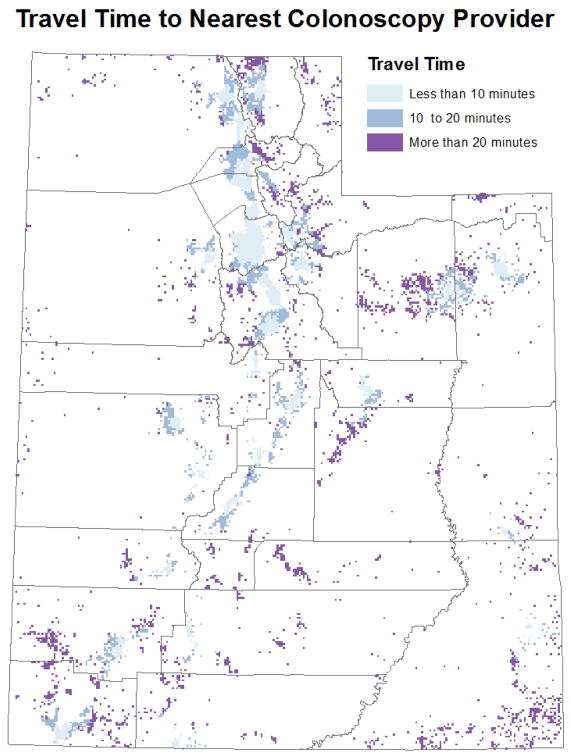
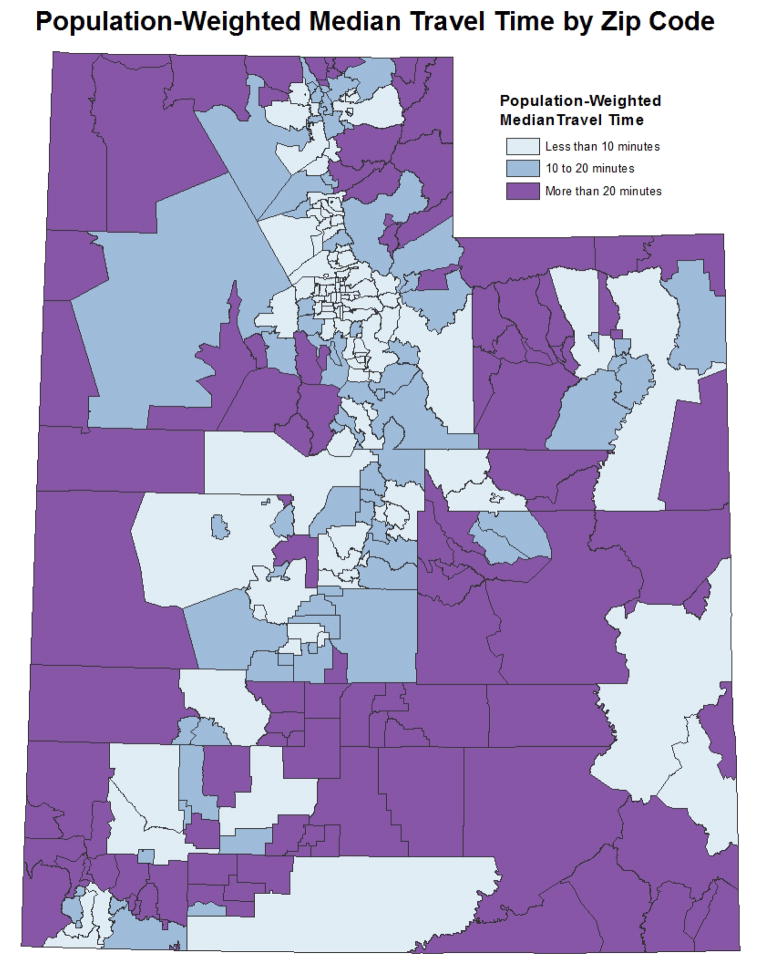
Background & aims: Little is known about the effects of geographic factors, such as rural vs urban residence and travel time to colonoscopy providers, on risk-appropriate use of colorectal cancer (CRC) screening in the general population. We evaluated the effects of geographic factors on adherence to CRC screening and differences in screening use among familial risk groups.
Methods: We analyzed data from the 2010 Utah Behavior Risk Factor Surveillance System, which included state-added questions on familial CRC. By using multiple logistic regression models, we assessed the effects of rural vs urban residence, travel time to the nearest colonoscopy provider, and spatial accessibility of providers on adherence to risk-appropriate screening guidelines. Study participants (n = 4260) were respondents aged 50 to 75 years.
Results: Sixty-six percent of the sample adhered to risk-appropriate CRC screening guidelines, with significant differences between urban and rural residents (68% vs 57%, respectively; P < .001) across all familial risk groups. Rural residents were less likely than urban dwellers to be up-to-date with screening guidelines (multivariate odds ratio, 0.65; 95% confidence interval, 0.53-0.79). In the unadjusted analysis, rural vs urban residence (P < .001), travel time to the nearest colonoscopy provider (P = .003), and spatial accessibility of providers (P = .012) were associated significantly with adherence to screening guidelines. However, rural vs urban residence (P < .001) was the only geographic variable independently associated with screening adherence in the adjusted analyses.
Conclusions: There are marked disparities in use of risk-appropriate CRC screening between rural and urban residents in Utah. Differences in travel time to the nearest colonoscopy provider and spatial accessibility of providers did not account for the geographic variations observed in screening adherence.
Copyright © 2013 AGA Institute. Published by Elsevier Inc. All rights reserved.
Conflict of interest statement
Figures
References
-
- US Cancer Statistics Working Group. United States Cancer Statistics (USCS) 1999–2007 incidence and mortality data. Atlanta, GA: U.S. Department of Health and Human Services, Centers for Disease Control and Prevention, National Cancer Institute; 2010. [Accessed January 11, 2012.]. http://www.cdc.gov/uscs.
-
- US Preventive Services Task Force. Screening for colorectal cancer. Rockville, MD: Agency for Healthcare Research and Quality; 2008. [Accessed January 11, 2012]. http://www.uspreventiveservicestaskforce.org/uspstf/uspscolo.htm.
-
- MMWR. Colorectal cancer screening, incidence, and mortality United States, 2002–2010. Mor Mortal Wkly Rep. 2011;60(26):884–889. - PubMed
-
- Beydoun HA, Beydoun MA. Predictors of colorectal cancer screening behaviors among average-risk older adults in the United States. Cancer Causes Control. 2008;19:339–359. - PubMed
Publication types
MeSH terms
Grants and funding
LinkOut - more resources
Full Text Sources
Other Literature Sources
Medical
