. 2012;4(12):1324-30.
doi: 10.1093/gbe/evs109.

Related giant viruses in distant locations and different habitats: Acanthamoeba polyphaga moumouvirus represents a third lineage of the Mimiviridae that is close to the megavirus lineage

Affiliations

Related giant viruses in distant locations and different habitats: Acanthamoeba polyphaga moumouvirus represents a third lineage of the Mimiviridae that is close to the megavirus lineage

Niyaz Yoosuf et al. Genome Biol Evol. 2012.

Abstract

The 1,021,348 base pair genome sequence of the Acanthamoeba polyphaga moumouvirus, a new member of the Mimiviridae family infecting Acanthamoeba polyphaga, is reported. The moumouvirus represents a third lineage beside mimivirus and megavirus. Thereby, it is a new member of the recently proposed Megavirales order. This giant virus was isolated from a cooling tower water in southeastern France but is most closely related to Megavirus chiliensis, which was isolated from ocean water off the coast of Chile. The moumouvirus is predicted to encode 930 proteins, of which 879 have detectable homologs. Among these predicted proteins, for 702 the closest homolog was detected in Megavirus chiliensis, with the median amino acid sequence identity of 62%. The evolutionary affinity of moumouvirus and megavirus was further supported by phylogenetic tree analysis of conserved genes. The moumouvirus and megavirus genomes share near perfect orthologous gene collinearity in the central part of the genome, with the variations concentrated in the terminal regions. In addition, genomic comparisons of the Mimiviridae reveal substantial gene loss in the moumouvirus lineage. The majority of the remaining moumouvirus proteins are most similar to homologs from other Mimiviridae members, and for 27 genes the closest homolog was found in bacteria. Phylogenetic analysis of these genes supported gene acquisition from diverse bacteria after the separation of the moumouvirus and megavirus lineages. Comparative genome analysis of the three lineages of the Mimiviridae revealed significant mobility of Group I self-splicing introns, with the highest intron content observed in the moumouvirus genome.


Figures
F<sc>ig</sc>. 1.—
Fig. 1.—
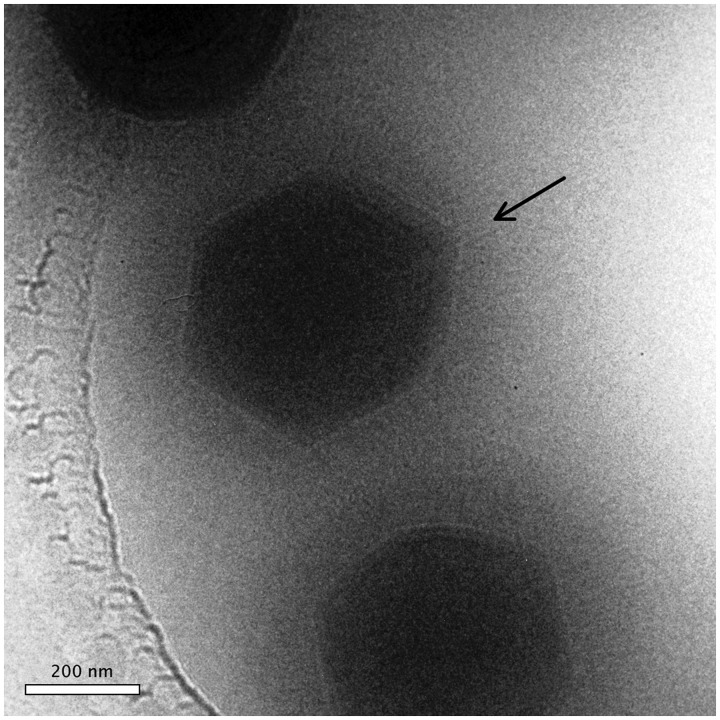
Cryo-electron micrograph of moumouvirus particles. The viral particles have a dense layer of fibers and their morphology resembles the shape of other Mimiviridae members, including a distinctive, starfish like vertex (arrow). Scale bar: 200 nm.
F<sc>ig</sc>. 2.—
Fig. 2.—
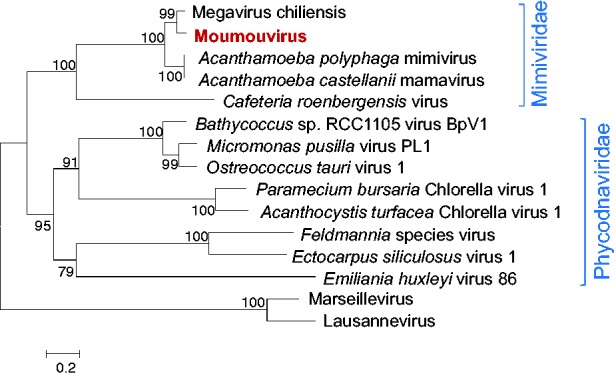
Phylogenetic tree of the Mimiviridae and selected Phycodnaviridae constructed from concatenated alignments of DNA polymerase, A32-like packaging ATPase, and A2-like Transcription Factor. Marseillevirus and lausannevirus were used as an outgroup. The alignment included 1,429 positions that were deemed reliably aligned. The bootstrap values (percentage points) are indicated for each internal branch (Mimiviridae).
F<sc>ig</sc>. 3.—
Fig. 3.—
Genomic dot plots for the moumouvirus and other members of the Mimiviridae. (A) Moumouvirus versus Megavirus chiliensis. (B) Moumouvirus versus Acanthamoeba polyphaga mimivirus. Each point represents a pair of orthologous genes (BBHs in BLASTP searches).
F<sc>ig</sc>. 4.—
Fig. 4.—
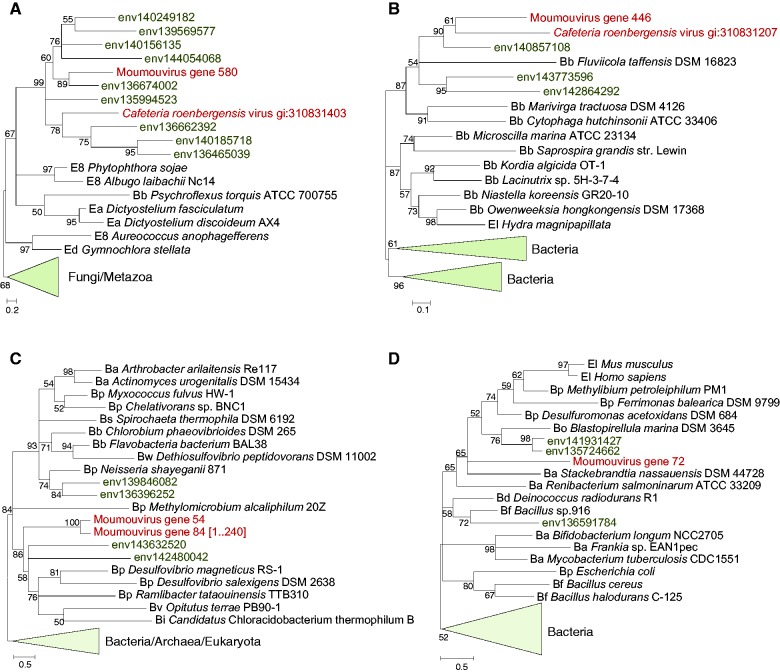
Phylogenetic trees of moumouvirus genes missing in other members of the Mimiviridae. (A) Cysteine dioxygenase, (B) NAD-dependent epimerase/dehydratase, (C) Methyltransferase, and (D) Nudix Hydrolase. The bootstrap values (percentage points) are indicated for each internal branch. Each sequence is denoted by taxa abbreviation and species name. GenBank Identification (GI) numbers for Cafeteria roenbergensis virus are shown on the trees. For other sequences, GI numbers are as follows: Phytophthora sojae, 348690046; Albugo laibachii Nc14, 325183169; Psychroflexus torquis ATCC 700755, 91214785; Dictyostelium fasciculatum, 328865331; Dictyostelium discoideum AX4, 66806929; Aureococcus anophagefferens, 323447704; Gymnochlora stellate, 193875832; Fluviicola taffensis DSM 16823, 327404160; Marivirga tractuosa DSM 4126, 313675758; Cytophaga hutchinsonii ATCC 33406, 110637252; Microscilla marina ATCC 23134, 124004204; Saprospira grandis str. Lewin, 379730028; Kordia algicida OT-1, 163754599; Lacinutrix sp. 5H-3-7-4, 336171271; Niastella koreensis GR20-10, 375148557; wenweeksia hongkongensis DSM 17368, 375013912; Hydra magnipapillata, 221105922; Arthrobacter arilaitensis Re117, 308177223; Actinomyces urogenitalis DSM 15434, 227495863; Myxococcus fulvus HW-1, 338534578; Chelativorans sp. BNC1, 110632790; Spirochaeta thermophila DSM 6192, 307718496; Chlorobium phaeovibrioides DSM 265, 145219574; Flavobacteria bacterium BAL38, 126664257; Neisseria shayeganii 871, 349575093; Dethiosulfovibrio peptidovorans DSM 11002, 288575048; Methylomicrobium alcaliphilum 20Z, 357407184; Desulfovibrio magneticus RS-1, 239906771; Desulfovibrio salexigens DSM 2638, 242280667; Ramlibacter tataouinensis TTB310, 337278313; Opitutus terrae PB90-1, 182415517; Candidatus Chloracidobacterium thermophilum B, 347756407; Mus musculus, 148701036; Homo sapiens, 344217763; Methylibium petroleiphilum PM1, 124266300; Ferrimonas balearica DSM 9799, 308049455; Desulfuromonas acetoxidans DSM 684, 95930587; Blastopirellula marina DSM 3645, 87312225; Stackebrandtia nassauensis DSM 44728, 291297650; Renibacterium salmoninarum ATCC 33209, 163840224; Deinococcus radiodurans R1, 6458004; Bacillus sp.916, 394994508; Bifidobacterium longum NCC2705, 23465838; Frankia sp. EAN1pec, 68197430; Mycobacterium tuberculosis CDC1551, 13879930; Escherichia coli, 50513417; Bacillus cereus, 51975946; Bacillus halodurans C-125, 10176350. Taxa abbreviations: Ba, Actinobacteria; Bb, Bacteroidetes/Chlorobi group; Bd, Deinococcus-Thermus; Bf, Firmicutes; Bi, Acidobacteria; Bo, Planctomycetes; Bp, Proteobacteria; Bs, Spirochaetes; Bv, Chlamydiae/Verrucomicrobia group; Bw, Synergistetes; E8, stramenopiles; Ea, Amoebozoa; Ed, Rhizaria; El, Opisthokonta.

References

    1. Altschul SF, et al. Gapped BLAST and PSI-BLAST: a new generation of protein database search programs. Nucleic Acids Res. 1997;25:3389–3402. - PMC - PubMed
    1. Arslan D, Legendre M, Seltzer V, Abergel C, Claverie JM. Distant mimivirus relative with a larger genome highlights the fundamental features of Megaviridae. Proc Natl Acad Sci U S A. 2011;108:17486–17491. - PMC - PubMed
    1. Boyer M, et al. Giant Marseillevirus highlights the role of amoebae as a melting pot in emergence of chimeric microorganisms. Proc Natl Acad Sci U S A. 2009;106:21848–21853. - PMC - PubMed
    1. Boyer M, et al. Mimivirus shows dramatic genome reduction after intraamoebal culture. Proc Natl Acad Sci U S A. 2011;108:10296–10301. - PMC - PubMed
    1. Byrne D, et al. The polyadenylation site of mimivirus transcripts obeys a stringent “hairpin rule”. Genome Res. 2009;19:1233–1242. - PMC - PubMed

Publication types

LinkOut - more resources