


doi: 10.1038/nn.3284.
Epub 2012 Dec 9.
Neurogliaform cells dynamically regulate somatosensory integration via synapse-specific modulation
Affiliations
- PMID: 23222912
- PMCID: PMC4132638
- DOI: 10.1038/nn.3284
Item in Clipboard
Neurogliaform cells dynamically regulate somatosensory integration via synapse-specific modulation
Nat Neurosci.
2013 Jan.
Abstract
Despite the prevailing idea that neurogliaform cells produce a spatially unrestricted widespread inhibition, we demonstrate here that their activity attenuates thalamic-evoked feed-forward inhibition in layer IV barrel cortex but has no effect on feed-forward excitation. The result of this circuit selectivity is a dynamic regulation in the temporal window for integration of excitatory thalamic input, thus revealing a new role for neurogliaform cells in shaping sensory processing.
Conflict of interest statement
The authors declare no competing financial interests.
Figures
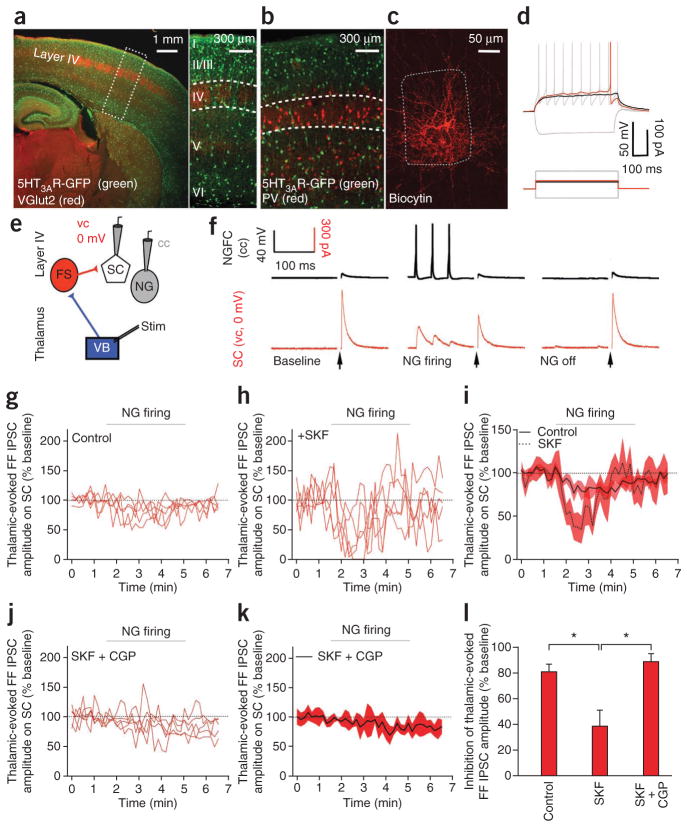
Layer IV NGFC activity inhibits the canonical thalamic-evoked FFI via GABAB receptor activation. (a) Fluorescence image of a thalamocortical slice (left) of a mouse expressing 5HT3AR-GFP (layer IV delineated with VGlut2 immunostaining). Magnification (right) of the boxed area. (b) Image of 5HT3AR-GFP+ cells, stained for PV. Dashed region indicates a single layer IV barrel. (c) Dense axonal arborization of a biocytin-filled layer IV 5HT3AR-GFP+ cell. (d) Depolarizing ramp (black) and late spiking (red) of 5HT3AR-GFP+ cell at subthreshold and rheobase current injections, respectively. Gray depicts membrane responses to hyperpolarizing and 2× rheobase current injections. (e) Dual NGFC and stellate cell (SC) whole-cell recording configuration. cc, current clamp; FS, fast-spiking interneuron; NG, neurogliaform cell; VB, ventrobasal thalamus; vc, voltage clamp. (f) Single-trace examples of simultaneous current-clamp and voltage-clamp recording in an NGFC (black) and an SC (holding potential (Vh) = 0 mV; red), respectively. Left, middle and right traces are traces at baseline, during NGFC firing and after NGFC firing was turned off, respectively. Arrows denote thalamic stimulation. (g,h) Individual data showing feed-forward (FF) IPSC amplitude on SCs in control conditions (n = 5; g) and in presence of GAT-1 block by 25 μM SKF-89976A (n = 5; h). (i) Pooled data of experiments depicted in g and h. (j,k) Individual (j) and pooled (k) data showing feed-forward IPSC amplitude on SCs in presence of GAT-1 uptake block (25 μM SFK-89976A) and GABAB receptor antagonism (10 μM CGP55845A; n = 5). (l) Summary graph of reduction in FFI amplitude 1 min after onset of NGFC firing (n = 5, P < 0.05). Shaded areas in i,k and error bars in l denote s.e.m.
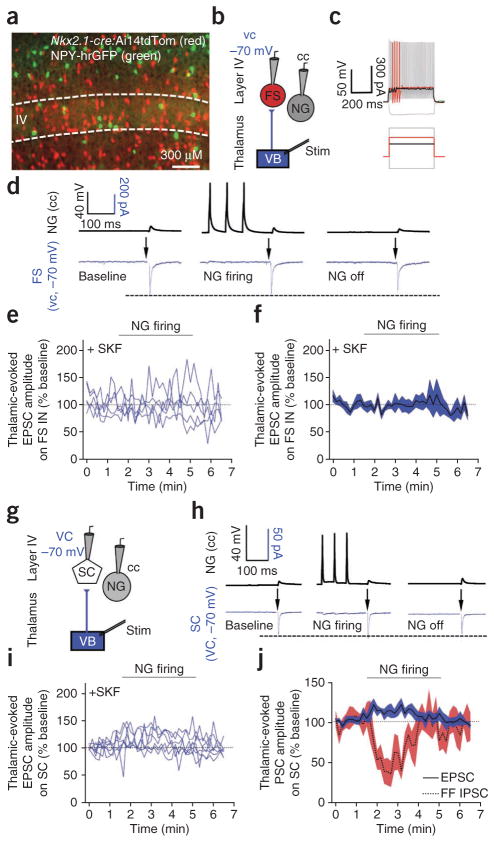
NGFC activity does not affect thalamic-evoked excitatory input onto layer IV fast-spiking interneurons or stellate cells. (a) Fluorescence image of layer IV in a transgenic mouse expressing NPY-hrGFP and with Nkx2.1-cre activity reported by loxP-flanked tdTomato (Ai14 mouse line). (b) Dual NGFC and fast-spiking interneuron whole-cell recording configuration. (c) Representative firing pattern of fast-spiking interneurons. (d) Single-trace examples of simultaneous current-clamp and voltage-clamp recording in a NGFC (black) and a fast-spiking interneuron (Vh) = −70 mV; blue), respectively. Arrows denote thalamic stimulation. (e,f) Individual (e) and pooled (f) data showing thalamic-evoked EPSC amplitude on fast-spiking interneurons in presence of GAT-1 block by 25 μM SKF-89976A (n = 5). (g) Dual NGFC and stellate cell (SC) whole-cell recording configuration. (h) Single-trace examples of simultaneous current-clamp and voltage-clamp recording in a NGFC (black) and SC (Vh = −70 mV; blue), respectively. Arrows denote thalamic stimulation. (i,j) Individual (i) and pooled (j) data showing EPSC amplitude on SCs at baseline, during and after NGFC firing in presence of GAT-1 block by 25 μM SFK-89976A (n = 7). PSC, postsynaptic current; FF, feed-forward. Red trace in j is a replot of the data shown in Figure 1i. Shaded areas in f and j denote s.e.m. Dotted lines in d and h indicate peak thalamic-evoked EPSC amplitude during baseline
References
Publication types
MeSH terms
Substances
Grants and funding
LinkOut - more resources
Full Text Sources
