Review
. 2013:768:183-95.
doi: 10.1007/978-1-4614-5107-5_11.

Deadenylation and P-bodies

Affiliations
Review

Deadenylation and P-bodies

Chyi-Ying A Chen et al. Adv Exp Med Biol. 2013.

Abstract

Deadenylation is the major step in triggering mRNA decay and results in mRNA translation inhibition in eukaryotic cells. Therefore, it is plausible that deadenylation also induces the mRNP remodeling required for formation of GW bodies or RNA processing bodies (P-bodies), which harbor translationally silenced mRNPs. In this chapter, we discuss several examples to illustrate the roles of deadenylation in regulating gene expression. We highlight several lines of evidence indicating that even though non-translatable mRNPs may be prepared and/or assembled into P-bodies in different ways, deadenylation is always a necessary, and perhaps the earliest, step in mRNA decay pathways that enable mRNP remodeling required for P-body formation. Thus, deadenylation and the participating deadenylases are not simply required for preparing mRNA substrates; they play an indispensable role both structurally and functionally in P-body formation and regulation.


Figures
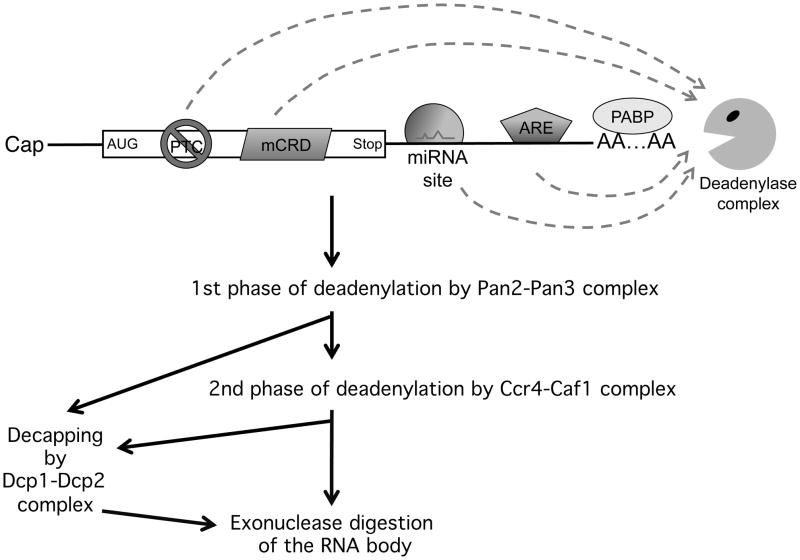
Figure 1
Figure 1. Deadenylation and major mRNA decay pathways in mammalian cells
Sequence elements are depicted for nonsense-mediated decay (NMD) triggered by a premature termination codon (PTC), decay mediated by the c-fos coding-region determinant (mCRD), miRNA-mediated decay, and decay mediated by AU-rich elements (ARE). The poly(A) tail, the poly(A)-binding protein (PABP) and the deadenylase complexes are shown at the 3′ end. The four RNA destabilizing elements or mutations and their cognate binding complexes have distinct paths (shown as dashed lines) to recruit deadenylation machinery and thus accelerate deadenylation, which occurs in two phases. In mammalian cells, decapping does not occur until the end of the first or second phase of deadenylation. Note that the slow, default decay of stable mRNAs lacking recognized destabilizing elements is also triggered by deadenylation.
Figure 2
Figure 2
Working model linking deadenylation and P-body formation.

Similar articles

Cited by

References

    1. Andrei MA, Ingelfinger D, Heintzmann R, Achsel T, Rivera-Pomar R, Luhrmann R. A role for eIF4E and eIF4E-transporter in targeting mRNPs to mammalian processing bodies. RNA. 2005;11:717–727. - PMC - PubMed
    1. Bagga S, Bracht J, Hunter S, Massirer K, Holtz J, Eachus R, Pasquinelli AE. Regulation by let-7 and lin-4 miRNAs results in target mRNA degradation. Cell. 2005;122:553– 563. - PubMed
    1. Baker EJ. Control of poly(A) length. In: Belasco JG, Brawerman G, editors. Control of messenger RNA stability. Academic Press; San Diego: 1993.
    1. Balagopal V, Parker R. Polysomes, P bodies and stress granules: states and fates of eukaryotic mRNAs. Current Opinion in Cell Biology. 2009;21:403–408. - PMC - PubMed
    1. Behm-Ansmant I, Rehwinkel J, Doerks T, Stark A, Bork P, Izaurralde E. mRNA degradation by miRNAs and GW182 requires both CCR4:NOT deadenylase and DCP1:DCP2 decapping complexes. Genes Dev. 2006;20:1885–1898. - PMC - PubMed

Publication types

MeSH terms

LinkOut - more resources
