


No survival benefit from adding cetuximab or panitumumab to oxaliplatin-based chemotherapy in the first-line treatment of metastatic colorectal cancer in KRAS wild type patients: a meta-analysis
- PMID: 23226426
- PMCID: PMC3511401
- DOI: 10.1371/journal.pone.0050925
No survival benefit from adding cetuximab or panitumumab to oxaliplatin-based chemotherapy in the first-line treatment of metastatic colorectal cancer in KRAS wild type patients: a meta-analysis
Abstract
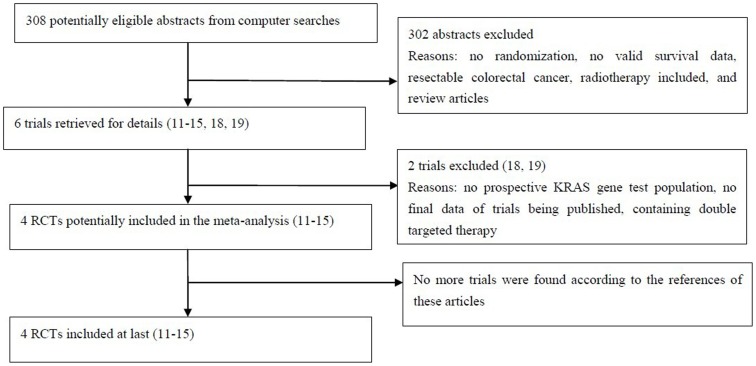
Background: The efficacy of combined therapies of oxaliplatin-based chemotherapy and anti-epidermal growth factor receptor (anti-EGFR) monoclonal antibodies (MAbs) remains controversial in colorectal cancer (CRC). The aim of this study is to estimate the efficacy and safety of adding cetuximab or panitumumab to oxaliplatin-based chemotherapy in the first line treatment in KRAS wild type patients with metastatic colorectal cancer (mCRC) through meta-analysis.
Methods: Medline, EMBASE, and Cochrane library, American Society of Clinical Oncology (ASCO) and European Society for Medical Oncology (ESMO) were searched. Eligible studies were randomized controlled trials (RCTs) which evaluated oxaliplatin-based chemotherapy with or without anti-EGFR drugs (cetuximab or panitumumab) in untreated KRAS wild type patients with mCRC. The outcomes included overall survival (OS), progression-free survival (PFS), overall response rate (ORR) and toxicities. Hazard ratios (HR) and risk ratio (RR) were used for the meta-analysis and were expressed with 95% confidence intervals.
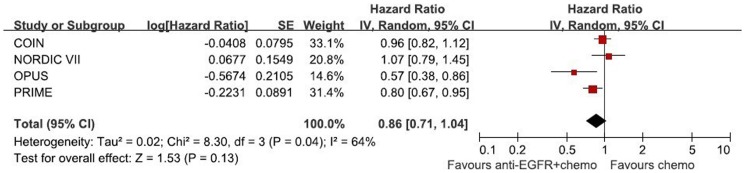
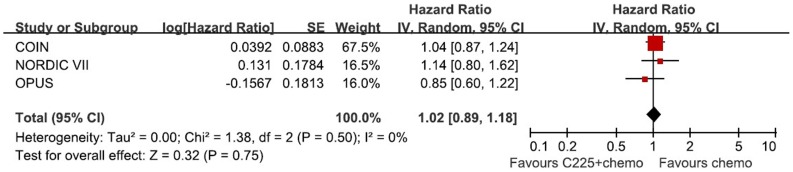
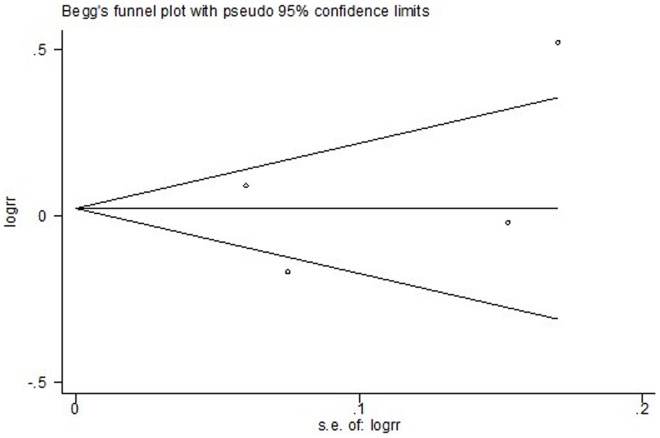
Results: This meta-analysis included four RCTs with 1270 patients, and all of the patients were administered oxaliplatin-based chemotherapy regimens with or without anti-EGFR MAbs. The result of heterogeneity of OS was not significant. Compared with chemotherapy alone, the addition of cetuximab or panitumumab didn't result in significant improvement in OS (HR = 1.00, 95%CI [0.88, 1.13], P = 0.95) or PFS (HR = 0.86, 95%CI [0.71, 1.04], P = 0.13). The subgroup analysis of cetuximab also revealed no significant benefit in OS (HR = 1.02, 95%CI [0.89, 1.18], P = 0.75) or in PFS (HR = 0.87, 95%CI [0.65, 1.17], P = 0.36). Patients who received combined therapy didn't have a higher ORR (Risk Ratio = 1.08, 95%CI [0.86, 1.36]). Toxicities slightly increased in anti-EGFR drugs group.
Conclusions: The addition of cetuximab or panitumumab to oxaliplatin-based chemotherapy in first-line treatment of mCRC in wild type KRAS population did not improve efficacy in survival benefit and response rate. More RCTs are warranted to evaluate the combination of chemotherapy and targeted therapy.
Conflict of interest statement
Figures




References
-
- Jemal A, Bray F (2011) Center MM, Ferlay J, Ward E, et al (2011) Global Cancer Statistics. CA Cancer J Clin 61: 134. - PubMed
-
- O’Neil BH, Goldberg RM (2008) Innovations in chemotherapy for metastatic colorectal cancer: an update of recent clinical trials. Oncologist 13: 1074–1083. - PubMed
-
- Van Cutsem E, Köhne CH, Hitre E, Zaluski J, Chang Chien CR, et al. (2009) Cetuximab and Chemotherapy as Initial Treatment for Metastatic Colorectal Cancer. N Engl J Med 360: 1408–1417. - PubMed
-
- Cunningham D, Humblet Y, Siena S, Khayat D, Bleiberg H, et al. (2004) Cetuximab Monotherapy and Cetuximab plus Irinotecan in Irinotecan-Refractory Metastatic Colorectal Cancer. N Engl J Med 351: 337–345. - PubMed
Publication types
MeSH terms
Substances
LinkOut - more resources
Full Text Sources
Medical
Research Materials
Miscellaneous
