


The incubation periods of Dengue viruses
- PMID: 23226436
- PMCID: PMC3511440
- DOI: 10.1371/journal.pone.0050972
The incubation periods of Dengue viruses
Abstract
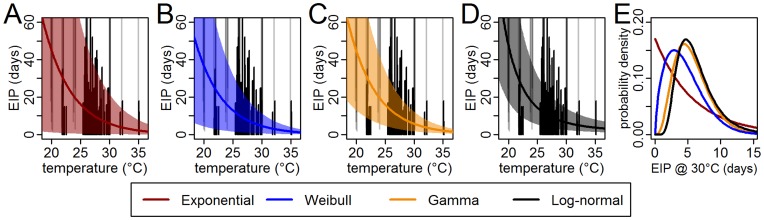
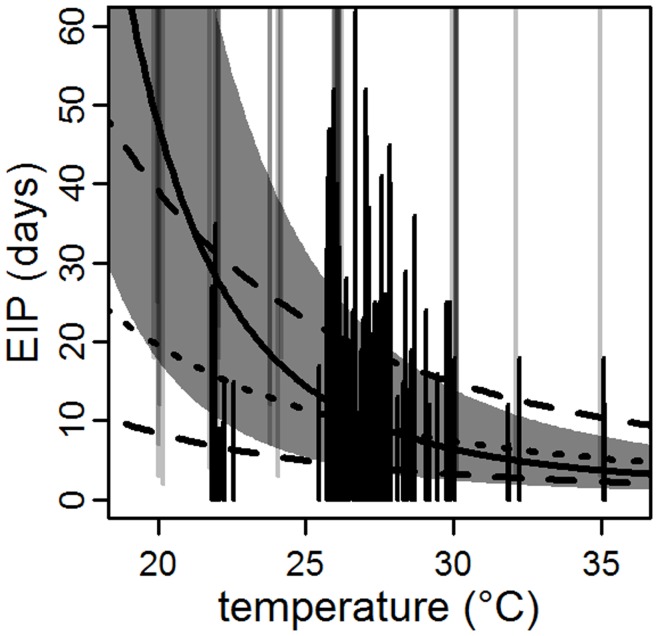
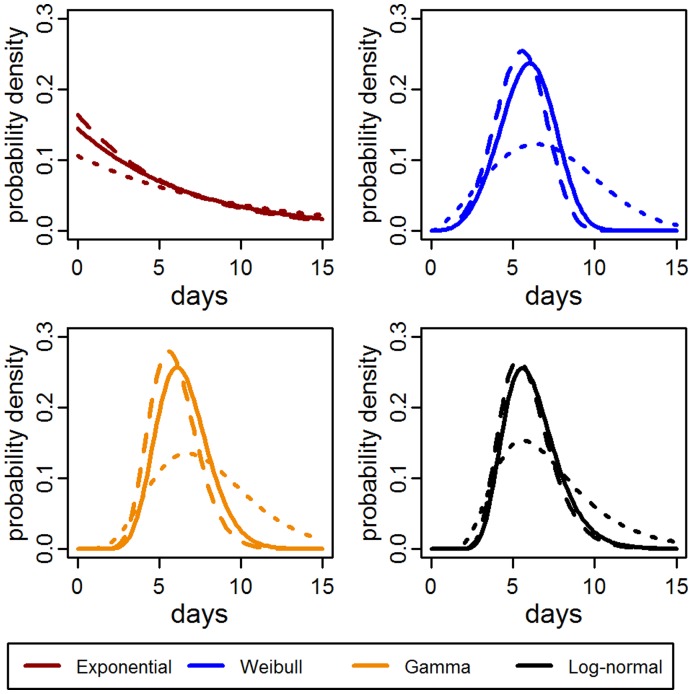
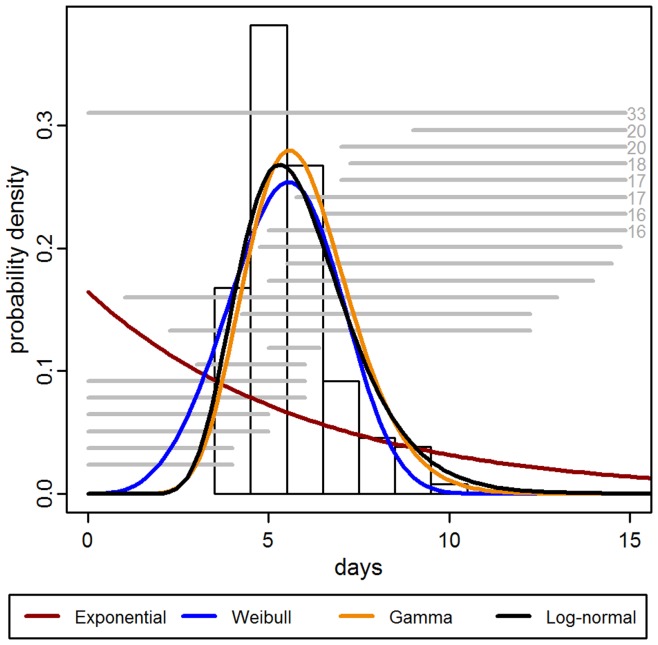
Dengue viruses are major contributors to illness and death globally. Here we analyze the extrinsic and intrinsic incubation periods (EIP and IIP), in the mosquito and human, respectively. We identified 146 EIP observations from 8 studies and 204 IIP observations from 35 studies. These data were fitted with censored Bayesian time-to-event models. The best-fitting temperature-dependent EIP model estimated that 95% of EIPs are between 5 and 33 days at 25°C, and 2 and 15 days at 30°C, with means of 15 and 6.5 days, respectively. The mean IIP estimate was 5.9 days, with 95% expected between days 3 and 10. Differences between serotypes were not identified for either incubation period. These incubation period models should be useful in clinical diagnosis, outbreak investigation, prevention and control efforts, and mathematical modeling of dengue virus transmission.
Conflict of interest statement
Figures
References
-
- Black WC, Bennett KE, Gorrochotegui-Escalante N, Barillas-Mury CV, Fernandez-Salas I, et al. (2002) Flavivirus susceptibility in Aedes aegypti . Arch Med Res 33: 379–388. - PubMed
-
- Bancroft T (1906) On the etilology of dengue fever. Aust Med Gaz 25: 17–18.
-
- McLean DM, Clarke AM, Coleman JC, Montalbetti CA, Skidmore AG, et al. (1974) Vector capability of Aedes aegypti mosquitoes for California encephalitis and dengue viruses at various temperatures. Can J Microbiol 20: 255–262. - PubMed
-
- Watts DM, Burke DS, Harrison BA, Whitmire RE, Nisalak A (1987) Effect of temperature on the vector efficiency of Aedes aegypti for dengue 2 virus. Am J Trop Med Hyg 36: 143–152. - PubMed
MeSH terms
LinkOut - more resources
Full Text Sources
