


Willingness to participate in HIV vaccine trials among men who have sex with men in Chennai and Mumbai, India: a social ecological approach
- PMID: 23226560
- PMCID: PMC3514227
- DOI: 10.1371/journal.pone.0051080
Willingness to participate in HIV vaccine trials among men who have sex with men in Chennai and Mumbai, India: a social ecological approach
Abstract
Background: Recruitment of low- and middle-income country volunteers from most-at-risk populations in HIV vaccine trials is essential to vaccine development. In India, men who have sex with men (MSM) are at disproportionately high risk for HIV infection and an important population for trial recruitment. Investigations of willingness to participate (WTP) in HIV vaccine trials have focused predominantly on individual-level determinants. We explored multi-level factors associated with WTP among MSM in India.
Methods: We conducted 12 focus groups (n = 68) with low socioeconomic MSM in Chennai and Mumbai, and 14 key informant interviews with MSM community leaders and service providers. Focus groups/interviews were recorded, transcribed and translated into English. Two bilingual investigators conducted thematic analysis using line-by-line coding and a constant comparative method, with member-checking by community representatives.
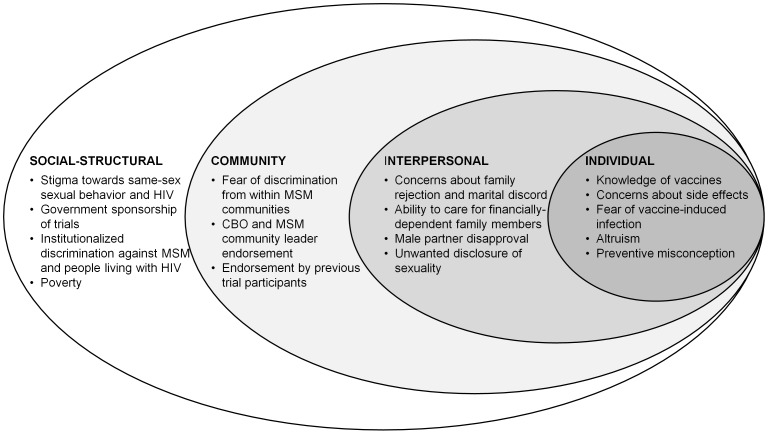
Results: Factors associated with WTP were evidenced across the social ecology of MSM-social-structural: poverty, HIV-, sexual- and gender non-conformity stigma, institutionalized discrimination and government sponsorship of trials; community-level: endorsement by MSM community leaders and organizations, and fear of within-group discrimination; interpersonal: anticipated family discord, partner rejection, having financially-dependent family members and disclosure of same-sex sexuality; and individual-level: HIV vaccine trial knowledge and misconceptions, safety concerns, altruism and preventive misconception.
Conclusion: Pervasive familial, community and social-structural factors characteristic of the Indian sociocultural context may complicate individual-focused approaches to WTP and thereby constrain the effectiveness of interventions to support recruitment and retention in HIV vaccine trials. Interventions to reduce stigma and discrimination against MSM and people living with HIV, capacity-building of MSM community organizations and transparent communications tailored to the knowledge and educational level of local communities may support meaningful engagement of MSM in HIV vaccine trials. Vigilance in providing fair but not excessive compensation and healthcare benefits and in mitigating preventive misconception are warranted to support ethical conduct of trials among MSM in India.
Conflict of interest statement
Figures
References
-
- Joint United Nations Programme on HIV/AIDS (UNAIDS) (2010) Global report: UNAIDS report on the global AIDS epidemic 2010. UNAIDS website. Available: http://www.unaids.org/globalreport/documents/20101123_GlobalReport_full_.... Accessed 2012 Nov 2.
-
- National AIDS Control Organization (NACO), Department of AIDS Control, Ministry of Health and Family Welfare, Government of India. Annual CMIS Bulletin 2008–09. AIDS Data Hub website. Available: http://aidsdatahub.org/en/india-reference-library/item/12112-annual-cmis.... Accessed 2012 Nov 2.
-
- International AIDS Vaccine Initiative (IAVI) (2011) THSTI & IAVI announce new HIV vaccine design program in India. IAVI website. Available: http://www.iavi.org/Information-Center/Press-Releases/Pages/THSTI-IAVI-A.... Accessed 2012 Nov 2.
-
- Excler JL, Kochhar S, Kapoor S, Das S, Bahri J, et al. (2008) Preparedness for AIDS vaccine trials in India. Indian J Med Res 127: 529–536. - PubMed
-
- Newman PA (2006) Towards a science of community engagement. Lancet 367(9507): 302. - PubMed
Publication types
MeSH terms
Substances
Grants and funding
LinkOut - more resources
Full Text Sources
Medical
