. 2012;2(6):620-57.
Epub 2012 Nov 20.

Regulators of gene expression as biomarkers for prostate cancer

Affiliations

Regulators of gene expression as biomarkers for prostate cancer

Stacey S Willard et al. Am J Cancer Res. 2012.

Abstract

Recent technological advancements in gene expression analysis have led to the discovery of a promising new group of prostate cancer (PCa) biomarkers that have the potential to influence diagnosis and the prediction of disease severity. The accumulation of deleterious changes in gene expression is a fundamental mechanism of prostate carcinogenesis. Aberrant gene expression can arise from changes in epigenetic regulation or mutation in the genome affecting either key regulatory elements or gene sequences themselves. At the epigenetic level, a myriad of abnormal histone modifications and changes in DNA methylation are found in PCa patients. In addition, many mutations in the genome have been associated with higher PCa risk. Finally, over- or underexpression of key genes involved in cell cycle regulation, apoptosis, cell adhesion and regulation of transcription has been observed. An interesting group of biomarkers are emerging from these studies which may prove more predictive than the standard prostate specific antigen (PSA) serum test. In this review, we discuss recent results in the field of gene expression analysis in PCa including the most promising biomarkers in the areas of epigenetics, genomics and the transcriptome, some of which are currently under investigation as clinical tests for early detection and better prognostic prediction of PCa.

Keywords: Prostate cancer; SNP; acetylation; biomarker; epigenetics; genomics; lncRNA; methylation; miRNA; ncRNA; transcriptomics.


Figures
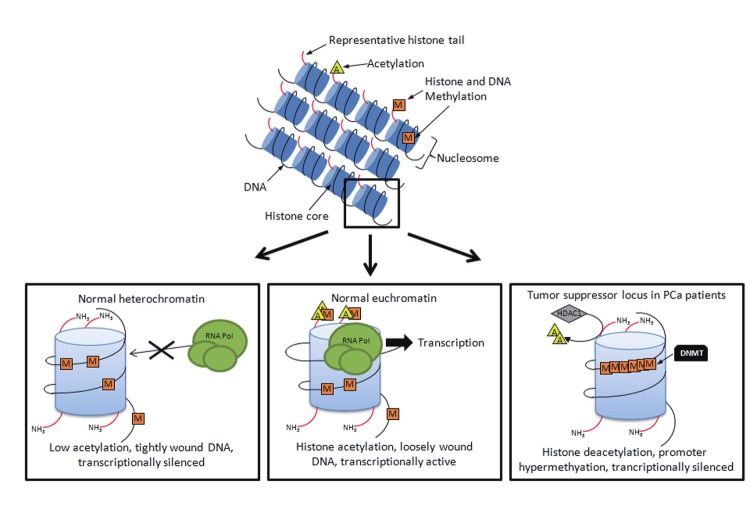
Figure 1
Figure 1
Epigenetic regulation of gene expression in PCa. This schematic illustrates how changes in the normal conformation of chromatin structure can impact transcription in PCa. In the left panel, low acetylation results in tightly wound DNA and transcription is rare. In the middle, methylation and acetylation of histones result in loose chromatin conformations and reduced ability of RNA polymerase (RNA Pol) to access the promoter region. Finally, the right panel illustrates the situation whereby histones are deacetylated by HDACs, promoter regions are hypermethylated by DNMTs and the chromatin conformation is closed. Transcription in this situation is very rare; the gene is effectively silenced. Orange “M” squares represent methyl groups; yellow “A” triangles represent acetyl groups.
Figure 2
Figure 2
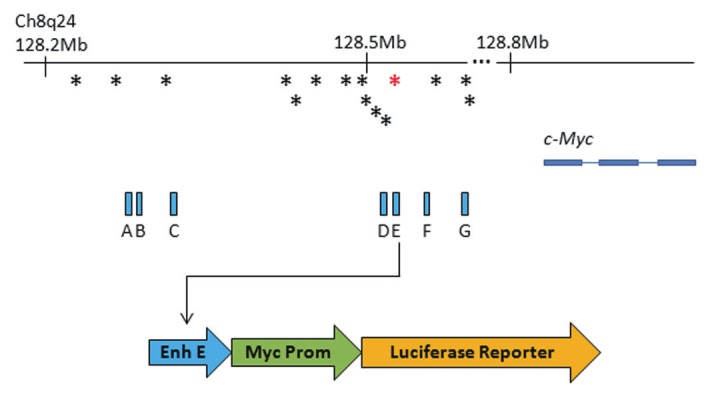
The 8q24 genomic locus. This locus spans over 1 Mb, but only a small relevant portion is shown. The c-Myc gene is the closest coding gene at 200 Kb from 8q24. This schematic illustrates not only the SNPs associated with 8q24 (asterisks), but also, in blue, the functional enhancer elements identified by Sotelo and colleagues [117]. In this study, each enhancer was subcloned into a vector containing a myc promoter and a luciferase reporter. In this way, the ability of each enhancer to drive reporter expression was assayed. The red asterisk represents the rs6983267 SNP. Alleles of this SNP have been associated with differential effects on c-Myc expression.
Figure 3
Figure 3
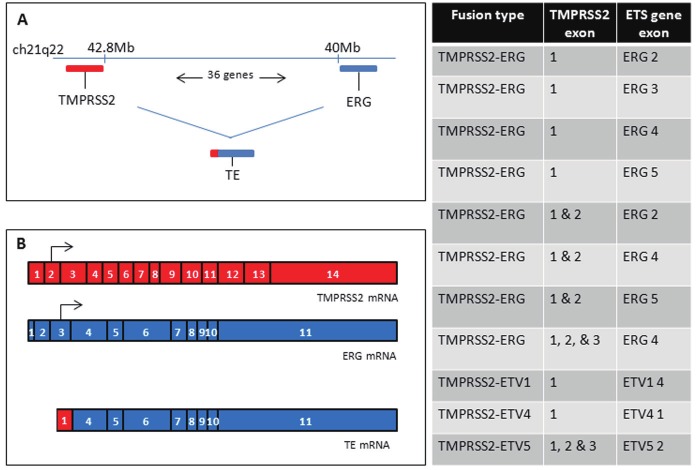
TMPRSS2-ETS gene fusion. Panel A illustrates the positions of TMPRSS2 and ERG in the human genome. The two genes are situated 2.8 Mb apart, with 36 predicted and coding genes in between. Deletion or translocation results in the fusion of the genes, as illustrated. Panel B displays the formation of the most common (30%) TE fusion product: fusion between TMPRSS2 exon 1 and ERG exons 4-11. Arrows indicate the start of translation in the normal mRNA. Since the canonical start is deleted in TE fusion of this type, an internal ATG is presumed to be the new translation initiation site. The table to the right shows the most commonly-found TMPRSS2-ETS family gene fusions [251].
Figure 4
Figure 4
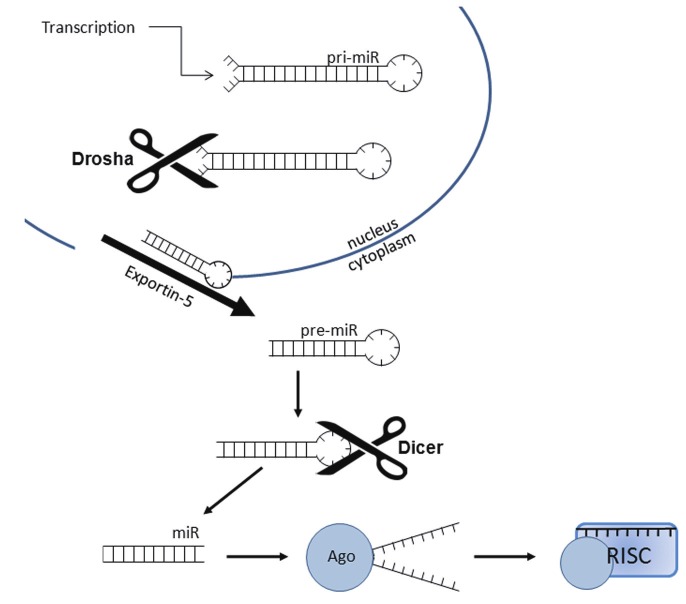
miRNA processing. This schematic illustrates the biogenesis of a mature RNA-induced silencing complex (RISC). First, the pri-miR is transcribed and clipped by Drosha. After translocation to the cytoplasm, the pre-miR is again processed by Dicer before unwinding by Argonaute (Ago) and binding to other complex members to form the RISC.

References

    1. Knudson AG Jr. Mutation and cancer: statistical study of retinoblastoma. Proc Natl Acad Sci U S A. 1971;68:820–823. - PMC - PubMed
    1. Society AC. In: Cancer Facts & Figures. Society AC, editor. Atlanta, GA: 2012.
    1. Moyer VA. Screening for Prostate Cancer: U. S. Preventive Services Task Force Recommendation Statement. Ann Intern Med. 2012;157:120–134. - PubMed
    1. Cooper CS, Foster CS. Concepts of epigenetics in prostate cancer development. Br J Cancer. 2009;100:240–245. - PMC - PubMed
    1. Hoque MO. DNA methylation changes in prostate cancer: current developments and future clinical implementation. Expert Rev Mol Diagn. 2009;9:243–257. - PMC - PubMed

LinkOut - more resources