


Auditory and phonetic memory codes in the discrimination of consonants and vowels
- PMID: 23226880
- PMCID: PMC3515632
- DOI: 10.3758/BF03214136
Auditory and phonetic memory codes in the discrimination of consonants and vowels
Abstract
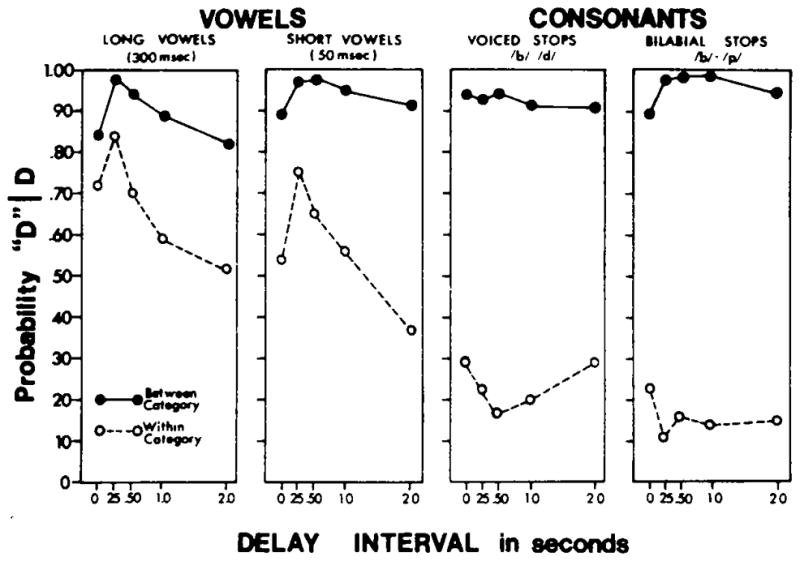
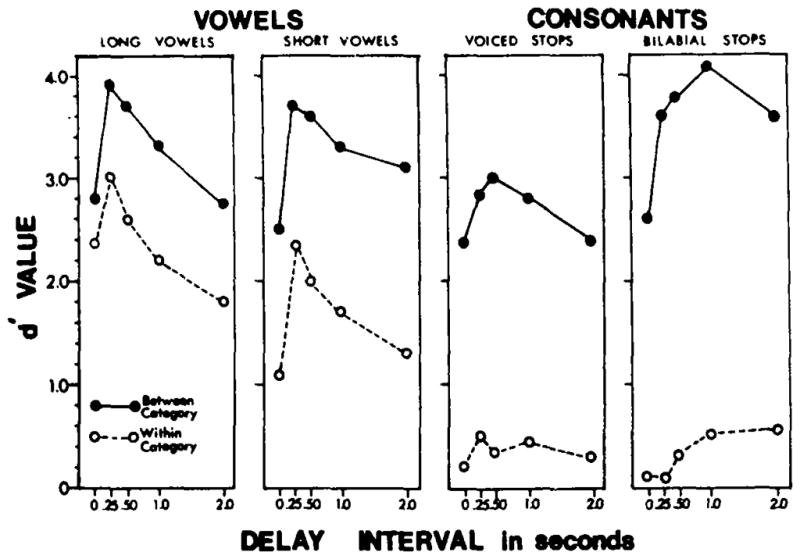
Recognition memory for consonants and vowels selected from within and between phonetic categories was examined in a delayed comparison discrimination task. Accuracy of discrimination for synthetic vowels selected from both within and between categories was inversely related to the magnitude of the comparison interval. In contrast, discrimination of synthetic stop consonants remained relatively stable both within and between categories. The results indicate that differences in discrimination between consonants and vowels are primarily due to the differential availability of auditory short-term memory for the acoustic cues distinguishing these two classes of speech sounds. The findings provide evidence for distinct auditory and phonetic memory codes in speech perception.
Figures

References
-
- Cooper FS, Mattingly IG. Status Report on Speech Research (SR-17/18) Haskins Laboratories; New York: 1969. Computer-controlled PCM system for investigation of dichotic speech perception; pp. 17–21.
-
- Crowder RG. The sound of vowels and consonants in immediate memory. Journal of Verbal Learning & Verbal Behavior. 1971;10:587–596.
-
- Fry DB, Abramson AS, Eimas PD, Liberman AM. The identification and discrimination of synthetic vowels. Language & Speech. 1962;5:171–189.
-
- Fujisaki H, Kawashima T. Annual Report of the Engineering Research Institute. Vol. 28. Faculty of Engineering, University of Tokyo; Tokyo: 1969. On the modes and mechanisms of speech perception; pp. 67–73.
-
- Fujisaki H, Kawashima T. Annual Report of the Engineering Research Institute. Vol. 29. Faculty of Engineering, University of Tokyo; Tokyo: 1970. Some experiments on speech perception and a model for the perceptual mechanism; pp. 207–214.
Grants and funding
LinkOut - more resources
Full Text Sources