Review
. 2012 Sep;14(3):293-305.
doi: 10.31887/DCNS.2012.14.3/jcrawley.

Translational animal models of autism and neurodevelopmental disorders

Affiliations
Review

Translational animal models of autism and neurodevelopmental disorders

Jacqueline N Crawley. Dialogues Clin Neurosci. 2012 Sep.

Abstract

Autism is a neurodevelopmental disorder whose diagnosis is based on three behavioral criteria: unusual reciprocal social interactions, deficits in communication, and stereotyped repetitive behaviors with restricted interests. A large number of de novo single gene mutations and chromosomal deletions are associated with autism spectrum disorders. Based on the strong genetic evidence, mice with targeted mutations in homologous genes have been generated as translational research tools. Mouse models of autism have revealed behavioral and biological outcomes of mutations in risk genes. The field is now poised to employ the most robust phenotypes in the most replicable mouse models for preclinical screening of novel therapeutics.

El autismo es un trastorno del neurodesarrollo cuyo diagnóstico se basa en tres criterios conductuales: interacciones sociales recíprocas inusuales, déficit en la comunicación y conductas repetitivas estereotipadas con intereses disminuidos. Los trastornos del espectro autista están asociados con un gran número de mutaciones monogénicas de novo y deleciones cromosómicas. En base a la gran evidencia genética, se han generado ratones con mutaciones específicas en genes homólogos como herramientas de investigatión traslacional. Hay modelos de autismo en el ratón que han revelado resultados conductuales y biológicos que corresponden a mutaciones en genes de riesgo en genes de riesgo. Este campo ahora está preparado para emplear los fenotipos más potentes en los modelos de ratón más reproducibles para la evaluatión preclínica de nuevas terapéuticas.

L'autisme est un trouble du neurodéveloppement dont le diagnostic se fonde sur 3 critères comportementaux: des interactions sociales réciproques inhabituelles, des déficits de communication et des comportements répétitifs stéréotypés accompagnés d'intérêts restreints. Les troubles autistiques sont associés à de nombreuses mutations monogéniques de novo et à des deletions chromosomiques. Sur la base des arguments génétiques solides, des souris aux mutations ciblées sur des gènes homologues ont été élevées comme outil de recherche translationnelle. Les modèles murins d'autisme ont présenté des mutations biologiques et comportementales correspondant aux mutations des gènes à risque. Ce domaine de recherche est maintenant prêt à employer les phénotypes les plus fiables des modèles murins les plus reproductibles pour le dépistage préclinique de nouveaux traitements.

Keywords: Fragile X; anxiety; autism; cognitive; genetics; mGluRS antagonist; mouse model; neurodevelopmental disorder; olfactory; repetitive behavior; self-grooming; social behavior; therapeutics; tuberous sclerosis; ultrasonic vocalization.


Figures
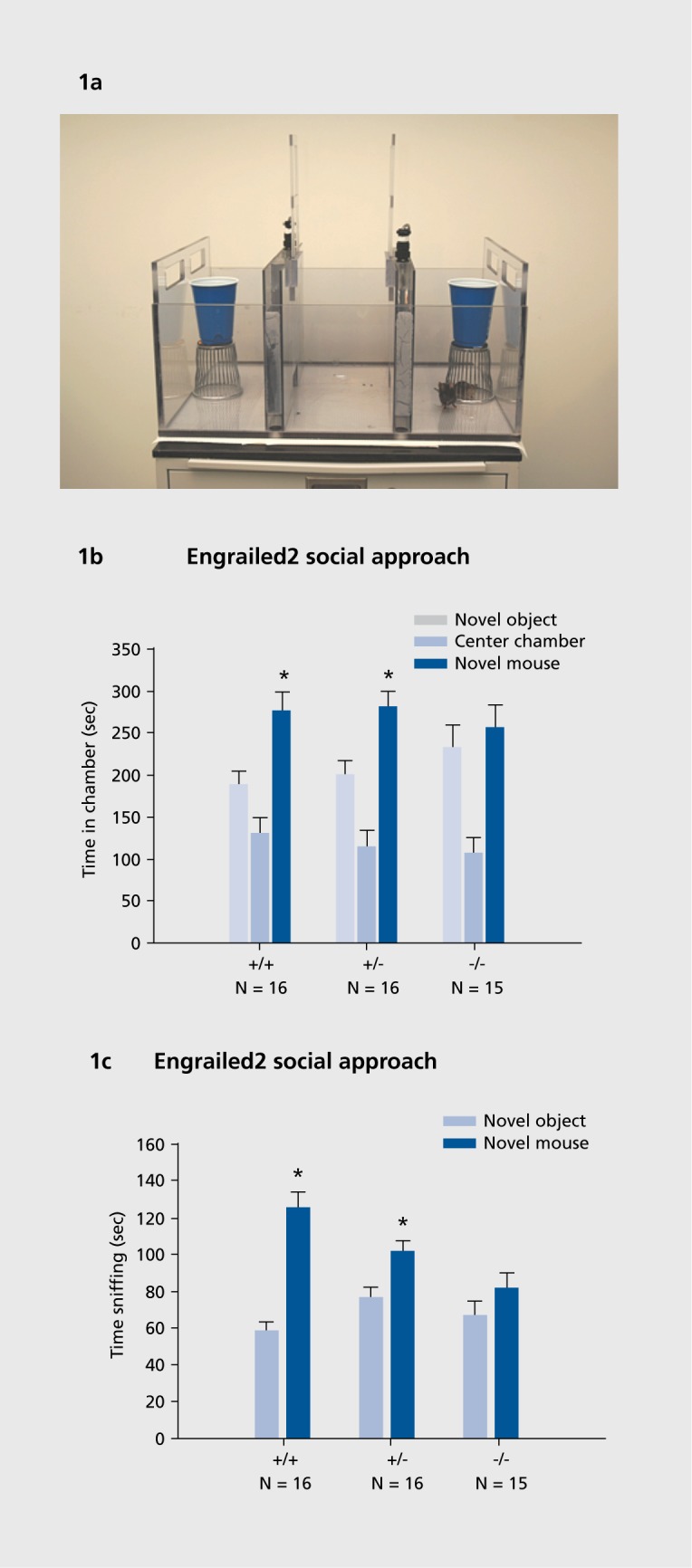
Figure 1.
Figure 1.. (a) Social approach apparatus for assaying sociability in mice. The subject mouse begins in the empty center chamber of a three-chambered Plexiglas apparatus. A novel object, an inverted wire pencil cup, is placed in one side chamber. A novel mouse, who has not been in visual, olfactory, or tactile contact with the subject, is placed inside an identical wire control cup in the opposite side chamber. Over a 10-minute test session, the automated photocells and software score the amount of time the subject mouse spends in each of the three chambers. The number of entries into each compartment is simultaneously recorded as an internal control for general exploratory activity. Time spent engaged in bone fide social interactions with the novel mouse, and directed exploration of the novel object, are subsequently scored from digital videotapes of the session, by investigators uninformed of the genotype or treatment condition. Photograph by Dr Mu Yang, contributed by the author. (b) Social approach chamber time scores in adult Engrailed2 (En2) knockout mice. Normal sociability is defined as more time spent in the chamber with the novel mouse than in the chamber with the novel object, and more time spent sniffing the novel mouse than sniffing the novel object. Wild-type littermate controls and heterozygotes displayed normal sociability on the chamber time parameter, while En2 null mutants failed to display sociability on this parameter. Reproduced from reference 170: Brielmaier J, Matteson PG, Silverman JL, et al. Autism-relevant social abnormalities and cognitive deficits in engrai!ed-2 knockout mice. PLoSOne. 2012;7:e40914. (c) Social approach sniff time scores in adult En2 mice. Wild-type littermate controls and heterozygotes displayed normal sociability on the sniff time parameter, while En2 null mutants failed to display sociability on this parameter. Time spent sniffing the novel mouse is a more direct measure of social inter actions, and usually more sensitive to mutations. Reproduced from reference 170: Brielmaier J, Matteson PG, Silverman JL, et al. Autism-relevant social abnormalities and cognitive deficits in engrailed-2 knockout mice. PLoS One. 2012;7:e40914.
Figure 2.
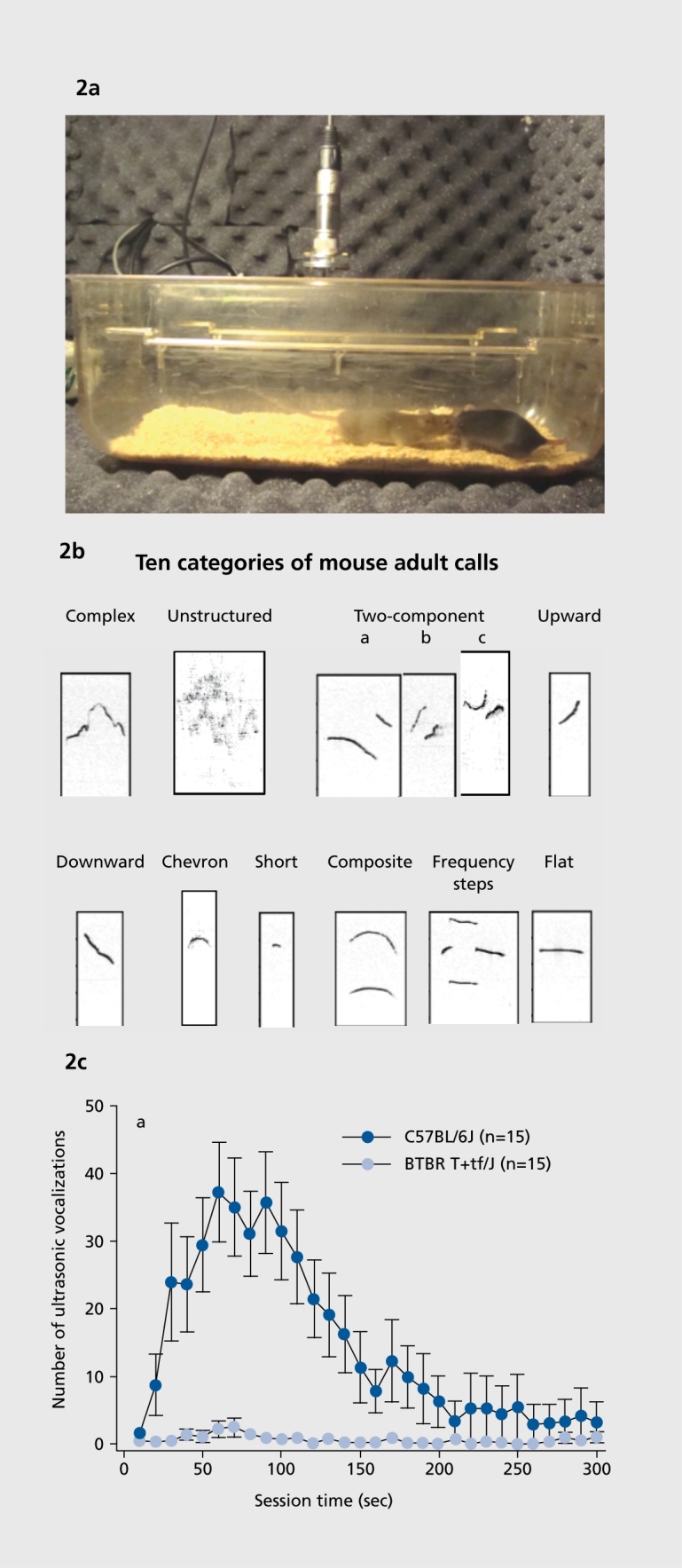
Figure 2.. (a) Ultrasonic vocalizations are recorded in adult mice engaged in social interactions, using an ultrasonic microphone and specialized software. Photograph by Dr Jennifer Brielmaier, contributed by the author. (b) Ultrasonic vocalization call categories in adult C57BL/6J mice, an inbred strain with normal sociability. Reproduced from ref 153: Scattoni M, Ricceri L, Crawley J. Unusual repertoire of vocalizations in adult BTBR T+tf/J mice during three types of social encounters. Genes Brain Behav. 2011;10:44-56. Copyright © Munskgaard 2011. (c) C57BL/6J adult male mice emit high numbers of ultrasonic vocalizations, while BTBR adult male mice emit low numbers of ultrasonic vocalizations, during a 5-minute session with an estrus female mouse. BTBR T+tf/J (BTBR) is an inbred strain of mice that displays robust, well-replicated social deficits on multiple tasks,,, markedly fewer vocalizations during social interaction sessions,,, and high levels of repetitive self-grooming and marble burying,,, representing the three diagnostic criteria for autism. Reproduced from ref 154: Wohr M, Roullet Fl, Crawley JN. Reduced scent marking and ultrasonic vocalizations in the BTBR T+tf/J mouse model of autism. Genes Brain Behav. 2011;10:35-43. Copyright © Munksgaard 2011
Figure 3.
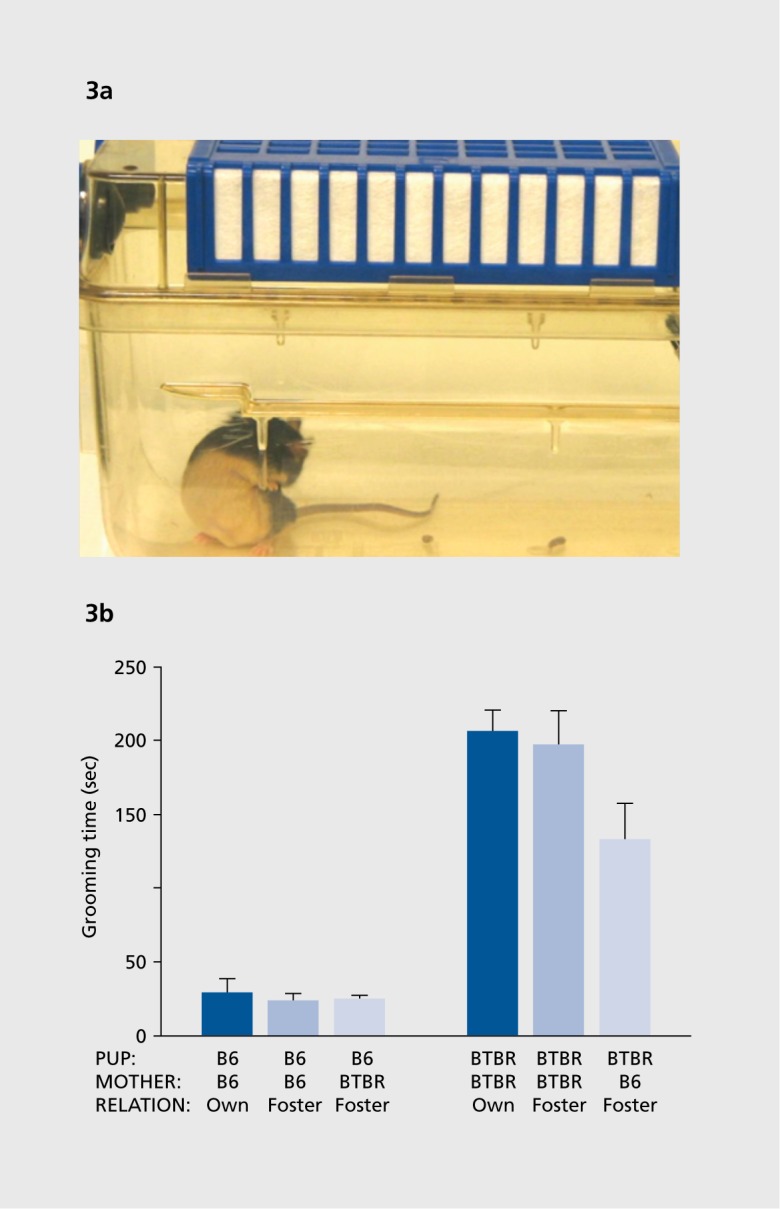
Figure 3.. (a) Unusually high levels of spontaneous repetitive self grooming, in which the normal pattern of grooming behaviors are present but the bouts of grooming are strikingly prolonged, are measured over a 10-minute session in which the subject mouse is in an empty cage. Digital videos of the session are scored by an investigator uninformed of the genotype or treatment condition. Photograph by Dr Mu Yang, contributed by the author. (b) High levels of repetitive self-grooming are displayed by adult BTBR mice as compared with C57BL/6J mice. In this cross-fostering experiment, self-grooming scores in adults were found to be independent of the strain of the dam that raised the pup. Reproduced from ref 55: PankseppJB, Jochman KA, Kim JU, et al. Affiliative behavior, ultrasonic communication and social reward are influenced by genetic variation in adolescent mice. PLoS One. 2007;2:e351. Copyright Public Library of Science 2007

References

    1. Kanner L. Child psychiatry; mental deficiency. Am J Psychiatry. 1946;102:520–522. - PubMed
    1. Asperger H. Die “Autistischen Psychopathen” im kindesalter. Archiv fur Psychiatrie und Nervenkrankheiten. 1944;117:76–136.
    1. American Psychiatric Association. Diagnostic and Statistical Manual of Mental Disorders. 4th ed. Washington, DC: American Psychiatric Association. 1994
    1. El-Fishawy P., State MW. The genetics of autism: key issues, recent findings, and clinical implications. Psychiatr Clin North Am. 2010;33:83–105. - PMC - PubMed
    1. Cook EH., Jr, Scherer SW. Copy-number variations associated with neuropsychiatric conditions. Nature. 2008;455:919–923. - PubMed

Publication types