. 2012:S8:3.
doi: 10.4172/2155-6113. Epub 2012 Mar 22.

Antigenicity and Immunogenicity in HIV-1 Antibody-Based Vaccine Design

Affiliations

Antigenicity and Immunogenicity in HIV-1 Antibody-Based Vaccine Design

Leopold Kong et al. J AIDS Clin Res. 2012.

Abstract

Neutralizing antibodies can protect from infection by immunodeficiency viruses. However, the induction by active vaccination of antibodies that can potently neutralize a broad range of circulating virus strains is a goal not yet achieved, despite more than 2 decades of research. Here we review progress made in the field, from early empirical studies to today's rational structure-based vaccine antigen design. We discuss the existence of broadly neutralizing antibodies, their implications for epitope discovery and recent progress made in antigen design. Finally, we consider the relationship between antigenicity and immunogenicity for B cell recognition and antibody production, a major hurdle for rational vaccine design to overcome.


Figures
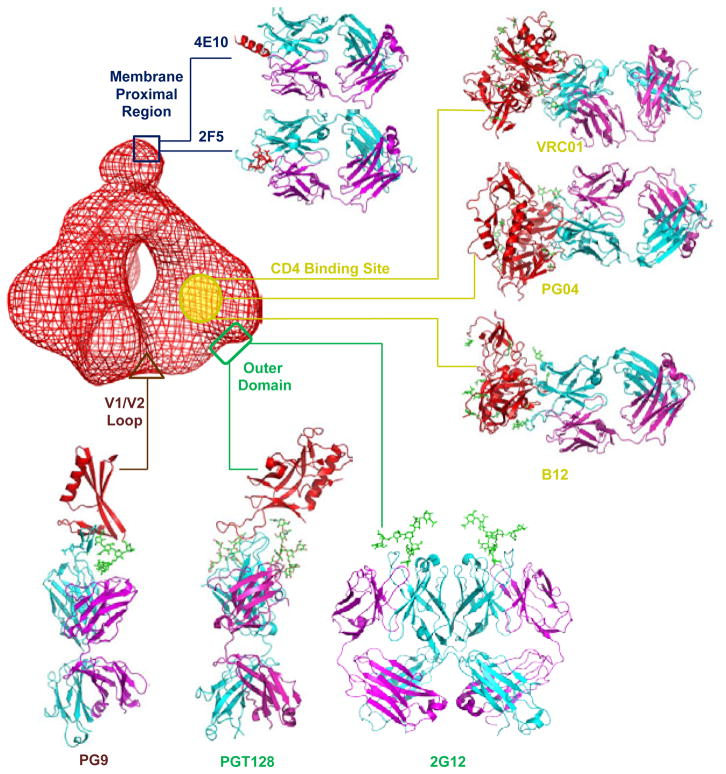
Figure 1
Figure 1. The epitopes of four classes of bNMAb
Currently, there are four broad classes of bNMAb against the HIV-1 trimeric spike (red): Ab that bind the membrane proximal region (blue), the CD4bs (yellow), the oligomannose patch on the outer domain with or without implication of the V3 loop (green) and the V1/V2 domain (brown). Representatives of each class have been extensively structurally characterised. Here, these are shown alongside a low-resolution cryo-EM map of the unliganded gp160 spike (EMDID: 5019) (red mesh) oriented with the viral membrane on the top. In the gp41 portion, the two bNMAb that recognize the membrane proximal region are shown: 4E10 (PDBID: 2FX7) and 2F5 (PDBID:1TJG). Beneath that, in the gp120 portion, are bNMAb that recognize the CD4bs: VRC01 (PDBID: 3NGB), PG04 (PDBID: 3SE9) and b12 (PDBID: 2NY7). Also in the gp120 portion are bNMAb that bind the outer domain region around the V3 loop: 2G12 (PDBID: 1OP5) and PGT128 (PDBID: 3TYG). Finally at the bottom is a bNMAb that binds a quaternary-fold-dependent epitope in the V1/V2 domain: PG9 (PDBID 3U2S). Here, all structures are displayed in cartoon format with the heavy chains of the Ab coloured cyan, the light chains coloured magenta, the gp120 protein portions coloured red and the gp120 glycan portions coloured green.
Figure 2
Figure 2. The structure-based vaccine antigen design strategy
The flow of steps in the process is shown here. The original complex antigen or a subcomponent of it is co-crystallized with a bNMAb to reveal atomic-level structural information about the epitope. The epitope is then recapitulated as a constrained mimic using scaffolds as backbones to present the epitope. If several different backbones are generated that present essentially the same epitopic structure, then these can be used in a series of heterologous immunizations to selectively amplify B cell responses to the epitope. If the strategy works, then the outcome would be the generation of a polyclonal B cell response containing bNMAb specificities that resemble the original template bNMAb.
Figure 3
Figure 3. HIV-1 gp120 flexibility and predicted B-cell immunogenicity
Here the structure of gp120 containing an intact V3 loop (PDBID: 2B4C) is shown in cartoon representations coloured by heat gradient (blue = least, red = most), according to either its crystallographic b-value-a measure of flexibility (left), or to its predicted b-cell immunogenicity by the BEprot server (right). The two representations are oriented to fully display the CD4bs, which has been circled in yellow.

References

    1. Plotkin SA. Vaccines: the fourth century. Clin Vaccine Immunol. 2009;16:1709–1719. - PMC - PubMed
    1. Mascola JR, Montefiori DC. The role of antibodies in HIV vaccines. Annu Rev Immunol. 2010;28:413–444. - PubMed
    1. Korber B, Gaschen B, Yusim K, Thakallapally R, Kesmir C, et al. Evolutionary and immunological implications of contemporary HIV-1 variation. Br Med Bull. 2001;58:19–42. - PubMed
    1. Zhuang J, Jetzt AE, Sun G, Yu H, Klarmann G, et al. Human immunodeficiency virus type 1 recombination: rate, fidelity, and putative hot spots. J Virol. 2002;76:11273–11282. - PMC - PubMed
    1. Koup RA, Douek DC. Vaccine design for CD8 T lymphocyte responses. Cold Spring Harb Perspect Med. 2011;1:a007252. - PMC - PubMed

LinkOut - more resources