Review
doi: 10.2174/1573403x10666140214120056.
Cardiac monitoring in patients with syncope: making that elusive diagnosis
Affiliations
- PMID: 23228074
- PMCID: PMC3941093
- DOI: 10.2174/1573403x10666140214120056
Item in Clipboard
Review
Cardiac monitoring in patients with syncope: making that elusive diagnosis
Curr Cardiol Rev.
2013 Nov.
Abstract
Elucidating the cause of syncope is often a diagnostic challenge. At present, there is a myriad of ambulatory cardiac monitoring modalities available for recording cardiac rhythm during spontaneous symptoms. We provide a comprehensive review of these devices and discuss strategies on how to reach the elusive diagnosis based on current evidencebased recommendations.
Figures

Holter Monitor. The recording device is worn by the patient using a shoulder strap or belt loop, attached to 3-5 skin electrodes for continuous monitoring. An event button (not shown) at the top of the housing of the device is pressed in the event of symptoms to mark the recording. See text for discussion.

Transtelephonic Monitors. The device is lightweight and portable. Four recording electrodes are present on the back of the device to permit single lead rhythm strip capture. A record button (top left) is pressed at the onset of symptoms, and the recorded event is transmitted to a base station over an analog phone line.

Loop Recorders. An external loop recorder (left) with cables that attach to the patient. The record button is pressed in the event of symptoms to store the previous 9 minutes, and the ensuing minute. The phone receiver is also placed over this button to transmit data over an analog phone line. An implantable cardiac monitor (center) and patient activator (right). The patient activator is used to “freeze” symptomatic events that are retrieved with a pacemaker programmer. Automatic events can also be captured (see text for discussion).

External Loop Recorder Tracing. Sinus rhythm during presyncope is recorded in a 43-year-old female with recurrent unexplained syncope and presyncope. The fluctuation in heart rate is suggestive of neurocardiogenic syncope.

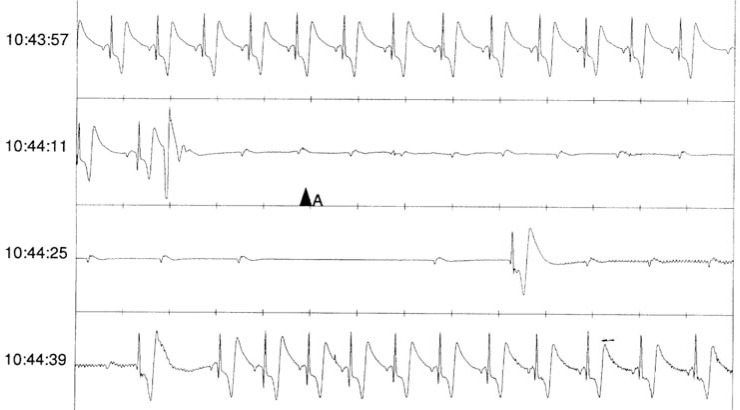
Automatic Event Detection from an ICM. This is a typical tracing of an event captured by an ICM during syncope in a patient. The arrow and letter A denotes automatic activation when the device detects a 3 second pause. Each line constitutes 10 seconds of a single lead rhythm strip. Note the slowing of the sinus rate prior to onset of a prolonged pause, which resulted in syncope. This is consistent with the diagnosis of neurocardiogenic syncope (ISSUE classification 1A).
Manual Event Detection from an ICM. Manual activation during presyncope in a 73-year-old male with two previous episodes of unexplained syncope. Note that the sinus rate and PR interval are unchanged surrounding the period of 2:1 AV conduction. This is classified as a 1C response by the proposed ISSUE classification, suggesting intrinsic AV node disease.
References
-
- Ganzeboom KS, Mairuhu G, Reitsma JB , et al. Lifetime cumulative incidence of syncope in the general population: a study of 549 Dutch subjects aged 35-60 years. J Cardiovasc Electrophysiol. 2006;17(11):1172–6. - PubMed
-
- Brignole M, Menozzi C, Moya A , et al. Mechanism of syncope in patients with bundle branch block and negative electrophysiological test. Circulation. 2001;104(17):2045–50. - PubMed
-
- Farwell D, Sulke N. How do we diagnose syncope. J Cardiovasc Electrophysiol. 2002;13(1 Suppl ):S9–13. - PubMed
-
- Soteriades ES, Evans JC, Larson MG , et al. Incidence and prognosis of syncope. N Engl J Med. 2002;347(12):878–85. - PubMed
Publication types
MeSH terms
LinkOut - more resources
Full Text Sources
Other Literature Sources
Medical