


Geographic variation in CKD prevalence and ESRD incidence in the United States: results from the reasons for geographic and racial differences in stroke (REGARDS) study
- PMID: 23228944
- PMCID: PMC3659181
- DOI: 10.1053/j.ajkd.2012.10.018
Geographic variation in CKD prevalence and ESRD incidence in the United States: results from the reasons for geographic and racial differences in stroke (REGARDS) study
Abstract
Background: It is not known whether geographic differences in the prevalence of chronic kidney disease exist and are associated with end-stage renal disease (ESRD) incidence rates across the United States.
Study design: Cross-sectional and ecologic.
Setting & participants: White (n = 16,410) and black (n = 11,109) participants from across the continental United States in the population-based Reasons for Geographic and Racial Differences in Stroke (REGARDS) Study.
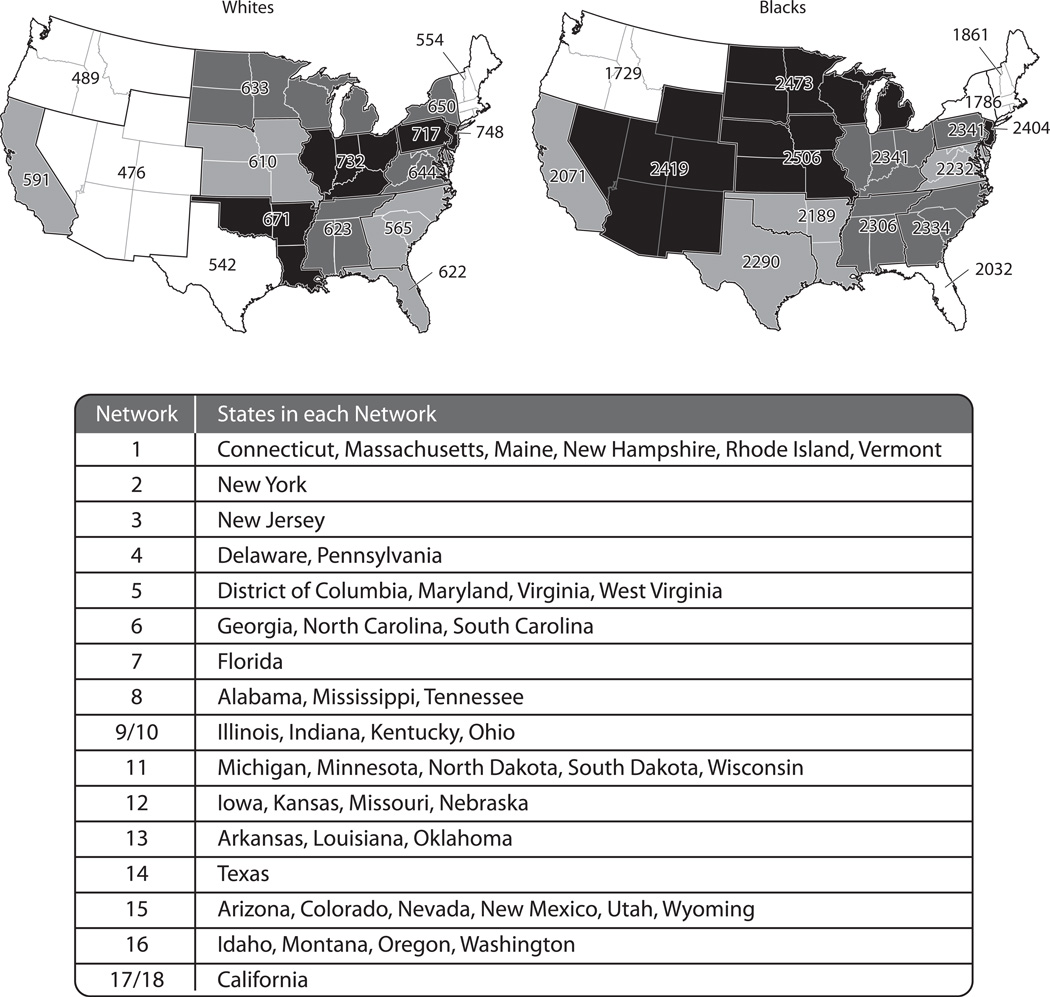
Predictor: Geographic region, defined by the 18 networks of the US ESRD Network Program.
Outcomes & measurements: Albuminuria, defined as albumin-creatinine ratio ≥30 mg/g, and decreased estimated glomerular filtration rate (eGFR), defined as <60 mL/min/1.73 m(2), were measured in the REGARDS Study. ESRD incidence rates were obtained from the US Renal Data System.
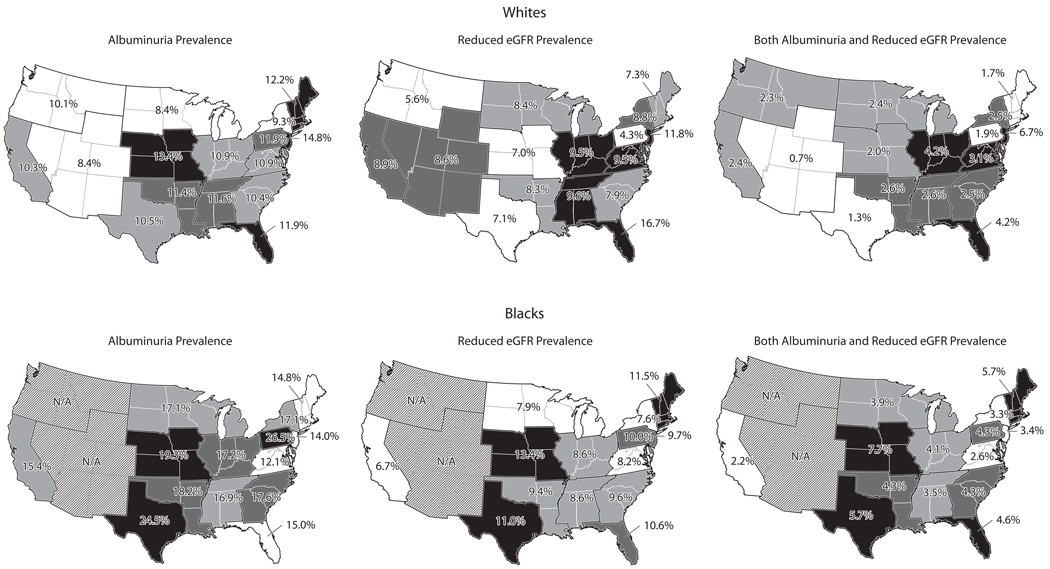
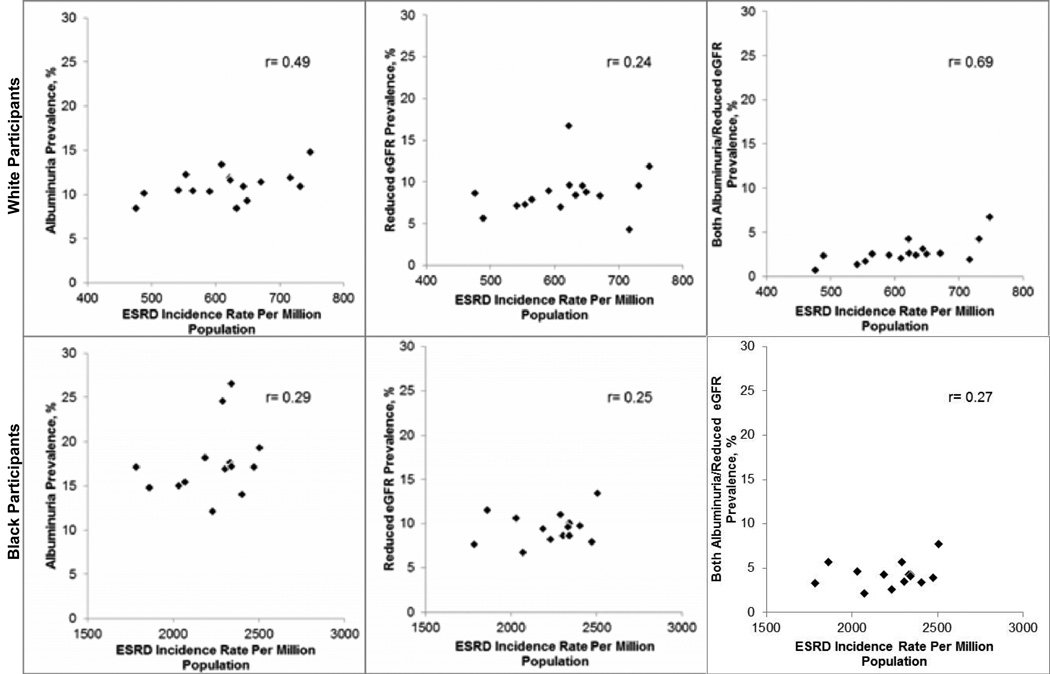
Results: For whites, the network-specific prevalence of albuminuria ranged from 8.4% (95% CI, 3.3%-13.5%) in Network 15 to 14.8% (95% CI, 8.0%-21.6%) in Network 3, and decreased eGFR ranged from 4.3% (95% CI, 2.0%-6.6%) in Network 4 to 16.7% (95% CI, 12.7%-20.7%) in Network 7. For blacks, the prevalence of albuminuria ranged from 12.1% (95% CI, 8.7%-15.5%) in Network 5 to 26.5% (95% CI, 16.7%-36.3%) in Network 4, and decreased eGFR ranged from 6.7% (95% CI, 5.0%-8.4%) in Network 17/18 to 13.4% (95% CI, 7.8%-19.1%) in Network 12. Spearman correlation coefficients for the prevalence of albuminuria and decreased eGFR with network-specific ESRD incidence rates were 0.49 and 0.24, respectively, for whites and 0.29 and 0.25, respectively, for blacks.
Limitations: There were few cases of albuminuria and decreased eGFR in some geographic regions.
Conclusions: In the United States, substantial geographic variations in the prevalence of albuminuria and decreased eGFR exist, but were correlated only modestly with ESRD incidence, suggesting the chronic kidney disease burden may not explain the geographic variation in ESRD incidence.
Copyright © 2013 National Kidney Foundation, Inc. Published by Elsevier Inc. All rights reserved.
Figures
References
-
- Coresh J, Selvin E, Stevens LA, et al. Prevalence of chronic kidney disease in the United States. JAMA : the journal of the American Medical Association. 2007 Nov 7;298(17):2038–2047. - PubMed
-
- USRDS. USRDS 2004 annual data report: atlas of end-stage renal disease in the United States. 2004 - PubMed
-
- Go AS, Chertow GM, Fan D, McCulloch CE, Hsu CY. Chronic kidney disease and the risks of death, cardiovascular events, and hospitalization. The New England journal of medicine. 2004 Sep 23;351(13):1296–1305. - PubMed
-
- Keith DS, Nichols GA, Gullion CM, Brown JB, Smith DH. Longitudinal follow-up and outcomes among a population with chronic kidney disease in a large managed care organization. Archives of internal medicine. 2004 Mar 22;164(6):659–663. - PubMed
-
- [Accessed August 8, 2011];Renal Data Extraction and Referencing System. http://www.usrds.org/odr/xrender_home.asp.
Publication types
MeSH terms
Grants and funding
LinkOut - more resources
Full Text Sources
Other Literature Sources
Medical
Research Materials
Miscellaneous
