. 2013 Jan;10(1):157-65.
doi: 10.4161/rna.22899. Epub 2012 Dec 10.

The CshA DEAD-box RNA helicase is important for quorum sensing control in Staphylococcus aureus

Affiliations

The CshA DEAD-box RNA helicase is important for quorum sensing control in Staphylococcus aureus

Stella Oun et al. RNA Biol. 2013 Jan.

Abstract

DEAD-box RNA helicases are present in almost all living organisms and participate in various processes of RNA metabolism. Bacterial proteins of this large family were shown to be required for translation initiation, ribosome biogenesis and RNA decay. The latter is primordial for rapid adaptation to changing environmental conditions. In particular, the RhlB RNA helicase from E. coli was shown to assist the bacterial degradosome machinery. Recently, the CshA DEAD-box proteins from Bacillus subtilis and Staphylococcus aureus were shown to interact with proteins that are believed to form the degradosome. S. aureus can cause life-threatening disease, with particular concern focusing on biofilm formation on catheters and prosthetic devices, since in this form the bacteria are almost impossible to eradicate both by the immune system and antibiotic treatment. This persistent state relies on the expression of surface encoded proteins that allow attachment to various surfaces, and contrasts with the dispersal mode of growth that relies on the secretion of proteins such as hemolysins and proteases. The switch between these two states is mainly mediated by the Staphylococcal cell density sensing system encoded by agr. We show that inactivation of the cshA DEAD-box gene results in dysregulation of biofilm formation and hemolysis through modulation of agr mRNA stability. Importantly, inactivation of the agrA gene in the cshA mutant background reverses the defect, indicating that cshA is genetically upstream of agr and that a delicate balance of agr mRNA abundance mediated through stability control by CshA is critical for proper expression of virulence factors.

Keywords: RNA helicase; Staphylococcus aureus; degradosome; quorum sensing.


Figures
None
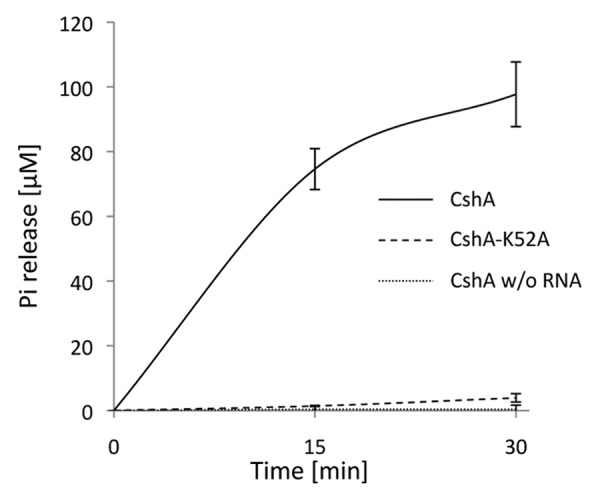
Figure 1. ATPase activity of CshA is RNA dependent. ATPase activity expressed in µM of Pi released, for wild type CshA (solid lines) and the K52A mutant (dashed lines) in the presence of RNA and in the absence of RNA (dotted lines). Error bars show the standard deviation.
None
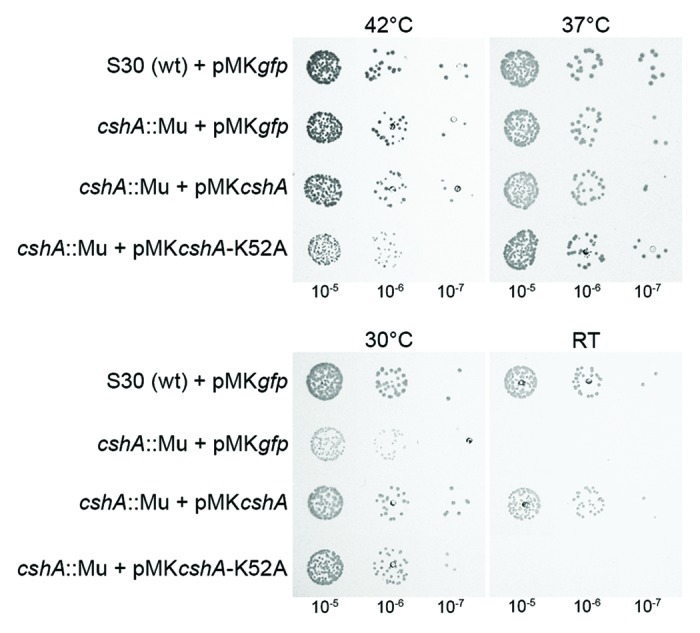
Figure 2. Inactivation of the cshA gene results in a cold-sensitive growth phenotype. The parental wild type strain S30, the cshA::mini-Mu insertion, the mutant complemented with wild type cshA and a Walker A motif mutant (K52A) under the control of a xylose-inducible promoter were spotted in serial dilutions (indicated underneath) on rich medium containing 1% xylose and chloramphenicol (15 μg/ml). All were incubated at 42°C, 37°C, 30°C, and room temperature for 24 h, 24 h, 48 h, and 4 d, respectively. Plasmids expressing GFP instead of CshA were used as controls
None
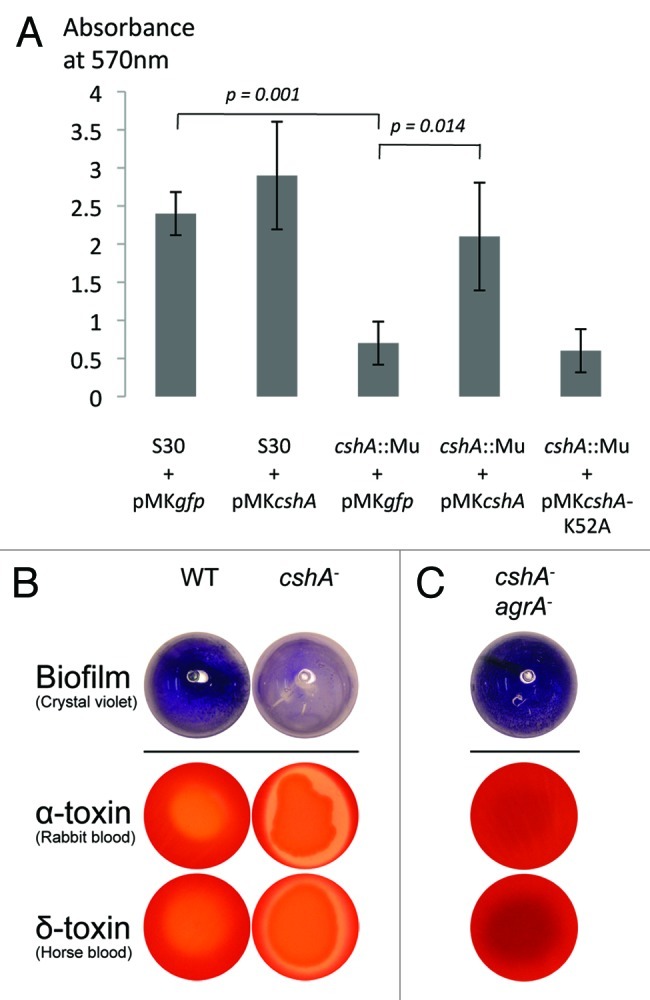
Figure 3. CshA is required for biofilm formation and reduces hemolysis. (A) Biofilm formation was analyzed by the crystal violet (CV) assay in polystyrene tubes after growth for 6 h in TSB medium with equal amounts of inoculated cells. The amount of biofilm was measured after solubilization of the CV in ethanol and measuring the absorbance at 570 nm. The error bars (standard deviation) are from 3 independent experiments. The differences between S30 + pMKgfp vs cshA::Mu + pMKgfp and cshA::Mu pMKgfp vs cshA::Mu pMKcshA were significant (p = 0.001, p = 0.014, respectively). (B) S30 wild type strain and its cshA mutant derivative were spotted onto rabbit and horse blood agar plates. Shown is one representative result from 5 independent experiments. (C) Inactivation of agrA in the cshA mutant restores biofilm formation and reduces hemolysis.
None
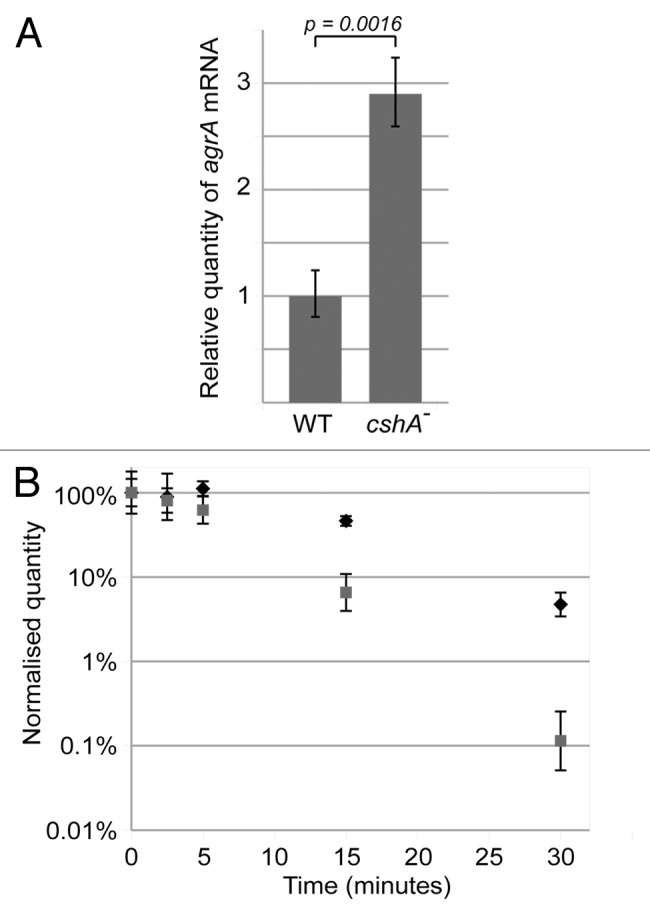
Figure 4. The agrA mRNA level is increased and stabilized in the cshA mutant strain. (A) RNA was isolated from exponentially growing cultures (approx. OD600 = 0.4) of the S30 wildtype and the cshA mutant. qRT-PCR was performed to determine the level of agr mRNA, using the HU mRNA as an internal reference. An unpaired T-test was performed to show that the difference in agr levels was significant (p = 0.0016). Error bars show the standard deviation. (B) Cultures of S30 (gray squares) and the cshA mutant (black diamonds) were rifampicin treated to block de novo RNA synthesis. Samples were taken for RNA isolation at 0, 2.5, 5, 15 and 30 min after treatment, and qRT-PCR was performed using primers and probe specific for agrA, and using HU mRNA as an internal reference. The quantity of agr, relative to HU, was normalized to 100% at time zero, and plotted in the graph. Error bars represent the 99% confidence level. The figure shows a single experiment out of three biological replicates.
None
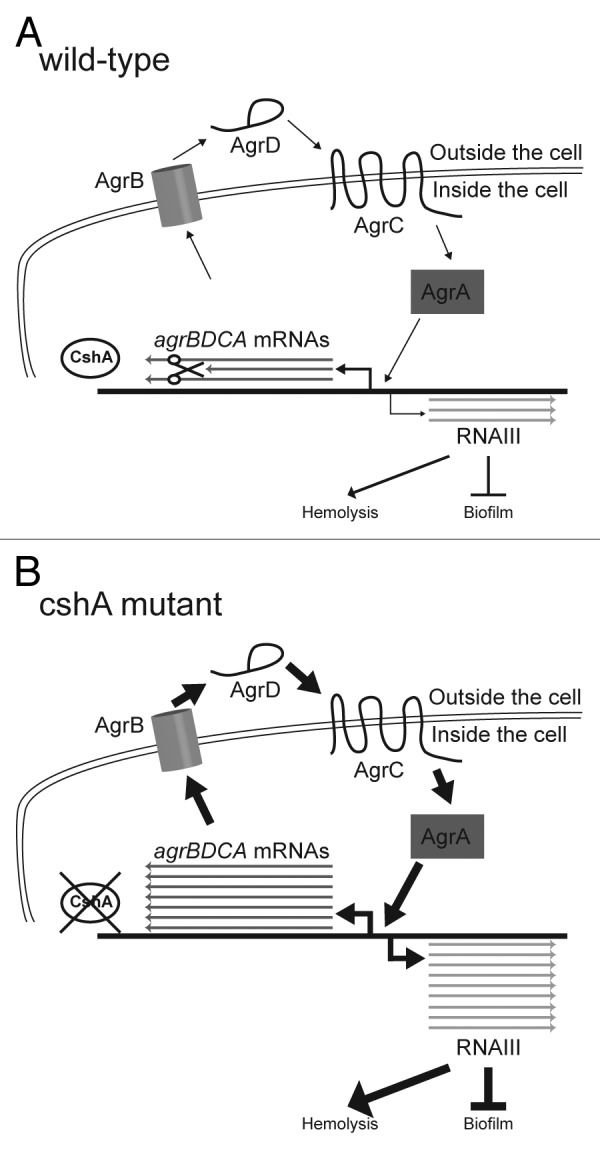
Figure 5. Model of CshA in the degradation of the agr mRNA. (A) In the wild type, agrBDCA mRNAs are produced. However, in the presence of CshA we hypothesize that the degradosome is able to degrade a significant portion of them. Thus the quorum sensing system is working correctly and only small amounts of RNAIII is produced leading to low stimulation of hemolysis and normal biofilm formation. (B) In absence of CshA, we propose that the degradosome is unable to degrade the agrBDCA mRNAs correctly, leading to a much higher level of Agr proteins, resulting in elevated RNAIII levels. The RNAIII, in turn, strongly stimulates production of hemolysins and extracellular proteases, and inhibits the production of biofilm components.

References

    1. Linder P, Jankowsky E. From unwinding to clamping - the DEAD box RNA helicase family. Nat Rev Mol Cell Biol. 2011;12:505–16. doi: 10.1038/nrm3154. - DOI - PubMed
    1. Liu F, Putnam A, Jankowsky E. ATP hydrolysis is required for DEAD-box protein recycling but not for duplex unwinding. Proc Natl Acad Sci U S A. 2008;105:20209–14. doi: 10.1073/pnas.0811115106. - DOI - PMC - PubMed
    1. Jankowsky E, Bowers H. Remodeling of ribonucleoprotein complexes with DExH/D RNA helicases. Nucleic Acids Res. 2006;34:4181–8. doi: 10.1093/nar/gkl410. - DOI - PMC - PubMed
    1. Nishi K, Morel-Deville F, Hershey JWB, Leighton T, Schnier J. An eIF-4A-like protein is a suppressor of an Escherichia coli mutant defective in 50S ribosomal subunit assembly. Nature. 1988;336:496–8. doi: 10.1038/336496a0. - DOI - PubMed
    1. Toone WM, Rudd KE, Friesen JD. deaD, a new Escherichia coli gene encoding a presumed ATP-dependent RNA helicase, can suppress a mutation in rpsB, the gene encoding ribosomal protein S2. J Bacteriol. 1991;173:3291–302. - PMC - PubMed

Publication types