. 2013 May;97(10):4467-83.
doi: 10.1007/s00253-012-4530-1. Epub 2012 Nov 16.

Molecular diagnosis to discriminate pathogen and apathogen species of the hybrid Verticillium longisporum on the oilseed crop Brassica napus

Affiliations

Molecular diagnosis to discriminate pathogen and apathogen species of the hybrid Verticillium longisporum on the oilseed crop Brassica napus

Van Tuan Tran et al. Appl Microbiol Biotechnol. 2013 May.

Abstract

The cruciferous fungal pathogen Verticillium longisporum represents an allodiploid hybrid with long spores and almost double the amount of nuclear DNA compared to other Verticillium species. V. longisporum evolved at least three times by hybridization. In Europe, virulent A1xD1 and avirulent A1xD3 hybrids were isolated from the oilseed crop Brassica napus. Parental A1 or D1 species are yet unknown whereas the D3 lineage represents Verticillium dahliae. Eleven V. longisporum isolates from Europe or California corresponding to hybrids A1xD1 or A1xD3 were compared. A single characteristic type of nuclear ribosomal DNA could be assigned to each hybrid lineage. The two avirulent A1xD3 isolates carried exclusively D3 ribosomal DNA (rDNA) which corresponds to V. dahliae. The rDNA of all nine A1xD1 isolates is identical but distinct from D3 and presumably originates from A1. Both hybrid lineages carry two distinct isogene pairs of four conserved regulatory genes corresponding to either A1 or D1/D3. D1 and D3 paralogues differ in several single nucleotide polymorphisms. Southern hybridization patterns confirmed differences between the A1 and D1/D3 isogenes and resulted in similar patterns for D1 and D3. Distinct signatures of the Verticillium transcription activator (VTA)2 regulatory isogene pair allow identification of V. longisporum hybrids by a single polymerase chain reaction and the separation from haploid species as V. dahliae or Verticillium albo-atrum. The combination between VTA2 signature and rDNA type identification represents an attractive diagnostic tool to discriminate allodiploid from haploid Verticillia and to distinguish between A1xD1 and A1xD3 hybrids which differ in their virulence towards B. napus.


Figures

Fig. 1
Fig. 1
Analysis of ITS region of ribosomal DNA in Verticillium plant pathogens. a V. longisporum isolates carry only one type of ITS. The V. dahliae D3 type corresponds to nine V. dahliae isolates. The A1 type corresponding to the unknown species A1 is closer related to V. albo-atrum than to V. dahliae. The two pyrimidine exchanges between ITS1 of A1 and V. albo-atrum at positions 90 and 125 are indicated in bold. The ITS region comprises ITS1 (129 nucleotides), 5.8S rRNA and ITS2 (165 nucleotides). A1xD3 strains (Vl19 and Vl32) isolated from oilseed rape in Northern Germany are avirulent, whereas the A1xD1 strains from oilseed rape in Europe or from cauliflower in California are virulent. b ITS-based phylogenetic analysis. Avirulent A1xD3 isolates carry V. dahliae ITS, whereas virulent A1xD1 isolates carry A1 ITS closer related to V. albo-atrum strains. The tree includes two additionally analyzed Verticillia for comparison: V. tricorpus is distant from V. longisporum, V. dahliae, and V. albo-atrum; V. nigrescens Vni1 (now Gibellulopsis nigrescens) represents the root of the phylogenetic tree
Fig. 2
Fig. 2
Analysis of the rDNA IGS located between 28S rRNA and 18S rRNA gene of Verticillium isolates. a IGS sequences of indicated strains which vary in their sequences between 1.7 and 1.9 kb (Fig. S1) were compared by a phylogenetic tree. The IGS sequence of V. tricorpus distant from all three species is used as root. A1 IGS rDNA (from A1xD1) group is closer to V. albo-atrum rDNA, whereas the D3 IGS (from A1xD3) is the closest to V. dahliae Vd39 isolated from sunflower. b A1 18S rRNA length of virulent A1xD1 isolates was compared to the 18S rRNA of the other strains. A1 18S rRNA carries an additional intron of 839 nucleotides which is as well absent in 18S rRNA of D3 of avirulent A1xD3 isolates as in 18S rRNA of V. dahliae or V. albo-atrum isolates
Fig. 3
Fig. 3
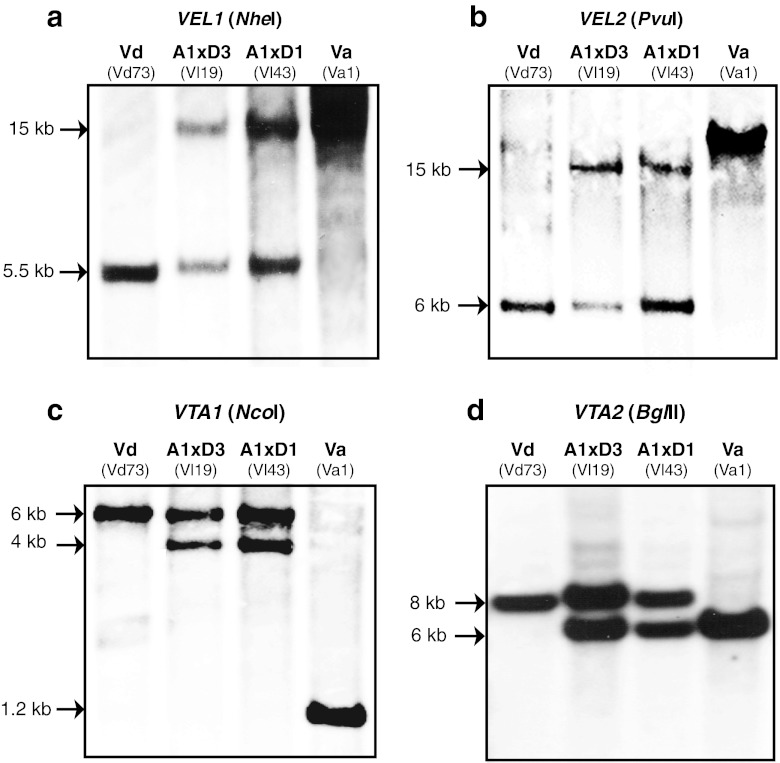
Comparative Southern hybridization for four single genes of V. dahliae (Vd) and V. albo-atrum (Va) in comparison to two isogenes of two V. longisporum (Vl) strains with different rDNA. a Genomic DNA of all representative strains was digested with NheI and probed with labeled VEL1 DNA. The same genomic DNAs were also treated with PvuI and hybridized to a VEL2 probe (b), digested with NcoI with VTA1 probe (c), and digested with BglII and probed with labeled VTA2 (d)
Fig. 4
Fig. 4
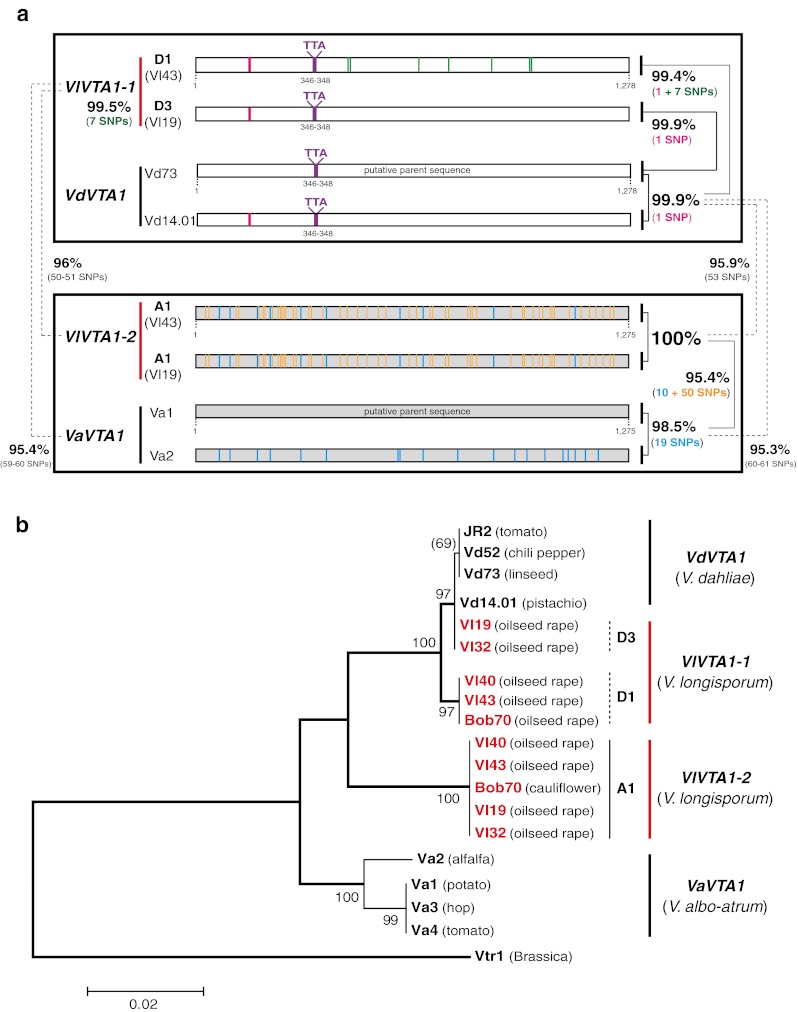
Two VTA1 isogenes of V. longisporum (VTA1-1, VTA1-2) in comparison to the corresponding single genes of V. dahliae and V. albo-atrum. a Comparative scheme of VTA1 from all three Verticillium species: Both the virulent A1xD1 isolates (Vl40, Vl43, Bob70) and the avirulent A1xD3 (Vl19, Vl32) carry two isogenes for VTA1 gene (VlVTA1-1, VlVTA1-2), whereas only one sequence of this gene is present in V. dahliae (VdVTA1) and V. albo-atrum (VaVTA1). The sequences for VlVTA1-1 of A1xD3 and A1xD1 are almost identical to V. dahliae VdVTA1 with a minor difference in one or eight SNPs, respectively. Both VlVTA1-1 and VdVTA1 possess the same signature consisting of a three-nucleotide insertion (TTA) in the coding region. In contrast, VlVTA1-2 is identical in both A1xD1 and A1xD3 and lacks the insertion of three nucleotides like V. albo-atrum VaVTA1. VlVTA1-2 shows 95–96 % identitiy to VdVTA2 and VaVTA2. Colored lines within the genes correspond to corresponding SNPs. Additional SNPs present in genes of the lower in comparison to the upper box are summarized next to the boxes and visualized by grey color. The VdVTA1 (from Vd73 isolate) and VaVTA1 (from Va1 isolate) are used as putative parent sequences for SNPs calculation. b Phylogenetic analysis based on the conserved VTA1 gene shows close connection of V. longisporum hybrids to V. dahliae and V. albo-atrum
Fig. 5
Fig. 5
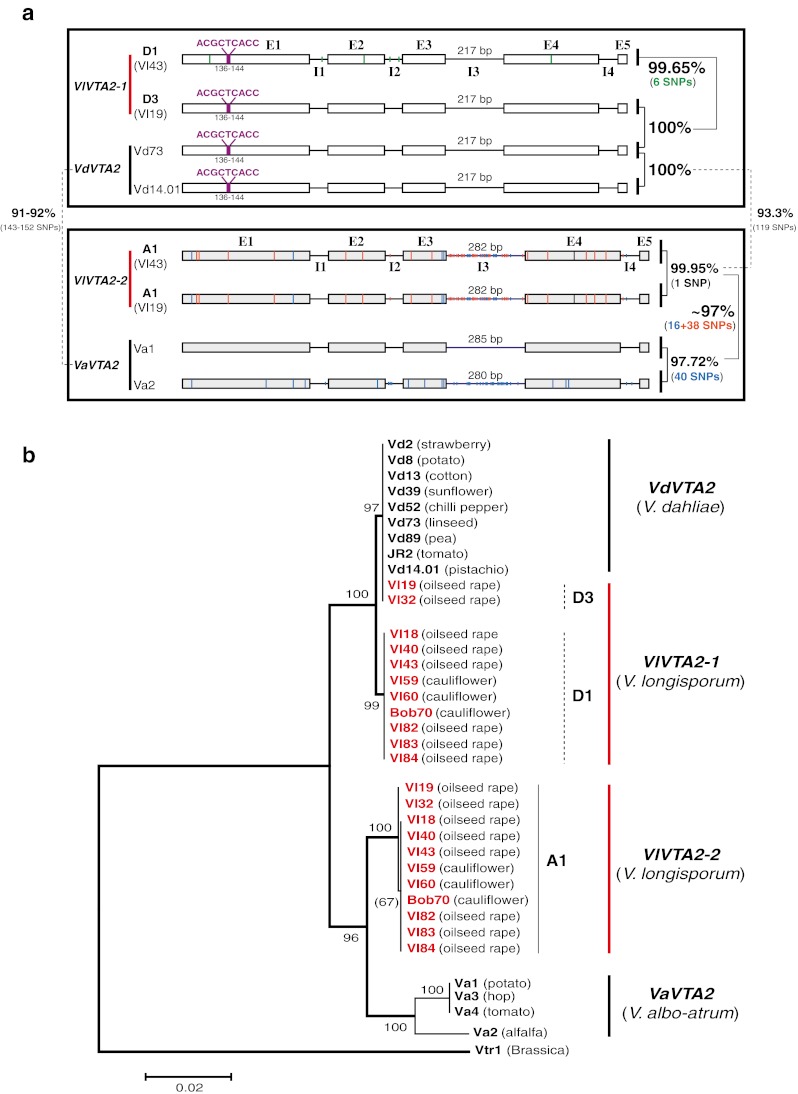
The evolutionary origin of all 11 V. longisporum strains based on the nuclear gene VTA2 with the length of 1,701–1,759 nucleotides. a Comparative scheme of VTA2 from all three Verticillium species: VlVTA2-1 and VlVTA2-2 isogenes of both V. longisporum lineages A1xD1 and A1xD3 are derivatives from V. dahliae and V. albo-atrum, respectively. Characteristic signatures include a nine-nucleotide insertion (ACGCTCACC) in the first exon (E1) and the length of the third intron (I3). VlVTA2-1 and the V. dahliae VdVTA2 carries the nine-nucleotide insertion in the first exon and a shortened third intron (217 bp), whereas VlVTA2-2 and V. albo-atrum VaVTA2 lacks this insertion in the first exon and carries an extended third intron (280–285 bp). VlVTA2-1 of the avirulent A1xD3 isolates is identical to V. dahliae VdVTA2 and differs from VlVTA2-1 of the virulent A1xD1 isolates by 6 single nucleotide polymorphisms (SNPs). VlVTA2-2 is identical in all A1xD1 isolates but differs from VlVTA2-2 of A1xD3 by only a single nucleotide. VlVTA2-2 displays 97 % identity to V. albo-atrum VaVTA2 and only 93 % to V. dahliae VdVTA2. SNPs are indicated by colors. The VdVTA2 (from Vd73 isolate) and VaVTA2 (from Va1 isolate) are used as putative parent sequences for SNPs calculation. b Phylogenetic analysis for all 11 V. longisporum isolates in comparison to V. dahliae and V. albo-atrum isolates. The VTA2 sequence of V. tricorpus is used as root of the phylogenetic tree
Fig. 6
Fig. 6
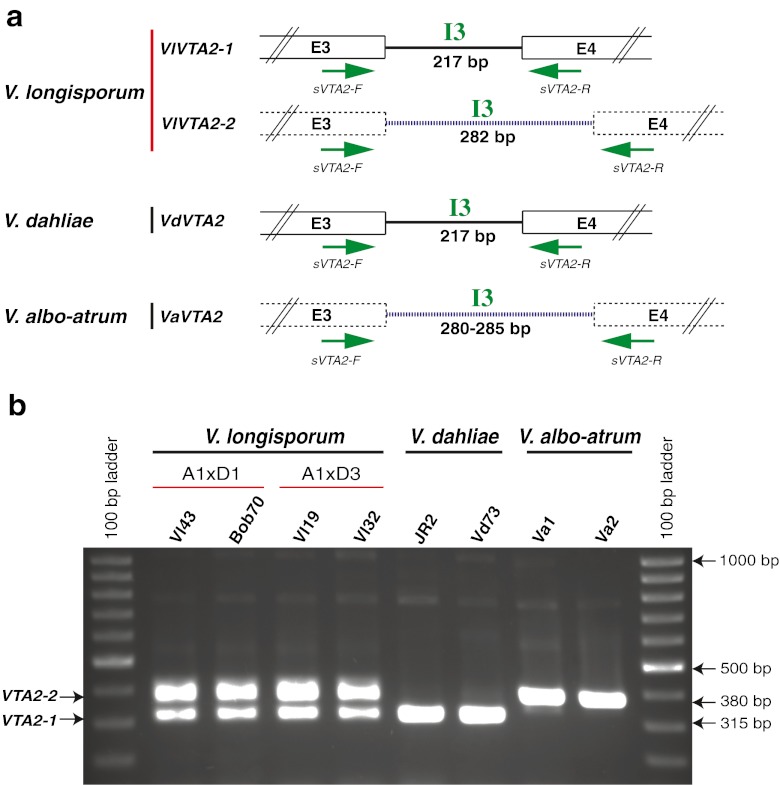
VTA2 is a barcode gene for specific recognition of V. longisporum hybrids. a Scheme for the structure of the third intronic region (I3) of VTA2 in three species. The specific primer pair (sVTA2-F/sVTA2-R) amplifying this intron is indicated by arrows. b PCR amplification with this primer pair results in two bands of 315 and 380 bp for both lineages A1xD1 and A1xD3 of the oilseed rape pathogen V. longisporum, whereas only a unique band of 315 or 380 bp is present in V. dahliae and V. albo-atrum, respectively
Fig. 7
Fig. 7
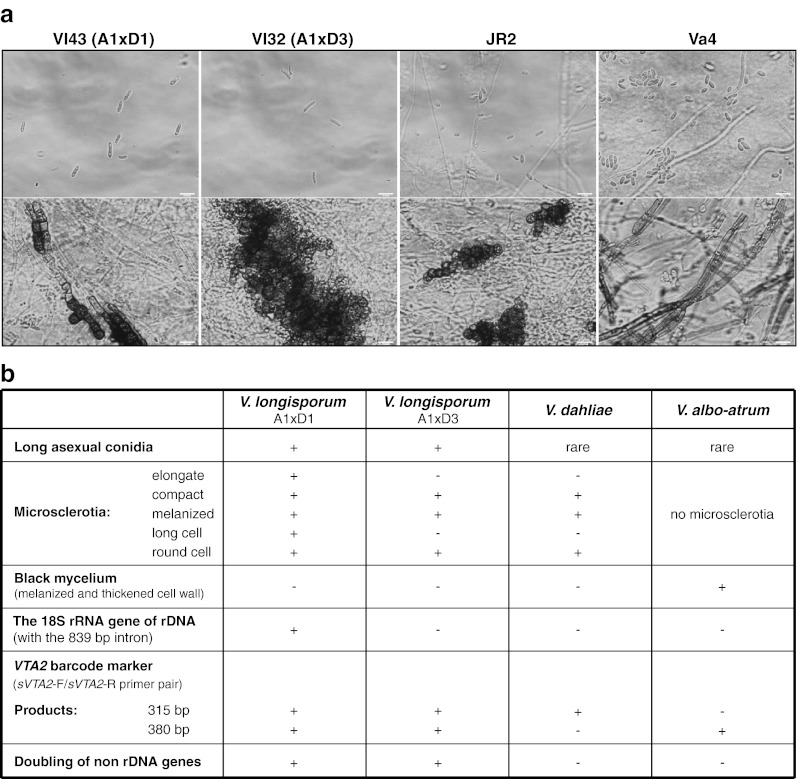
Criteria for discrimination of V. longisporum hybrids from each other and from V. dahliae and V. albo-atrum. a Morphological analysis for some representatives of V. longisporum, V. dahliae and V. albo-atrum. On the SXM medium mimicking xylem sap (Neumann and Dobinson 2003), two V. longisporum representative isolates produce long spores including the virulent isolate Vl43 (A1xD1) forms a mixture of elongate and compact microsclerotia whereas the avirulent one Vl32 (A1xD3) forms only compact microsclerotia comprising a group of many melanized round cells. V. dahliae produces short spores and compact microsclerotia with few melanized round cells, whereas V. albo-atrum also produces short spores but black hyphae as the resting structure. The same scale bars were indicated. b The summary of typical features as criteria for specific recognition of V. longisporum hybrids (A1xD1, A1xD3), V. dahliae and V. albo-atrum

References

    1. Agrios GN. Plant pathology. Burlington, USA: Elsevier; 2005.
    1. Barbara DJ, Clewes E. Plant pathogenic Verticillium species: how many of them are there? Mol Plant Pathol. 2003;4:297–305. doi: 10.1046/j.1364-3703.2003.00172.x. - DOI - PubMed
    1. Bayram O, Braus GH. Coordination of secondary metabolism and development in fungi: the velvet family of regulatory proteins. FEMS Microbiol Rev. 2012;36:1–24. doi: 10.1111/j.1574-6976.2011.00285.x. - DOI - PubMed
    1. Bayram O, Krappmann S, Ni M, Bok JW, Helmstaedt K, Valerius O, Braus-Stromeyer S, Kwon NJ, Keller NP, Yu JH, Braus GH (2008) VelB/VeA/LaeA complex coordinates light signal with fungal development and secondary metabolism. Science 320:1504–1506 - PubMed
    1. Beser J, Hagblom P, Fernandez V. Frequent in vitro recombination in internal transcribed spacers 1 and 2 during genotyping of Pneumocystis jirovecii. J Clin Microbiol. 2007;45:881–886. doi: 10.1128/JCM.02245-06. - DOI - PMC - PubMed

Publication types

LinkOut - more resources