. 2013 Feb;81(2):531-41.
doi: 10.1128/IAI.00982-12. Epub 2012 Dec 10.

Novel cholix toxin variants, ADP-ribosylating toxins in Vibrio cholerae non-O1/non-O139 strains, and their pathogenicity

Affiliations

Novel cholix toxin variants, ADP-ribosylating toxins in Vibrio cholerae non-O1/non-O139 strains, and their pathogenicity

Sharda Prasad Awasthi et al. Infect Immun. 2013 Feb.

Abstract

Cholix toxin (ChxA) is a recently discovered exotoxin in Vibrio cholerae which has been characterized as a third member of the eukaryotic elongation factor 2-specific ADP-ribosyltransferase toxins, in addition to exotoxin A of Pseudomonas aeruginosa and diphtheria toxin of Corynebacterium diphtheriae. These toxins consist of three characteristic domains for receptor binding, translocation, and catalysis. However, there is little information about the prevalence of chxA and its genetic variations and pathogenic mechanisms. In this study, we screened the chxA gene in a large number (n = 765) of V. cholerae strains and observed its presence exclusively in non-O1/non-O139 strains (27.0%; 53 of 196) and not in O1 (n = 485) or O139 (n = 84). Sequencing of these 53 chxA genes generated 29 subtypes which were grouped into three clusters designated chxA I, chxA II, and chxA III. chxA I belongs to the prototype, while chxA II and chxA III are newly discovered variants. ChxA II and ChxA III had unique receptor binding and catalytic domains, respectively, in comparison to ChxA I. Recombinant ChxA I (rChxA I) and rChxA II but not rChxA III showed variable cytotoxic effects on different eukaryotic cells. Although rChxA II was more lethal to mice than rChxA I when injected intravenously, no enterotoxicity of any rChxA was observed in a rabbit ileal loop test. Hepatocytes showed coagulation necrosis in rChxA I- or rChxA II-treated mice, seemingly the major target for ChxA. The present study illustrates the potential of ChxA as an important virulence factor in non-O1/non-O139 V. cholerae, which may be associated with extraintestinal infections rather than enterotoxicity.


Figures
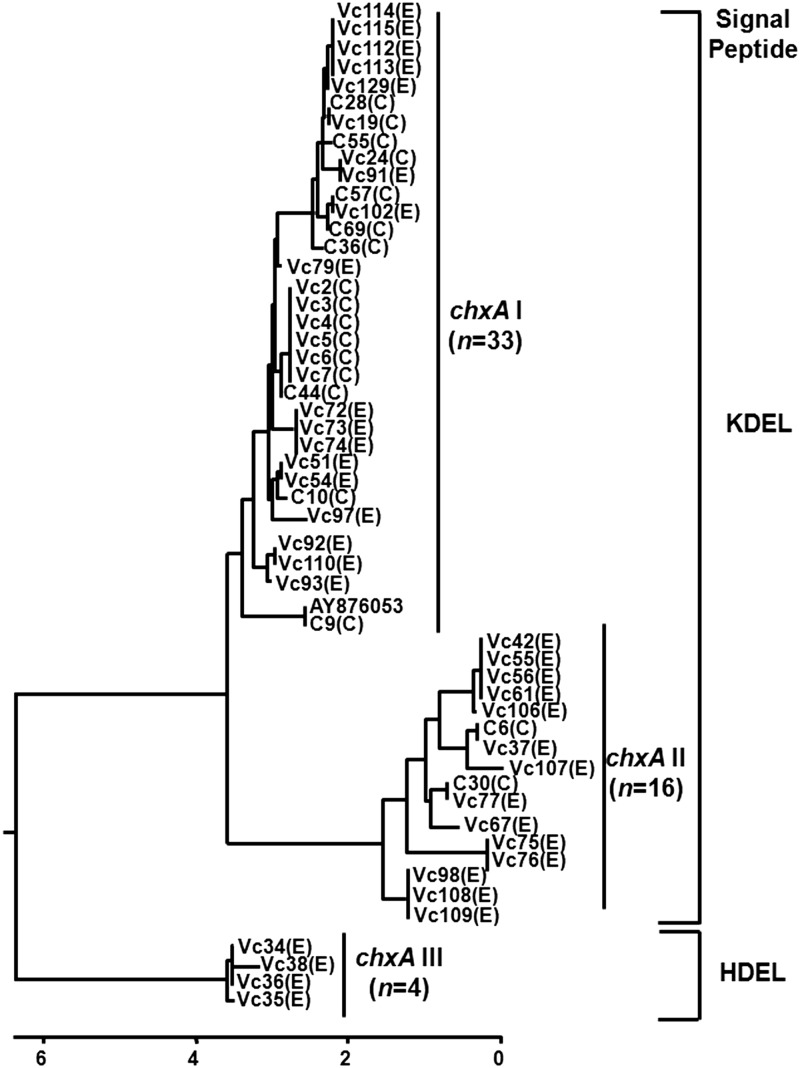
Fig 1
Fig 1
Dendrogram depicting the diversity of the chxA gene from V. cholerae non-O1/non-O139 strains. Overall, 29 different chxA subtypes were observed among 53 sequences. These strains were grouped into three sequence clusters: chxA I (n = 33), chxA II (n = 16), and chxA III (n = 4). The chxA I sequences are close to the published prototype sequence (accession no. AY876053). Letters in parentheses show the origin of the isolate: C and E, clinical and environmental, respectively. At protein level, the signal peptide in ChxA I and II is KDEL whereas ChxA III has HDEL.
Fig 2
Fig 2
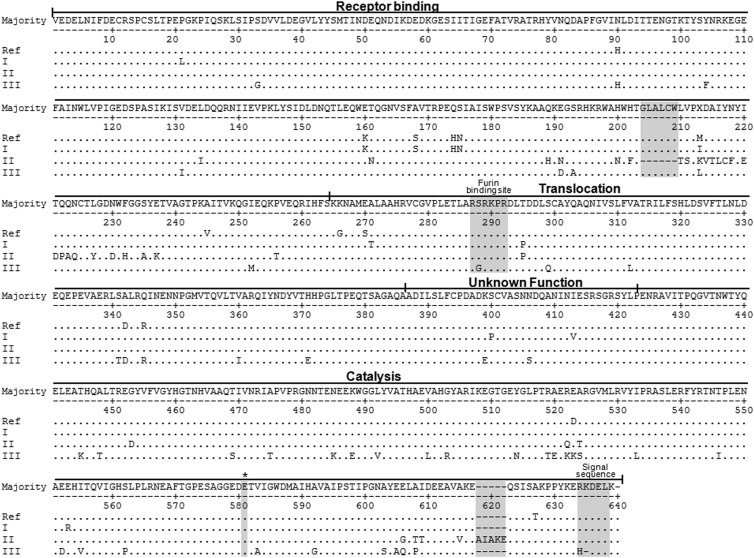
Alignment of the amino acid sequences representing the three clusters of ChxA (ChxA I, II and III) from V. cholerae strains. Only one ChxA sequence from each cluster, along with the published prototype sequence (AY876053), is shown here for simplicity. The ChxA I sequences are identical or similar to prototype ChxA. The ChxA II sequences clearly define the amino acid changes in the receptor binding domain (RBD) and ChxA III in the catalytic domain (CD). All the sequences of ChxA II possess an identical deletion of 6 amino acids (GLALCW) in the RBD, and 6 sequences have a 5-amino-acid (AIAKE) insertion in CD. ChxA I and II possess KDEL whereas ChxA III possesses an HDEL signal peptide at the C-terminal end. Serine-to-glycine substitution can be observed at the P5 position of the furin binding site in ChxA III. *, conserved amino acid residue critical for catalytic activity. Matching amino acids are indicated by dots and deleted ones by dashes.
Fig 3
Fig 3
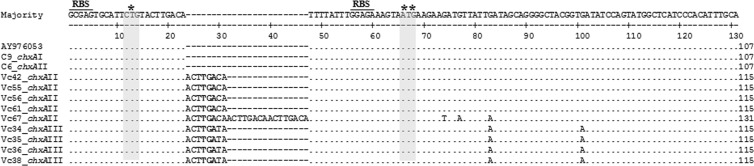
chxA leader gene sequence alignment for the strains with nucleotide repeat insertion. One chxA leader gene sequence from chxA I and chxA II, along with the published prototype sequence (AY876053), is shown here for comparison. All the chxA I leader gene sequences are conserved. The chxA II leader sequences from 5 strains have insertions of single or 3 copies of octamer repeats, and all 4 chxA III also have insertions of single copies of nearly identical octamers. The bold characters show the termination codon; *, initiation codon in the prototype sequence; **, proposed initiation codon with probable ribosome binding site (RBS). Matching amino acids are indicated by dots and deleted ones by dashes.
Fig 4
Fig 4
Number of amino acid changes at each domain of the three ChxA toxinotypes in comparison to the prototype sequence (AY876053). The length of ChxA peptide is 634 amino acids for ChxA I and 633 for ChxA III. The peptide length of ChxA II varies from 628 to 633 amino acids. The receptor binding domain (RBD) of ChxA II with 34 to 38 amino acid changes and the catalytic domain (CD) of ChxA III with 29 to 32 amino acid changes are the most diverse domains. TD, translocation domain; UFD, unknown function domain. †, common deletion of 6 amino acids in all strains; ‡, insertion of 5 amino acids in 6 strains; ¶, deletion of 1 amino acid in all strains.
Fig 5
Fig 5
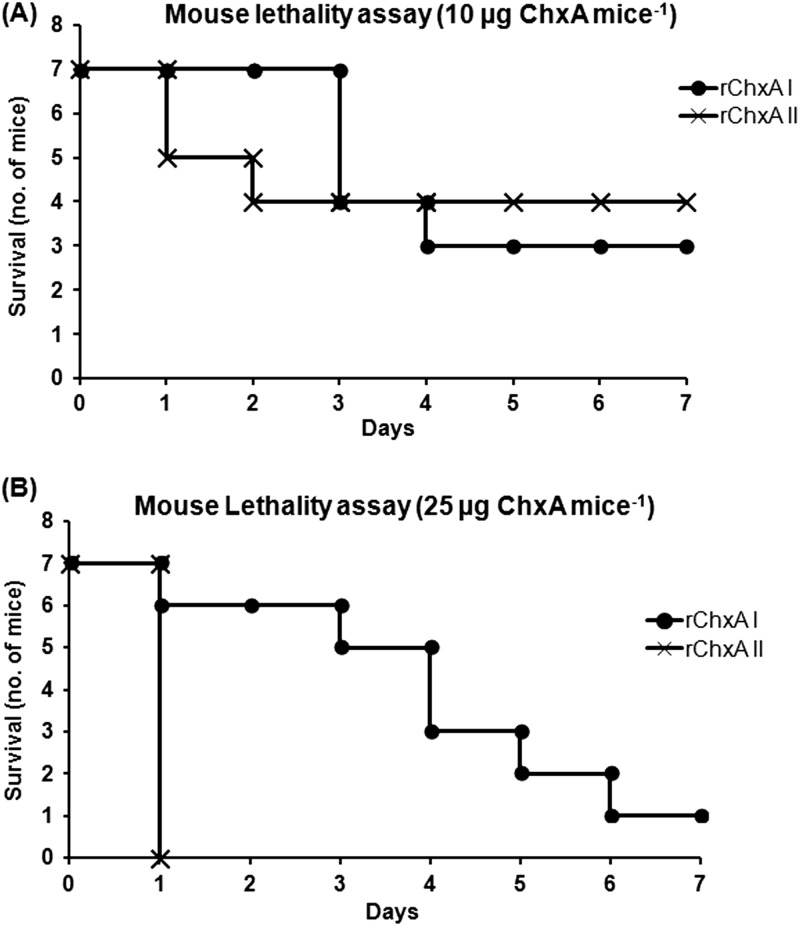
Mouse lethality assay with rChxA I and rChxA II. Specific-pathogen-free male ICR mice (n = 7, each group) with an average body weight of 20 g were intravenously injected with rChxA I and rChxA II. The survival was observed for 1 week. Survival curves with 10 μg mouse−1 (500 μg kg−1) rChxA (A) and 25 μg mouse−1 (1.25 mg kg−1) rChxA (B) are shown here.
Fig 6
Fig 6
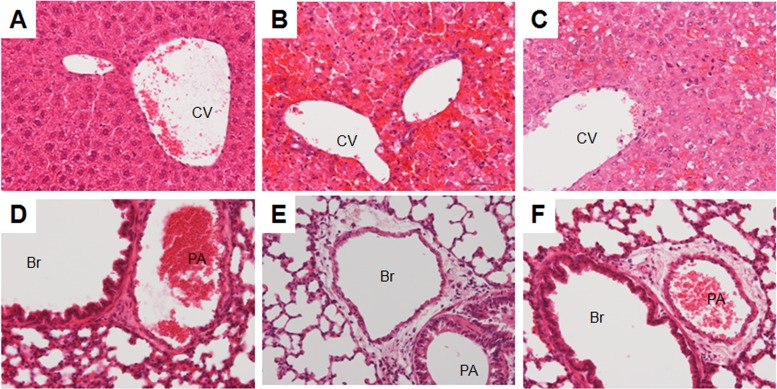
Hematoxylin-and-eosin-stained sections of mouse liver (A, B, and C) and lung (D, E, and F). (A and D) Control group. (B and E) rChxA I-treated group. (C and F) rChxA II-treated group. Severe coagulation necrosis of the hepatocytes and interstitial edema with mild inflammation around the arteriole in lungs can be observed in both the groups treated with either rChxA I or rChxA II. CV, central vein; Br, bronchiole; PA, pulmonary arteriole. Magnification, ×200.

References

    1. WHO July 2012. Cholera. Media centre fact sheet no. 107. WHO, Geneva, Switzerland: http://www.who.int/mediacentre/factsheets/fs107/en/.
    1. Sharma C, Thungapathra M, Ghosh A, Mukhopadhyay AK, Basu A, Mitra R, Basu I, Bhattacharya SK, Shimada T, Ramamurthy T, Takeda T, Yamasaki S, Takeda Y, Nair GB. 1998. Molecular analysis of Vibrio cholerae non-O1, non-O139 associated with an unusual upsurge in the incidence of cholera-like disease in Calcutta, India. J. Clin. Microbiol. 36:756–763 - PMC - PubMed
    1. Faruque SM, Chowdhury N, Kamruzzaman M, Dziejman M, Rahman MH, Sack DA, Nair GB, Mekalanos JJ. 2004. Genetic diversity and virulence potential of environmental Vibrio cholerae population in a cholera-endemic area. Proc. Natl. Acad. Sci. U. S. A. 101:2123–2128 - PMC - PubMed
    1. Chatterjee S, Ghosh K, Raychoudhuri A, Chowdhury G, Bhattacharya MK, Mukhopadhyay AK, Ramamurthy T, Bhattacharya SK, Klose KE, Nandy RK. 2009. Incidence, virulence factors, and clonality among clinical strains of non-O1, non-O139 Vibrio cholerae isolates from hospitalized diarrheal patients in Kolkata, India. J. Clin. Microbiol. 47:1087–1095 - PMC - PubMed
    1. Dziejman M, Serruto D, Tam VC, Sturtevant D, Diraphat P, Faruque SM, Rahman MH, Heidelberg JF, Decker J, Li L, Montgomery KT, Grills G, Kucherlapati R, Mekalanos JJ. 2005. Genomic characterization of non-O1, non-O139 Vibrio cholerae reveals genes for a type III secretion system. Proc. Natl. Acad. Sci. U. S. A. 102:3465–3470 - PMC - PubMed

Publication types

MeSH terms

LinkOut - more resources