A comparison of therapies for the treatment of drug cues: counterconditioning vs. extinction in male rats
- PMID: 23230857
- PMCID: PMC3716831
- DOI: 10.1037/a0030593
A comparison of therapies for the treatment of drug cues: counterconditioning vs. extinction in male rats
Abstract
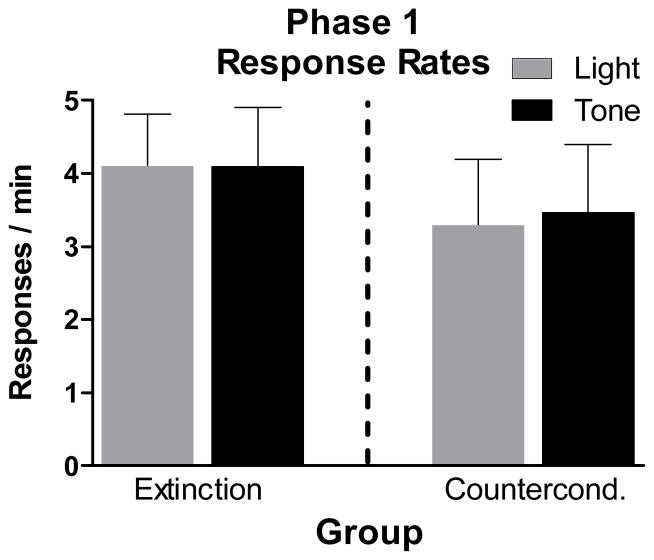
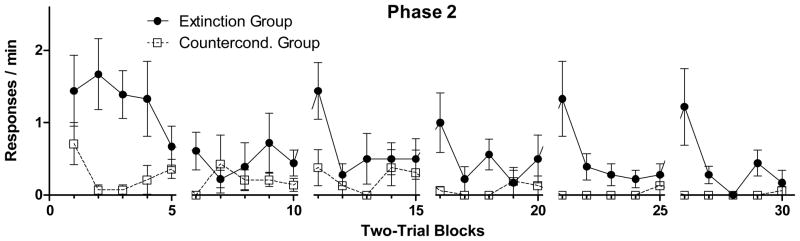
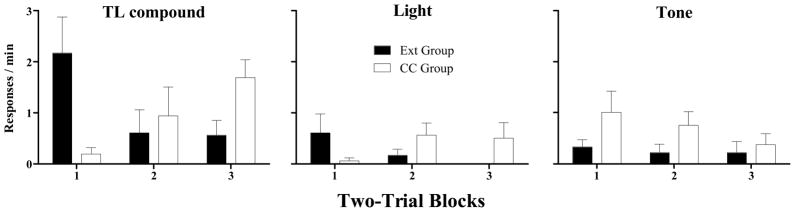
Although extinction has been used as a treatment to reduce the power of drug cues, a better method is needed. Research with traditional reinforcers has shown that counterconditioning--pairing an appetitive cue with an aversive stimulus--can suppress cue-controlled behavior. The present experiment compared the counterconditioning and extinction of cocaine cues. Male rats were first trained to self-administer cocaine during a light cue. In the second phase, the light was paired with footshock in the counterconditioning group. The extinction group was treated similarly, except light presentations did not end in footshock. Counterconditioning suppressed cocaine seeking to a greater extent than extinction while the counterconditioning treatment was actively administered. On a subsequent stimulus compounding test, where footshock was discontinued and the light was presented simultaneously with an untreated cocaine cue (a tone), suppressive effects of counterconditioning were evident during the early portion of the test but not during later trials. Overall, results of the present experiment suggest that counterconditioning produces only temporarily suppressive effects on cue-controlled cocaine seeking. Methods for directly weakening the cue-drug association (e.g., "deepened extinction") may prove to be more useful drug cue treatments.
Figures
Similar articles
-
Outcome specificity in deepened extinction may limit treatment feasibility: co-presentation of a food cue interferes with extinction of cue-elicited cocaine seeking.Drug Alcohol Depend. 2013 Dec 15;133(3):832-7. doi: 10.1016/j.drugalcdep.2013.08.029. Epub 2013 Sep 11. Drug Alcohol Depend. 2013. PMID: 24071568 Free PMC article.
-
Deepened extinction of cocaine cues.Drug Alcohol Depend. 2012 Aug 1;124(3):283-7. doi: 10.1016/j.drugalcdep.2012.01.024. Epub 2012 Feb 21. Drug Alcohol Depend. 2012. PMID: 22356891 Free PMC article.
-
Taming temptations: Comparing the effectiveness of counterconditioning and extinction in reducing food cue reactivity.Appetite. 2025 Apr 1;208:107932. doi: 10.1016/j.appet.2025.107932. Epub 2025 Feb 26. Appetite. 2025. PMID: 40020972
-
Extinction of conditioned cues attenuates incubation of cocaine craving in adolescent and adult rats.Neurobiol Learn Mem. 2017 Sep;143:88-93. doi: 10.1016/j.nlm.2016.09.002. Epub 2016 Sep 8. Neurobiol Learn Mem. 2017. PMID: 27614140
-
Behavioral and neural processes in counterconditioning: Past and future directions.Behav Res Ther. 2020 Feb;125:103532. doi: 10.1016/j.brat.2019.103532. Epub 2019 Dec 12. Behav Res Ther. 2020. PMID: 31881357 Free PMC article. Review.
Cited by
-
Targeting the Reconsolidation of Licit Drug Memories to Prevent Relapse: Focus on Alcohol and Nicotine.Int J Mol Sci. 2021 Apr 15;22(8):4090. doi: 10.3390/ijms22084090. Int J Mol Sci. 2021. PMID: 33920982 Free PMC article. Review.
-
Kappa counterconditioning of cocaine cues.Neuropsychopharmacology. 2018 Jun;43(7):1469-1470. doi: 10.1038/s41386-018-0037-5. Epub 2018 Mar 6. Neuropsychopharmacology. 2018. PMID: 29559727 Free PMC article. No abstract available.
-
Novelty-facilitated extinction: providing a novel outcome in place of an expected threat diminishes recovery of defensive responses.Biol Psychiatry. 2015 Aug 1;78(3):203-9. doi: 10.1016/j.biopsych.2014.12.008. Epub 2014 Dec 16. Biol Psychiatry. 2015. PMID: 25636175 Free PMC article.
-
Exposure to Olfactory Alcohol Cues During Non-rapid Eye Movement Sleep Did Not Decrease Craving in Patients With Alcohol Dependence.Front Psychiatry. 2022 Apr 1;13:837573. doi: 10.3389/fpsyt.2022.837573. eCollection 2022. Front Psychiatry. 2022. PMID: 35432045 Free PMC article.
-
Aversive Counterconditioning Attenuates Reward Signaling in the Ventral Striatum.Front Hum Neurosci. 2016 Aug 19;10:418. doi: 10.3389/fnhum.2016.00418. eCollection 2016. Front Hum Neurosci. 2016. PMID: 27594829 Free PMC article.
References
-
- Annau Z, Kamin LJ. The conditioned emotional response as a function of intensity of the US. Journal of Comparative and Physiological Psychology. 1961;54:428–32. - PubMed
-
- Benjamini Y, Hochberg Y. Controlling the false discovery rate: a practical and powerful approach to multiple testing. Journal of the Royal Statistical Society. 1995;57B:289–300.
-
- Bordnick PS, Elkins RL, Orr TE, Walters P, Thyer BA. Evaluating the relative effectiveness of three aversion therapies designed to reduce craving among cocaine abusers. Behavioral Interventions. 2004;19:1–24.
-
- Bouton ME, Peck CA. Spontaneous recovery in cross-motivational transfer (counterconditioning) Animal Learning & Behavior. 1992;20:313–321.