


Transitions in smoking status over time in a population-based panel study of smokers
- PMID: 23231826
- PMCID: PMC3682842
- DOI: 10.1093/ntr/nts259
Transitions in smoking status over time in a population-based panel study of smokers
Abstract
Introduction: Few studies have examined the transitions of smokers in the general population through multiple periods of daily, occasional smoking, or abstinence over time. Transitions from daily to occasional smoking are particularly of interest as these may be steps toward cessation.
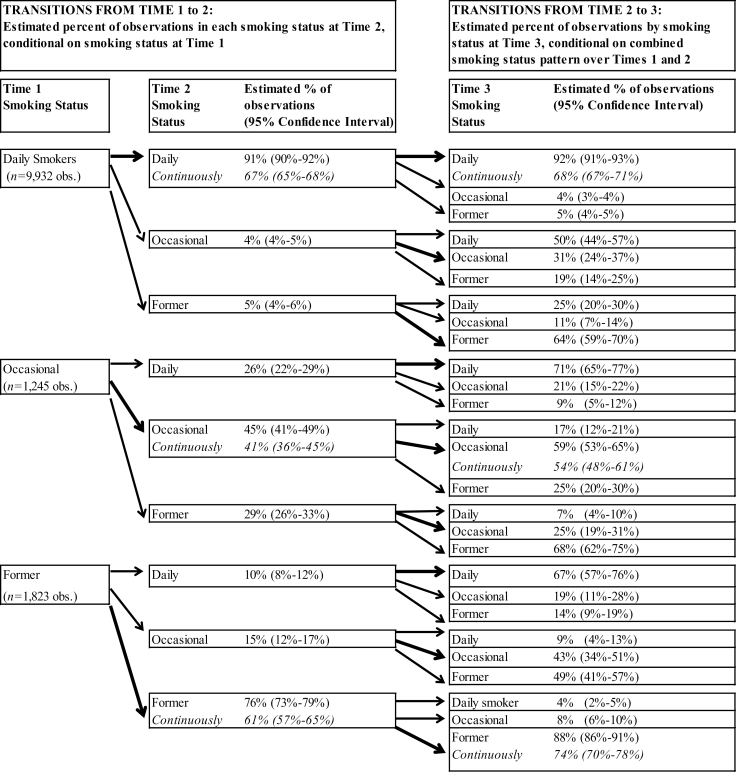
Methods: The Ontario Tobacco Survey panel study followed 4,355 baseline smokers, semiannually for up to 3 years. Probabilities of all possible changes in smoking status more than 6 months were estimated using 13,000 repeated measures observations generated from sets of 3 consecutive interviews (n = 9,932 daily smokers, 1,245 occasion smokers, and 1,823 abstinent for at least 30 days, at Time 1).
Results: For initial daily smokers, an estimated 83% remained daily smokers more than 2 follow-ups. The majority of those who had been abstinent for 30 days at 1 interview, were also former smokers at the following interview. In contrast, occasional smoking status was unstable and future smoking status was dependent upon smoking history and subjective dependence. Among daily smokers who became occasional smokers 6 months later, an estimated 20% became a former smoker, at the next interview, but 50% returned to daily smoking. Daily, turned occasional smokers who rebounded back to daily smoking were more likely to describe themselves as addicted at Time 1. Continuing occasional smokers were somewhat less likely to intend to quit, or have tried, despite considering themselves less addicted.
Conclusions: Reducing to occasional smoking can be a stepping stone toward cessation but entails a greater risk of return to daily smoking, compared with complete abstinence.
Figures
References
-
- Bondy S., Brown K. S., Cohen J., Ferrence R., Garcia J., McDonald P. W, … Victor J. C. (2006). Development and design of the Ontario Tobacco Survey. Statistics Canada International Symposium Series - Proceedings. Symposium 2006: Methodological Issues in Measuring Population Health Ottawa, Ontario, Canada: Statistics Canada.
-
- Bondy S., Diemert L., McDonald P., Victor J., Cohen J. (2012). Is NRT being used by those for whom it is indicated? A prospective analysis in a population-based cohort of smokers. Chronic Diseases and Injuries in Canada, 33(1):19–28. - PubMed
-
- Bondy S. J., Victor J. C., O’Connor S., McDonald P. W., Diemert L. M., Cohen J. E. (2010). Predictive validity and measurement issues in documenting quit intentions in population surveillance studies. Nicotine & Tobacco Research, 12, 43–52. 10.1093/ntr/ntp171 - PubMed
-
- Cheong Y., Yong H.-H., Borland R. (2007). Does how you quit affect success? A comparison between abrupt and gradual methods using data from the International Tobacco Control Policy Evaluation Study. Nicotine & Tobacco Research, 9, 801–810. - PubMed
Publication types
MeSH terms
LinkOut - more resources
Full Text Sources
Medical
