


Hospice utilization in nursing homes: association with facility end-of-life care practices
- PMID: 23231947
- PMCID: PMC3858022
- DOI: 10.1093/geront/gns153
Hospice utilization in nursing homes: association with facility end-of-life care practices
Abstract
Objectives: Hospice care provided to nursing home (NH) residents has been shown to improve the quality of end-of-life (EOL) care. However, hospice utilization in NHs is typically low. This study examined the relationship between facility self-reported EOL practices and residents' hospice use and length of stay.
Design: The study was based on a retrospective cohort of NH residents. Medicare hospice claims, Minimum Data Set, Online Survey, Certification, and Reporting system and the Area Resource File were linked with a survey of directors of nursing (DON) regarding institutional EOL practice patterns (EOLC Survey).
Setting and participants: In total, 4,540 long-term-care residents who died in 2007 in 290 facilities which participated in the EOLC Survey were included in this study.
Measurements: We measured NHs' tendency to offer hospice to residents and to initiate aggressive treatments (hospital transfers and feeding tubes) for EOL residents based on DON's responses to survey items. Residents' hospice utilization was determined using Medicare hospice claims.
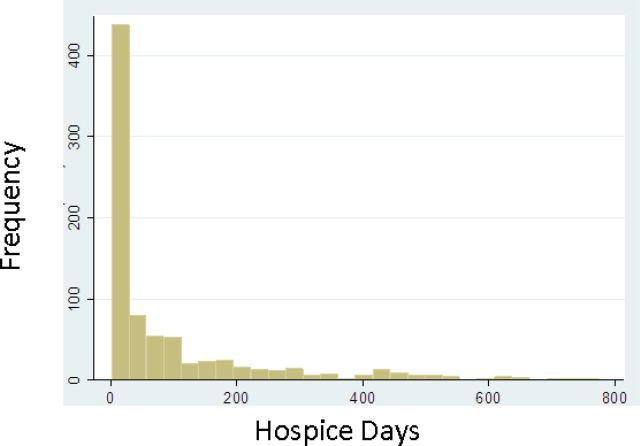
Results: The prevalence of hospice use was 18%. The average length of stay was 93 days. After controlling for individual risk factors, facilities' self-reported practice measures associated with residents' likelihood of using hospice were tendency to offer hospice (p = .048) and tendency to hospitalize (p = .002). Residents in NHs reporting higher tendency to hospitalize tended to enroll in hospice closer to death.
Conclusion: Residents' hospice utilization is not only associated with individual and facility characteristics but also with NHs' self-reported EOL care practices. Potential interventions to effect greater use of hospice may need to focus on facility-level care processes and practices.
Keywords: Hospice length of stay; Hospice referral; Hospice utilization; Nursing home end-of-life care practices; Quality of end-of-life care.
Figures
References
-
- Baer W. M., Hanson L. C. (2000). Families’ perception of the added value of hospice in the nursing home. Journal of the American Geriatrics Society, 48(8), 879–882 PMID: 10968290 - PubMed
-
- Buntin M. B., Zaslavsky A. M. (2004). Too much ado about two-part models and transformation? Comparing methods of modeling Medicare expenditures. Journal of Health Economics, 23(3), 525–542. 10.1016/j.jhealeco.2003.10.005 - PubMed
-
- Casarett D., Karlawish J., Morales K., Crowley R., Mirsch T., Asch D. A. (2005). Improving the use of hospice services in nursing homes: A randomized controlled trial. JAMA: The Journal of the American Medical Association, 294(2), 211–217. 10.1001/jama.294.2.211 - PubMed
-
- Christakis N. A., Escarce J. J. (1996). Survival of Medicare patients after enrollment in hospice programs. The New England Journal of Medicine, 335(3), 172–178. 10.1056/NEJM199607183350306 - PubMed
-
- Christakis N. A., Iwashyna T. J. (2000). Impact of individual and market factors on the timing of initiation of hospice terminal care. Medical Care, 38(5), 528–541 - PubMed
Publication types
MeSH terms
Grants and funding
LinkOut - more resources
Full Text Sources
Medical
