Predicting cognitive decline in subjects at risk for Alzheimer disease by using combined cerebrospinal fluid, MR imaging, and PET biomarkers
- PMID: 23232293
- PMCID: PMC3558874
- DOI: 10.1148/radiol.12120010
Predicting cognitive decline in subjects at risk for Alzheimer disease by using combined cerebrospinal fluid, MR imaging, and PET biomarkers
Abstract
Purpose: To assess the extent to which multiple Alzheimer disease (AD) biomarkers improve the ability to predict future decline in subjects with mild cognitive impairment (MCI) compared with predictions based on clinical parameters alone.
Materials and methods: All protocols were approved by the institutional review board at each site, and written informed consent was obtained from all subjects. The study was HIPAA compliant. Alzheimer's Disease Neuroimaging Initiative (ADNI) baseline magnetic resonance (MR) imaging and fluorine 18 fluorodeoxyglucose (FDG) positron emission tomography (PET) studies for 97 subjects with MCI were used. MR imaging-derived gray matter probability maps and FDG PET images were analyzed by using independent component analysis, an unbiased data-driven method to extract independent sources of information from whole-brain data. The loading parameters for all MR imaging and FDG components, along with cerebrospinal fluid (CSF) proteins, were entered into logistic regression models (dependent variable: conversion to AD within 4 years). Eight models were considered, including all combinations of MR imaging, PET, and CSF markers with the covariates (age, education, apolipoprotein E genotype, Alzheimer's Disease Assessment Scale-Cognitive subscale score).
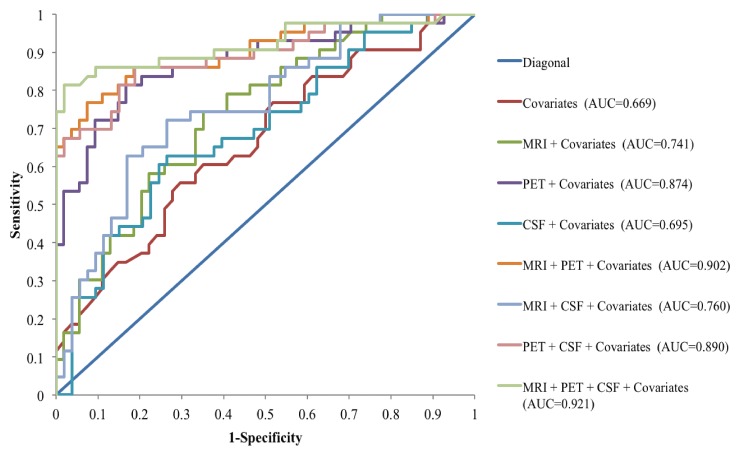
Results: Combining MR imaging, FDG PET, and CSF data with routine clinical tests significantly increased the accuracy of predicting conversion to AD compared with clinical testing alone. The misclassification rate decreased from 41.3% to 28.4% (P < .00001). FDG PET contributed more information to routine tests (P < .00001) than CSF (P = .32) or MR imaging (P = .08).
Conclusion: Imaging and CSF biomarkers can improve prediction of conversion from MCI to AD compared with baseline clinical testing. FDG PET appears to add the greatest prognostic information.
Figures

Comment in
-
[Mild cognitive impairment/Alzheimer disease - combined marker for prediction of cognitive decline].Rofo. 2013 Jul;185(7):604-5. doi: 10.1055/s-0032-1319579. Epub 2013 Jun 26. Rofo. 2013. PMID: 23804126 German. No abstract available.
References
-
- Khachaturian ZS. Diagnosis of Alzheimer’s disease. Arch Neurol 1985;42(11):1097–1105 - PubMed
-
- Petrella JR, Coleman RE, Doraiswamy PM. Neuroimaging and early diagnosis of Alzheimer disease: a look to the future. Radiology 2003;226(2):315–336 - PubMed
-
- Alzheimer’s Association 2010 Alzheimer’s disease facts and figures. Alzheimers Dement 2010;6(2):158–194 - PubMed
-
- Hebert LE, Scherr PA, Bienias JL, Bennett DA, Evans DA. Alzheimer disease in the US population: prevalence estimates using the 2000 census. Arch Neurol 2003;60(8):1119–1122 - PubMed
Publication types
MeSH terms
Substances
Grants and funding
LinkOut - more resources
Full Text Sources
Other Literature Sources
Medical
Molecular Biology Databases