


Extracellular brain pH with or without hypoxia is a marker of profound metabolic derangement and increased mortality after traumatic brain injury
- PMID: 23232949
- PMCID: PMC3587815
- DOI: 10.1038/jcbfm.2012.186
Extracellular brain pH with or without hypoxia is a marker of profound metabolic derangement and increased mortality after traumatic brain injury
Abstract
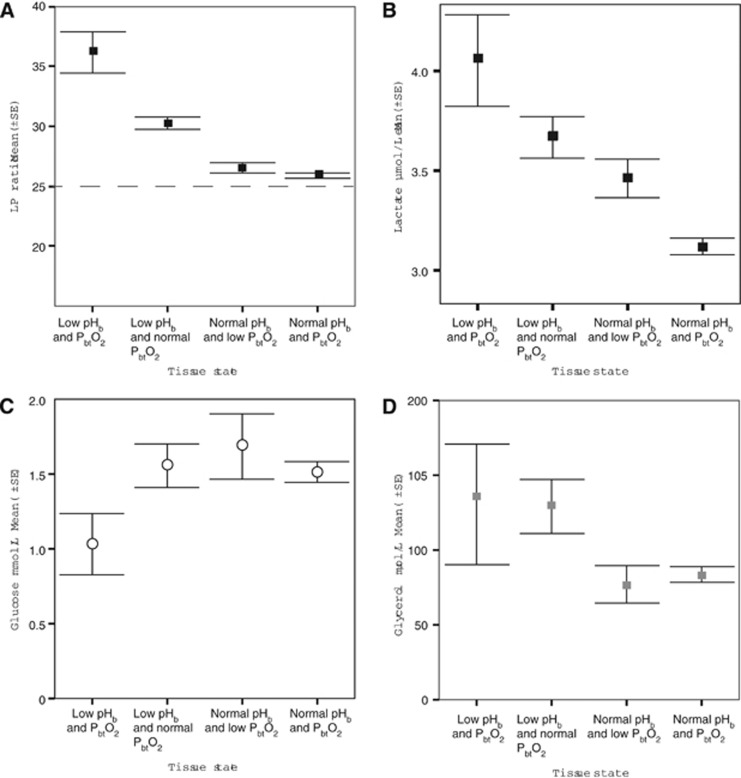
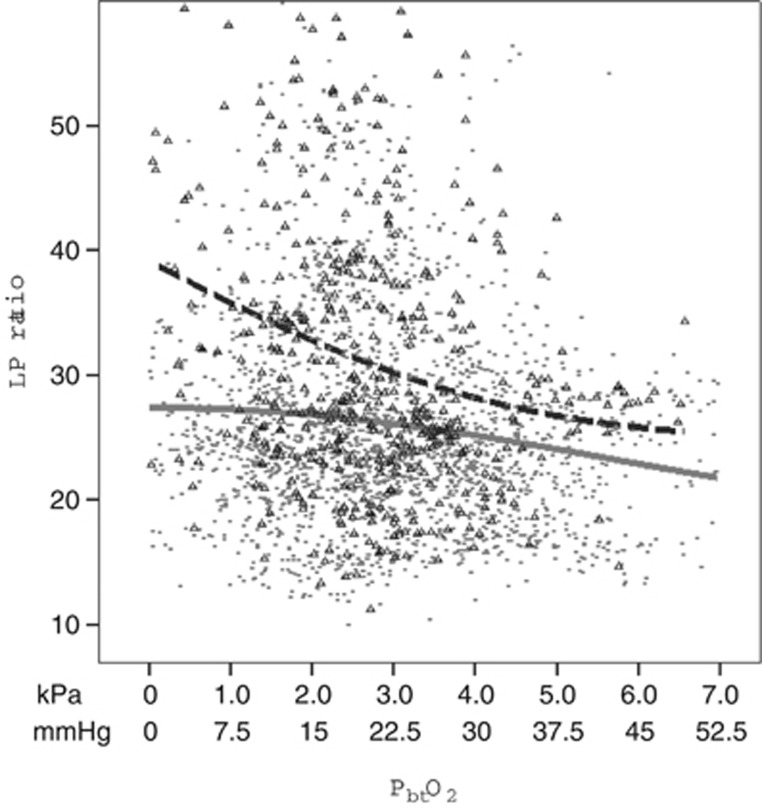
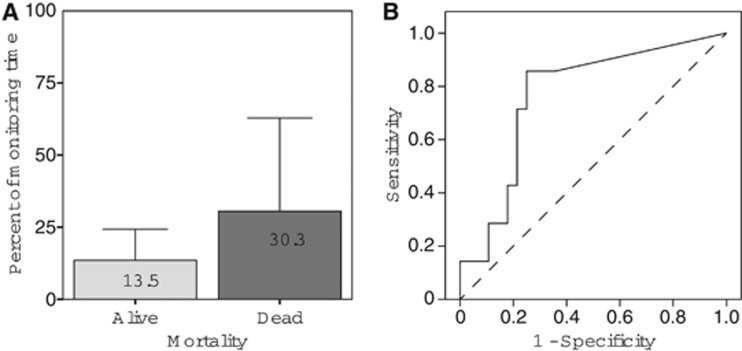
Cerebral hypoxia and acidosis can follow traumatic brain injury (TBI) and are associated with increased mortality. This study aimed to evaluate a relationship between reduced pH(bt) and disturbances of cerebral metabolism. Prospective data from 56 patients with TBI, receiving microdialysis and Neurotrend monitoring, were analyzed. Four tissue states were defined based on pH(bt) and P(bt)O(2): 1--low P(bt)O(2)/pH(bt), 2--low pH(bt)/normal P(bt)O(2), 3--normal pH(bt)/low P(bt)O(2), and 4--normal pH(bt)/P(bt)O(2)). Microdialysis values were compared between the groups. The relationship between P(bt)O(2) and lactate/pyruvate (LP) ratio was evaluated at different pH(bt) levels. Proportional contribution of each state was evaluated against mortality. As compared with the state 4, the state 3 was not different, the state 2 exhibited higher levels of lactate, LP, and glucose and the state 1--higher LP and reduced glucose (P<0.001). A significant negative correlation between LP and P(bt)O(2) (rho=-0.159, P<0.001) was stronger at low pH(bt) (rho=-0.201, P<0.001) and nonsignificant at normal pH(bt) (P=0.993). The state 2 was a significant discriminator of mortality categories (P=0.031). Decreased pH(bt) is associated with impaired metabolism. Measuring pH(bt) with P(bt)O(2) is a more robust way of detecting metabolic derangements.
Figures
References
-
- Nortje J, Coles JP, Timofeev I, Fryer TD, Aigbirhio FI, Smielewski P, et al. Effect of hyperoxia on regional oxygenation and metabolism after severe traumatic brain injury: preliminary findings. Crit Care Med. 2008;36 (1:273–81. - PubMed
-
- Verweij BH, Muizelaar JP, Vinas FC, Peterson PL, Xiong Y, Lee CP. Impaired cerebral mitochondrial function after traumatic brain injury in humans. J Neurosurg. 2000;93 (5:815–20. - PubMed
-
- Siesjo BK. Pathophysiology and treatment of focal cerebral ischemia. Part I: Pathophysiology. J Neurosurg. 1992;77 (2:169–84. - PubMed
Publication types
MeSH terms
Substances
Grants and funding
LinkOut - more resources
Full Text Sources
