


Self-report of stroke, transient ischemic attack, or stroke symptoms and risk of future stroke in the REasons for Geographic And Racial Differences in Stroke (REGARDS) study
- PMID: 23233382
- PMCID: PMC3558975
- DOI: 10.1161/STROKEAHA.112.675033
Self-report of stroke, transient ischemic attack, or stroke symptoms and risk of future stroke in the REasons for Geographic And Racial Differences in Stroke (REGARDS) study
Abstract
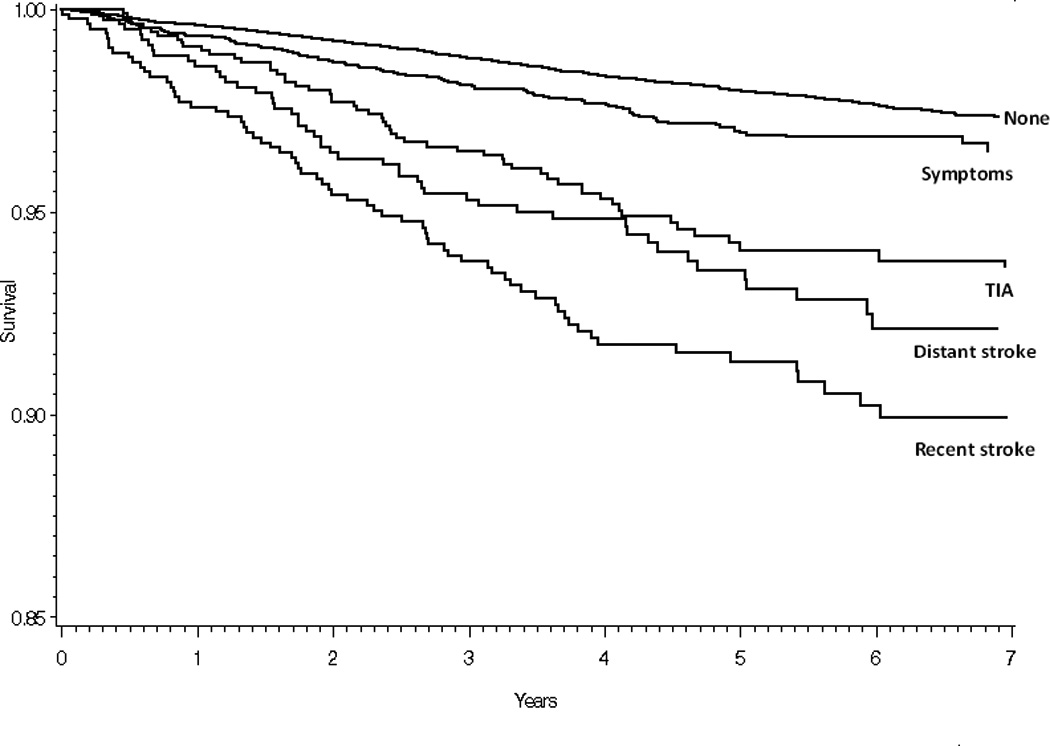
Background and purpose: History of stroke and transient ischemic attack (TIA) are documented risk factors for subsequent stroke and all-cause mortality. Recent reports suggest increased risk among those reporting stroke symptoms absent stroke or TIA. However, the relative magnitude of increased stroke risk has not been described across the symptomatic spectrum: (1) asymptomatic, (2) stroke symptoms (SS) only, (3) TIA, (4) distant stroke (DS), and (5) recent stroke (RS).
Methods: Between 2003 and 2007, the REasons for Geographic And Racial Differences in Stroke (REGARDS) study enrolled 30 239 black and white Americans ≥45 years of age. DS and RS were defined as self-report of physician diagnosis of stroke >5 or <5 years before baseline, respectively. SS was defined as a history of any of 6 sudden onset stroke symptoms absent TIA/stroke diagnosis. Kaplan-Meier and proportional hazards analysis were used to contrast stroke risk differences.
Results: Over 5.0±1.72 years of follow-up, 737 strokes were validated. Compared with asymptomatic persons, those with SS, TIA, DS, and RS all had increased risk of future stroke. After adjustment for age, race, sex, income, education, alcohol intake, current smoking, and a history of diabetes mellitus, hypertension, myocardial infarction, atrial fibrillation, and dyslipidemia, there was 1.20-fold (not statistically significant) increased stroke risk for SS (95% CI, 0.96-1.51), 1.73-fold for TIA (95% CI, 1.27-2.36), 2.23-fold for DS (95% CI, 1.61- 3.09), and 2.85-fold for RS (95% CI, 2.16-3.76).
Conclusions: Results suggest a spectrum of risk from stroke symptoms to TIA, DS, and RS, and imply a need for establishing these categories in health screenings to manage risk for future stroke, reinforcing the clinical importance of stroke history including the presence of stroke symptoms.
Figures
Comment in
-
Letter by Mittal and McCormick regarding article, "self-report of stroke, transient ischemic attack, or stroke symptoms and risk of future stroke in the REasons for Geographic and Racial Differences in Stroke (REGARDS) study".Stroke. 2013 May;44(5):e53. doi: 10.1161/STROKEAHA.113.000877. Epub 2013 Apr 2. Stroke. 2013. PMID: 23549135 No abstract available.
References
-
- Lloyd-Jones D, Adams R, Carnethon M, De Simone G, Ferguson TB, Flegal K, et al. Heart disease and stroke statistics--2009 update: A report from the american heart association statistics committee and stroke statistics subcommittee. Circulation. 2009;119:480–486. - PubMed
-
- Johnston SC, Fayad PB, Gorelick PB, Hanley DF, Shwayder P, van Husen D, et al. Prevalence and knowledge of transient ischemic attack among us adults. Neurology. 2003;60:1429–1434. - PubMed
-
- Kleindorfer D, Panagos P, Pancioli A, Khoury J, Kissela B, Woo D, et al. Incidence and short-term prognosis of transient ischemic attack in a population-based study. Stroke. 2005;36:720–723. - PubMed
-
- Lisabeth LD, Ireland JK, Risser JM, Brown DL, Smith MA, Garcia NM, et al. Stroke risk after transient ischemic attack in a population-based setting. Stroke. 2004;35:1842–1846. - PubMed
-
- Howard VJ, McClure LA, Meschia JF, Pulley L, Orr SC, Friday GH. High prevalence of stroke symptoms among persons without a diagnosis of stroke or transient ischemic attack in a general population: The reasons for geographic and racial differences in stroke (regards) study. Arch Intern Med. 2006;166:1952–1958. - PubMed
Publication types
MeSH terms
Grants and funding
LinkOut - more resources
Full Text Sources
Other Literature Sources
Medical
