


Comparative study comparing endoscopic thyroidectomy using the axillary approach and open thyroidectomy for papillary thyroid microcarcinoma
- PMID: 23234462
- PMCID: PMC3544716
- DOI: 10.1186/1477-7819-10-269
Comparative study comparing endoscopic thyroidectomy using the axillary approach and open thyroidectomy for papillary thyroid microcarcinoma
Abstract
Background: Endoscopic thyroidectomy has been applied prudently to malignant thyroid tumors. The purpose of our study was to compare the surgical outcomes of endoscopic thyroidectomy (ET) and conventional open thyroidectomy (COT) for micropapillary thyroid carcinoma.
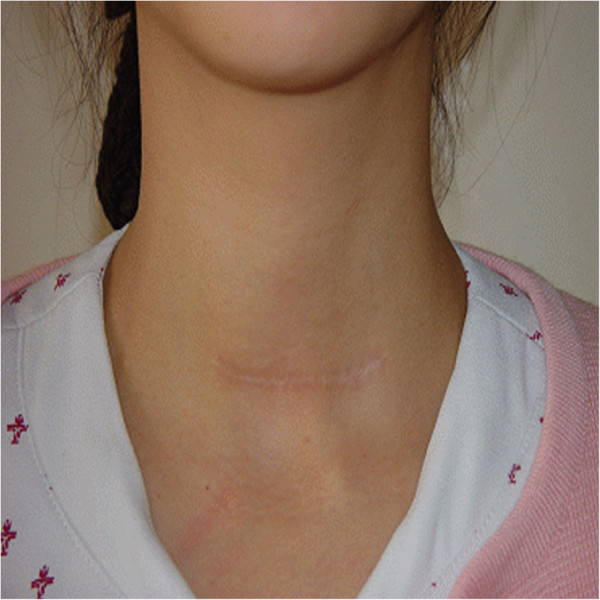
Methods: From October 2002 to December 2008, 78 patients underwent unilateral lobectomy and isthmectomy with central lymph node dissection for papillary thyroid microcarcinoma. Of these, 37 patients underwent ET and 41 patients COT. Surgical outcomes, including operation time, number of retrieved lymph nodes, postoperative complication rate and patients' satisfaction with the cosmetic results, were analyzed.
Results: The mean age of the patients was 42.3 ± 7.6 years in the ET group and 49.0 ± 10.8 years in the OT group (P = 0.003). The operation time was shorter in the COT group (112.3 ± 14 min) than in the ET group (138.4 ± 36.9 min, P< 0.01). However, there were no significant differences in tumor size (0.5 ± 0.231 vs. 0.41 ± 0.264 cm, P = 0.116), number of retrieved lymph nodes (3.63 ± 2.1 vs. 3.82 ± 3.28, P = 0.78) or postoperative hospital stay (3.35 ± 0.94 vs. 3.17 ± 1.16 days, P = 0.457). Patients in the ET group experienced more pain than those in the COT group at 1 and 7 days after the operation as evaluated by a visual analog scale (P = 0.037, 0.026). Cosmetically, patients in the ET group were very satisfied with the operative procedure according to the questionnaire we used (1.43 ± 0.55 vs. 3.21 ± 0.72, P< 0.001). The mean follow-up period was 54.3 months in the ET group and 47.4 months in the COT group, and each group exhibited one case of tumor recurrence detected at the other thyroid lobe within 2 years.
Conclusions: Large series of prospective studies and long-term follow-up are needed, but the results of ET using the axillary approach for micropapillary thyroid carcinoma were not inferiortothose using COT, and it might be a safe and feasible procedure with good cosmetic results.
Figures



References
-
- Jeong JJ, Kang S-W, Yun J-S, Sung TY, Lee SC, Lee YS, Nam K-H, Chang HS, Chung WY, Park CS. Comparative study of endoscopic thyroidectomy versus conventional open thyroidectomy in papillary thyroid microcarcinoma (PTMC) patients. J Surg Oncol. 2009;100:477–480. doi: 10.1002/jso.21367. - DOI - PubMed
-
- Ohgami M, Ishii S, Arisawa Y, Ohmori T, Noga K, Furukawa T, Kitajima M. Scarless endoscopic thyroidectomy: breast approach for better cosmesis. Surg Laparosc Endosc Percutan Tech. 2000;10:1–4. - PubMed
Publication types
MeSH terms
Supplementary concepts
LinkOut - more resources
Full Text Sources
Medical
Miscellaneous
