Review
. 2012 Dec 12;10(79):20120835.
doi: 10.1098/rsif.2012.0835. Print 2013 Feb.

On the binding affinity of macromolecular interactions: daring to ask why proteins interact

Affiliations
Review

On the binding affinity of macromolecular interactions: daring to ask why proteins interact

Panagiotis L Kastritis et al. J R Soc Interface. .

Abstract

Interactions between proteins are orchestrated in a precise and time-dependent manner, underlying cellular function. The binding affinity, defined as the strength of these interactions, is translated into physico-chemical terms in the dissociation constant (K(d)), the latter being an experimental measure that determines whether an interaction will be formed in solution or not. Predicting binding affinity from structural models has been a matter of active research for more than 40 years because of its fundamental role in drug development. However, all available approaches are incapable of predicting the binding affinity of protein-protein complexes from coordinates alone. Here, we examine both theoretical and experimental limitations that complicate the derivation of structure-affinity relationships. Most work so far has concentrated on binary interactions. Systems of increased complexity are far from being understood. The main physico-chemical measure that relates to binding affinity is the buried surface area, but it does not hold for flexible complexes. For the latter, there must be a significant entropic contribution that will have to be approximated in the future. We foresee that any theoretical modelling of these interactions will have to follow an integrative approach considering the biology, chemistry and physics that underlie protein-protein recognition.


Figures
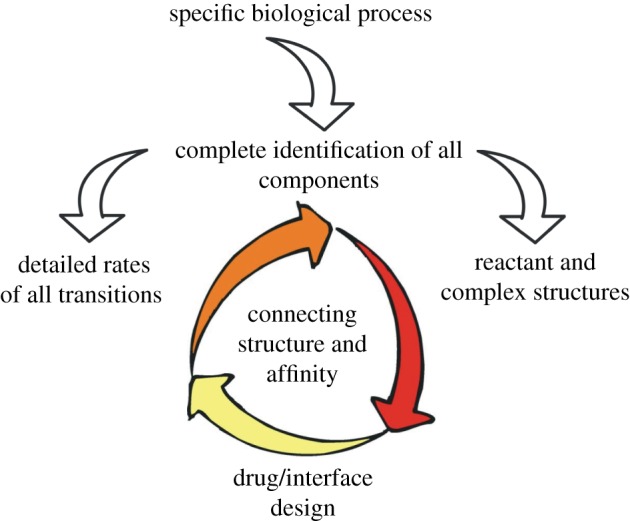
Figure 1.
Figure 1.
Methodology to follow in protein–protein interaction identification leading to drug/interface design.
Figure 2.
Figure 2.
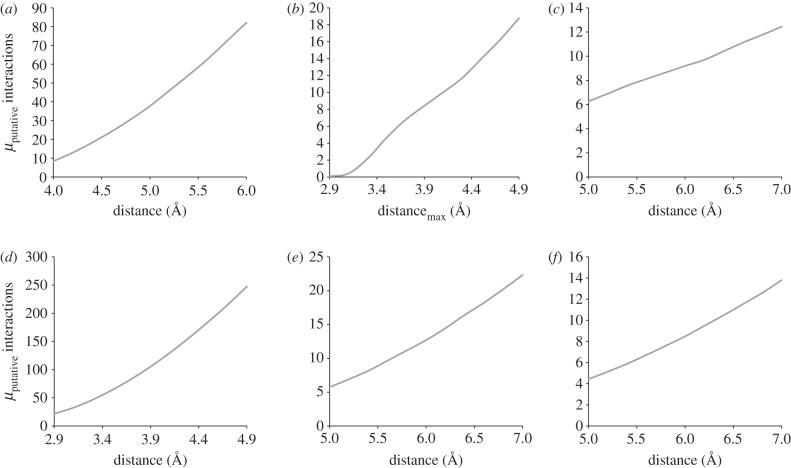
Change in the number of intermolecular interactions for 195 protein–protein complexes using cut-offs ±1 Å. μ corresponds to the average value calculated. (a) Hydrophobic contacts, (b) hydrogen bonds, (c) ionic, (d) van der Waals, (e) aromatic and (f) π–cation interactions.
Figure 3.
Figure 3.
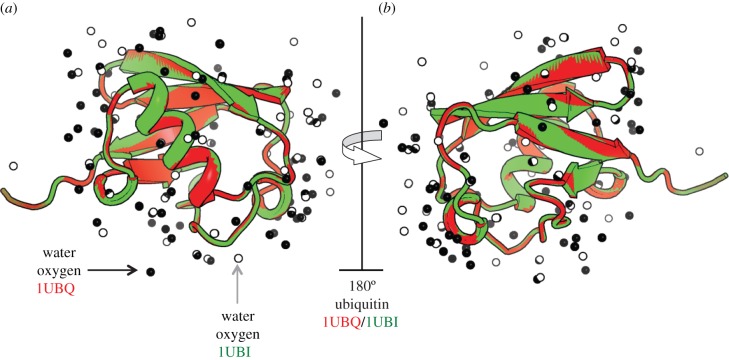
(a,b) Crystallographically determined structures of ubiquitin (PDB entries 1UBQ and 1UBI), along with their corresponding crystallographic water molecules. Ubiquitin is shown in cartoon representation, whereas the oxygen atoms of water are shown as spheres.
Figure 4.
Figure 4.
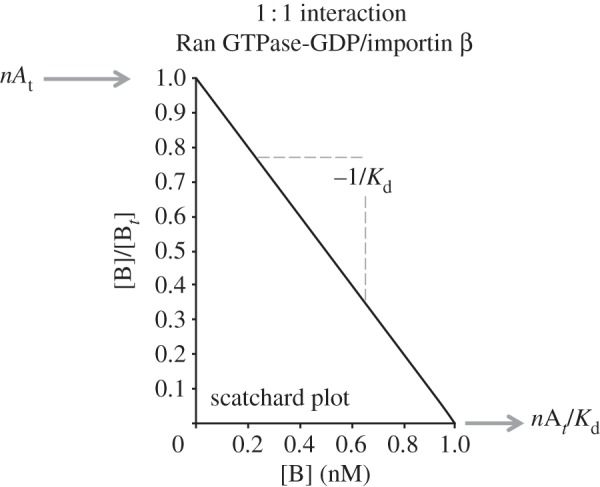
Simulated scatchard plot for Ran GTPase-GDP and importin β. We assume a 1 : 1 interaction, having exactly 1 nM affinity (see text).
Figure 5.
Figure 5.
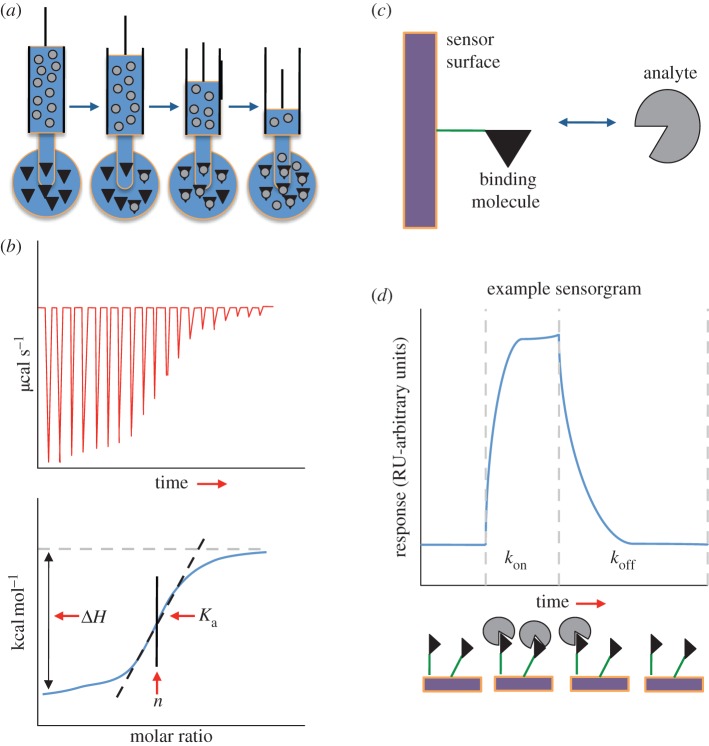
(a,b) Isothermal titration calorimetry and (c,d) surface plasmon resonance (SPR) techniques. (a) Titrations used to measure heat capacity changes and (b) calculation of Ka. (c) SPR method and (d) monitoring of the association/dissociation process of the mobile agent. See text for details.
Figure 6.
Figure 6.
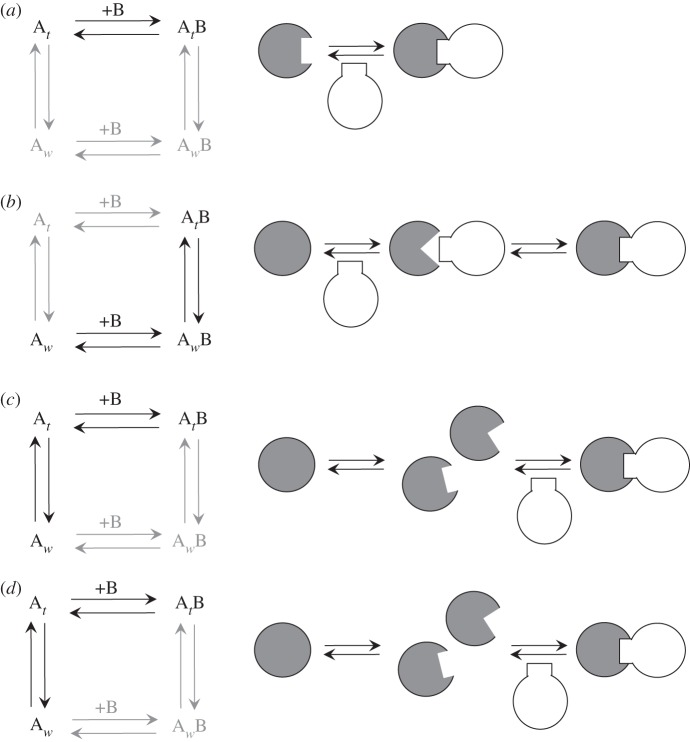
The three basic mechanisms proposed for molecular recognition: (a) lock and key, (b) induced fit, and (c) conformational selection (dynamic fit). On the left, At and Aw denote protein A in its tight (binding competent) and weak (binding incompetent) conformation. The chemical pathways that do not exist in each proposed model are indicated by light grey arrows and the way the binding occurs by black arrows. Note that protein B can also undergo conformational transitions; it is shown here rigid for simplicity.
Figure 7.
Figure 7.
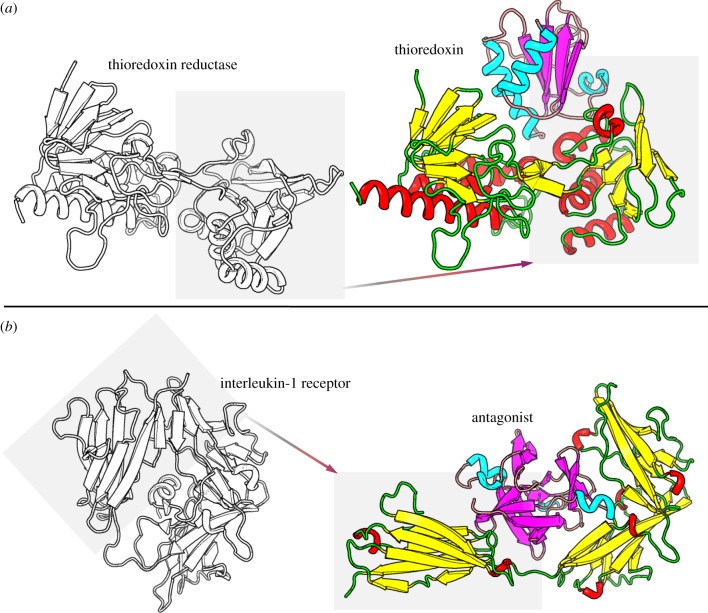
Conformational changes in protein–protein complexes; unbound conformations are shown in greyscale, whereas bound conformations are shown in colour code by assigning a secondary structure; (a) the complex between thioredoxin reductase and thioredoxin is illustrated in cartoon representation, and (b) the interleukin-1 receptor in complex with its antagonist; both complexes undergo extensive conformational changes upon ligand binding (see also text).
Figure 8.
Figure 8.
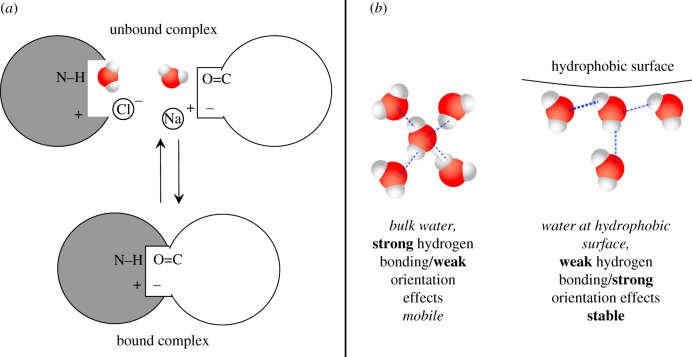
Water in protein–protein interactions and the explanation of the Chothia–Janin theory for the affinity of protein–protein complexes; (a) intermolecular interactions are recovered in the bound conformation, being already present with the molecules of the solvent and its ions; (b) water at hydrophobic interfaces loses its entropy in comparison with bulk water, which is highly mobile.
Figure 9.
Figure 9.
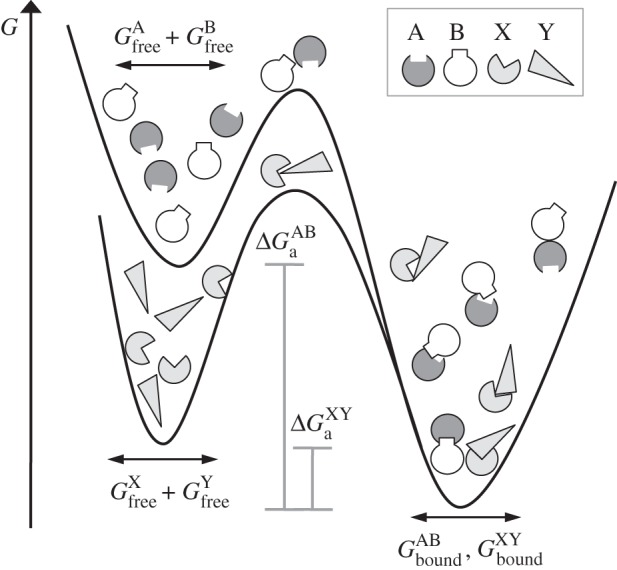
Schematic of the energy landscape of two different protein–protein complexes.
Figure 10.
Figure 10.
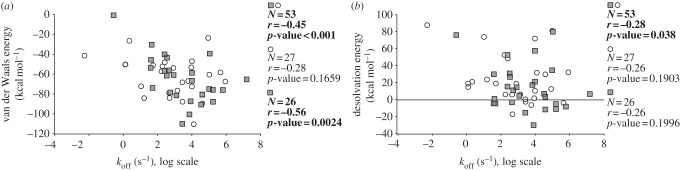
Correlations between some energetic components of the HADDOCK score [217] ((a) van der Waals interactions; (b) desolvation energy) and experimental koff for 54 protein–protein complexes [98,133]. (Near) rigid binders are shown by grey squares, whereas flexible binders are shown by white circles. r denotes the correlation coefficient, whereas the p-value denotes the corresponding p-value (p-value < 0.05 is considered significant). Significant correlations are highlighted in bold.

References

    1. Mulder GJ. 1839. Ueber die Zusammensetzung einiger thierischen Substanzen. J. Prakt. Chem. 16, 129–15210.1002/prac.18390160137 (doi:10.1002/prac.18390160137) - DOI - DOI
    1. Perrett D. 2007. From ‘protein’ to the beginnings of clinical proteomics. Proteomics Clin. Appl. 1, 720–73810.1002/prca.200700525 (doi:10.1002/prca.200700525) - DOI - DOI - PubMed
    1. Tanford C, Reynolds J. 2004. Nature‘s robots: a history of proteins. New York, NY: Oxford University Press
    1. Proust LJ. 1819. Recherches sur le principe qui assaisonne les fromages. Ann. Chim. Phys. 29, 29–49
    1. Meyer CE, Rose WC. 1936. The spatial configuration of a-amino-b-hydroxy-n-butyric acid. J. Biol. Chem. 115, 721–729

Publication types

MeSH terms

Substances