. 2013 Mar;7(3):652-9.
doi: 10.1038/ismej.2012.147. Epub 2012 Dec 13.

Global biogeography of highly diverse protistan communities in soil

Affiliations

Global biogeography of highly diverse protistan communities in soil

Scott T Bates et al. ISME J. 2013 Mar.

Abstract

Protists are ubiquitous members of soil microbial communities, but the structure of these communities, and the factors that influence their diversity, are poorly understood. We used barcoded pyrosequencing to survey comprehensively the diversity of soil protists from 40 sites across a broad geographic range that represent a variety of biome types, from tropical forests to deserts. In addition to taxa known to be dominant in soil, including Cercozoa and Ciliophora, we found high relative abundances of groups such as Apicomplexa and Dinophyceae that have not previously been recognized as being important components of soil microbial communities. Soil protistan communities were highly diverse, approaching the extreme diversity of their bacterial counterparts across the same sites. Like bacterial taxa, protistan taxa were not globally distributed, and the composition of these communities diverged considerably across large geographic distances. However, soil protistan and bacterial communities exhibit very different global-scale biogeographical patterns, with protistan communities strongly structured by climatic conditions that regulate annual soil moisture availability.


Figures
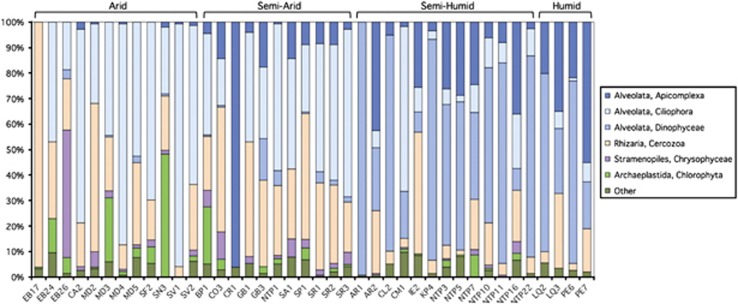
Figure 1
Figure 1
Relative abundance of soil protistan taxa (y axis as group percentage of the total number of 18S rRNA gene sequences per sample, after rarefaction to correct for uneven sampling effort) grouped by general CMI class. Identities of the sites sampled are given on the x axis (see Supplementary Table S1 for specific details on site and soil characteristics).
Figure 2
Figure 2
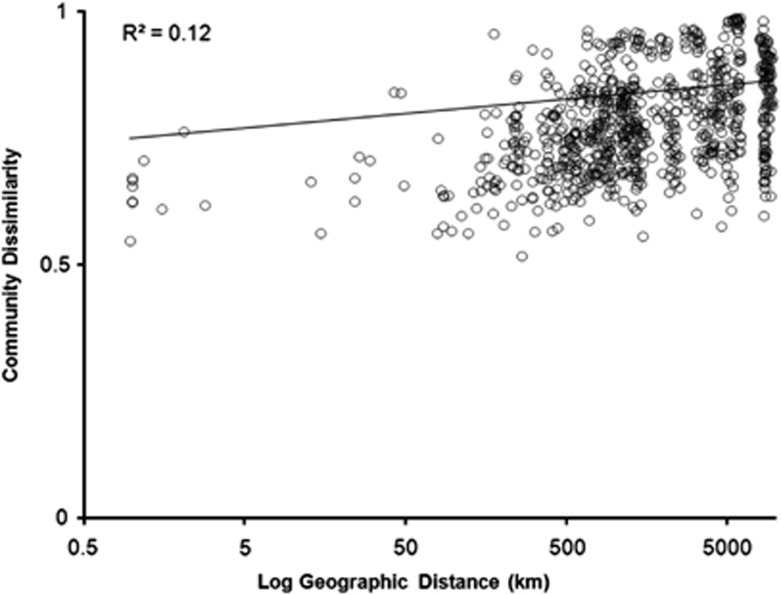
Protistan community dissimilarity (unweighted UniFrac) with increasing geographic distance (best-fitted linear regression line). UniFrac values range from 1 (completely different phylogenetic assemblages) to 0 (no differences observed between communities).
Figure 3
Figure 3
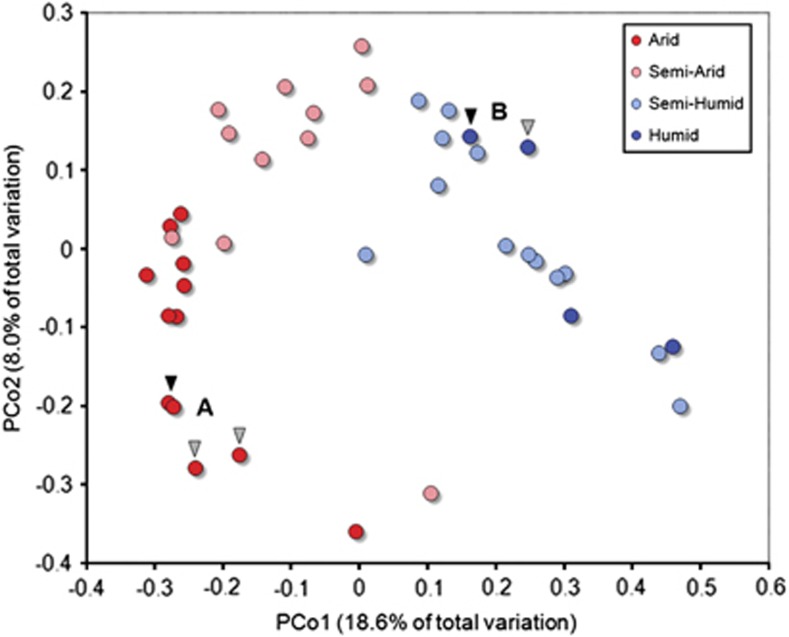
Principal coordinates analysis (PCoA) plot on the unweighted UniFrac distance matrix generated from rarefied taxon abundances and depicting patterns of beta diversity for protistan communities of soil. Points that are closer together on the ordination have communities that are more similar. permutational multivariate analysis of variance indicated that differences between communities mapped according to site CMI classes were highly significant (P<0.001). Sites where community composition was highly similar despite large geographic separation are highlighted with arrows indicating (A) Antarctic Dry Valleys (black; EB24 and EB26) and Mojave Desert (gray; MD4 and MD5) of California, USA and (B) Peru (black; PE7) and Puerto Rico (gray; LQ3).
Figure 4
Figure 4
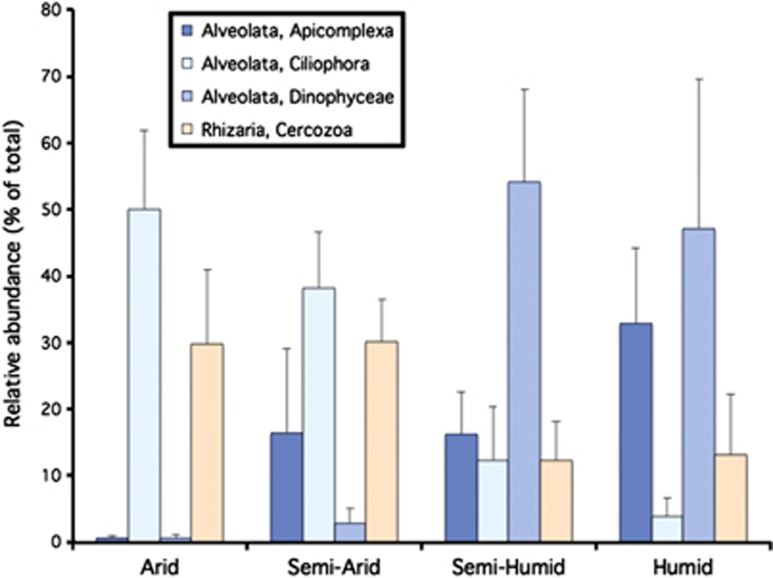
Relative abundance of soil protistan taxa (y axis as group percentage of the total number of 18S rRNA gene sequences per sample, after rarefaction to correct for uneven sampling effort) averaged across CMI classes.

References

    1. Adl M, Simpson AGB, Farmer MA, Andersen RA, Anderson OR, Barta JR, et al. The new higher level classification of eukaryotes with emphasis on the taxonomy of protists. J Eukaryot Microbiol. 2005;52:399–451. - PubMed
    1. Adl SM, Gupta VVSR. Protists in soil ecology and forest nutrient cycling. Can J Forest Res. 2006;36:1805–1817.

    1. Aguilar M, Lado C. Ecological niche models reveal the importance of climate variability for the biogeography of protosteloid amoebae. ISME J. 2012;6:1506–1514. - PMC - PubMed
    1. Altschul SF, Madden TJ, Schaffer AA, Zhang J, Zhang Z, Miller W, et al. Gapped BLAST and PSI-BLAST: a new generation of protein database search programs. Nucleic Acids Res. 1997;25:3389–3402. - PMC - PubMed
    1. Aurrecoechea C, Brestelli J, Brunk BP, Fischer S, Gajria B, Gao X, et al. EuPathDB: a portal to eukaryotic pathogen databases. Nucleic Acids Res. 2010;38 ((Suppl 1)::D415–D419. - PMC - PubMed

Publication types