. 2013 Apr;7(4):718-29.
doi: 10.1038/ismej.2012.157. Epub 2012 Dec 13.

Sediment microbial communities in Great Boiling Spring are controlled by temperature and distinct from water communities

Affiliations

Sediment microbial communities in Great Boiling Spring are controlled by temperature and distinct from water communities

Jessica K Cole et al. ISME J. 2013 Apr.

Abstract

Great Boiling Spring is a large, circumneutral, geothermal spring in the US Great Basin. Twelve samples were collected from water and four different sediment sites on four different dates. Microbial community composition and diversity were assessed by PCR amplification of a portion of the small subunit rRNA gene using a universal primer set followed by pyrosequencing of the V8 region. Analysis of 164 178 quality-filtered pyrotags clearly distinguished sediment and water microbial communities. Water communities were extremely uneven and dominated by the bacterium Thermocrinis. Sediment microbial communities grouped according to temperature and sampling location, with a strong, negative, linear relationship between temperature and richness at all taxonomic levels. Two sediment locations, Site A (87-80 °C) and Site B (79 °C), were predominantly composed of single phylotypes of the bacterial lineage GAL35 (\[pmacr]=36.1%), Aeropyrum (\[pmacr]=16.6%), the archaeal lineage pSL4 (\[pmacr]=15.9%), the archaeal lineage NAG1 (\[pmacr]=10.6%) and Thermocrinis (\[pmacr]=7.6%). The ammonia-oxidizing archaeon 'Candidatus Nitrosocaldus' was relatively abundant in all sediment samples <82 °C (\[pmacr]=9.51%), delineating the upper temperature limit for chemolithotrophic ammonia oxidation in this spring. This study underscores the distinctness of water and sediment communities in GBS and the importance of temperature in driving microbial diversity, composition and, ultimately, the functioning of biogeochemical cycles.


Figures

Figure 1
Figure 1
Photograph of GBS with sampling sites identified. Temperature range displayed at each site represents the temperatures recorded during sample collection. Temperature of sediment samples measured in water above each sample site.
Figure 2
Figure 2
Visual representation of the similarity of samples based on their community composition, considered at the phylum level for bacteria and the class level for archaea. (a) Cluster tree calculated using Bray–Curtis dissimilarity, with jackknife values ⩾80.0% displayed. (b) Bar chart displaying the community composition of each sample, including the 15 most abundant taxa in all samples with remaining taxa included as ‘Others'. ‘(A)' or ‘(B)' after taxon name in legend designates an archaeal or bacterial taxon, respectively.
Figure 3
Figure 3
Visual representation of the similarity of samples based on their community composition, considered at the 97% OTU level. (a) Cluster tree calculated using Bray–Curtis dissimilarity, with jackknife values ⩾80.0% displayed. (b) Principal coordinates analysis constructed with Bray–Curtis dissimilarity. Principal coordinate 1, P1 and principal coordinate 2, P2, plotted against each other, with a total of 71.85% of variation explained.
Figure 4
Figure 4
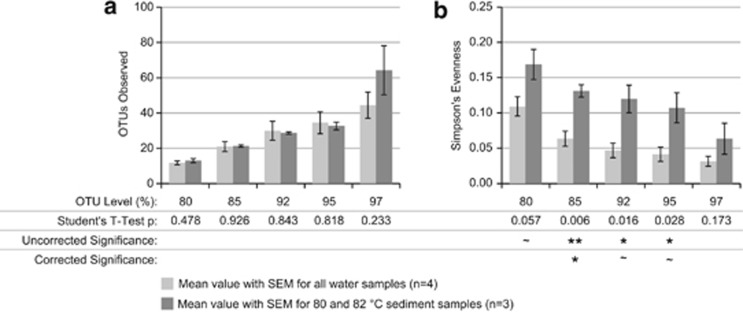
Comparison of alpha diversity measures of complete communities (both archaea and bacteria) in water samples to sediment samples of comparable temperature (82–80 °C). Calculations were performed with OTUs determined at five sequence identity levels and errors bars indicate s.e.m. Student's t-tests were performed for each pair of comparisons, water vs sediment, at each OTU level to determine significance. ***, significant at α=0.001; **, significant at α=0.01; *, significant at α=0.05; ∼, significant at α=0.1. (a) Richness measured in the water samples compared with that of sediment samples of comparable temperature. (b) Simpson's evenness measured in the water samples compared with that of the sediment samples.
Figure 5
Figure 5
Alpha diversity measures of complete communities (combined archaea and bacteria) for all sediment samples, plotted against sample temperature, with regression lines for each OTU level. ***, significant at α=0.001; **, significant at α=0.01; *, significant at α=0.05; ∼, significant at α=0.1. (a) Richness vs sample temperature. (b) Simpson's evenness vs sample temperature. nd, slope not significantly different from zero.
Figure 6
Figure 6
Exponential decay of community similarity as the difference between sample temperatures increases. The linear regression between log-transformed Bray–Curtis similarity and the difference between sample temperatures was highly significant (y=56.021e−0.116x, R2=0.73, P<0.001).

References

    1. Barns SM, Fundyga RE, Jeffries MW, Pace NR. Remarkable archaeal diversity detected in a Yellowstone National Park hot spring environment. Proc Natl Acad Sci. 1994;91:1609–1613. - PMC - PubMed
    1. Blank CE, Cady SL, Pace NR. Microbial composition of near-boiling silica-depositing thermal springs throughout Yellowstone National Park. Appl Environ Microbiol. 2002;68:5123–5135. - PMC - PubMed
    1. Bray JR, Curtis JT. An ordination of the upland forest communities of Southern Wisconsin. Ecol Monogr. 1957;27:325–349.
    1. Brock TD. Micro-organisms adapted to high temperatures. Nature. 1967;214:882–885. - PubMed

    1. Caporaso JG, Kuczynski J, Stombaugh J, Bittinger K, Bushman FD, Costello EK, et al. QIIME allows analysis of high-throughput community sequencing data. Nat Methods. 2010;7:335–336. - PMC - PubMed

Publication types