. 2012 Dec 13;3(12):e443.
doi: 10.1038/cddis.2012.178.

The restricted binding repertoire of Bcl-B leaves Bim as the universal BH3-only prosurvival Bcl-2 protein antagonist

Affiliations

The restricted binding repertoire of Bcl-B leaves Bim as the universal BH3-only prosurvival Bcl-2 protein antagonist

G J P Rautureau et al. Cell Death Dis. .

Abstract

B-cell lymphoma-2 (Bcl-2) proteins mediate intrinsic-, or mitochondrial-, initiated apoptosis. We have investigated the structure and function of the least characterized Bcl-2 family member, Bcl-B, solving the crystal structure of a Bcl-B:Bim complex to 1.9 Å resolution. Bcl-B is distinguished from other Bcl-2 family members through an insertion of an unstructured loop between helices α5 and α6. Probing Bcl-B interactions with Bcl-2 homology (BH)3 motifs using a combination of biophysical- and cell-based assays revealed a unique BH3-only protein binding profile. Bcl-B has high-affinity interactions with Bim and Bik only. Our results not only delineate the mode of action of Bcl-B but also complete our understanding of the specific interactions between BH3-only proteins and their prosurvival Bcl-2 counterparts. Notably, we conclude that Bim is the universal prosurvival antagonist as no other BH3-only protein binds all six prosurvival proteins and that Mcl-1 and Bcl-x(L) form a distinct prosurvival dyad.


Figures
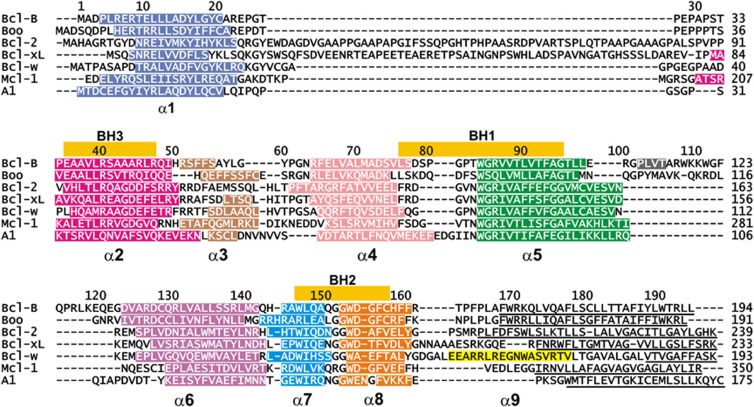
Figure 1
Figure 1
Sequence and structure alignment of Bcl-2 proteins. Sequences were aligned using MEGA5, followed by structural alignment with TOP, to identify equivalent structural positions and the sequence alignment adjusted accordingly. The sequence numbering is that for Bcl-B. Helices are indicated with colored bars and named α1–α9 below the sequence. C-terminal residues deleted in structure determinations are underlined and the N-terminal residues of Mcl-1 are not shown. The position of BH motifs is indicated by bars above the alignment. Accession numbers for the sequences and structures are given in the Supplementary Information
Figure 2
Figure 2
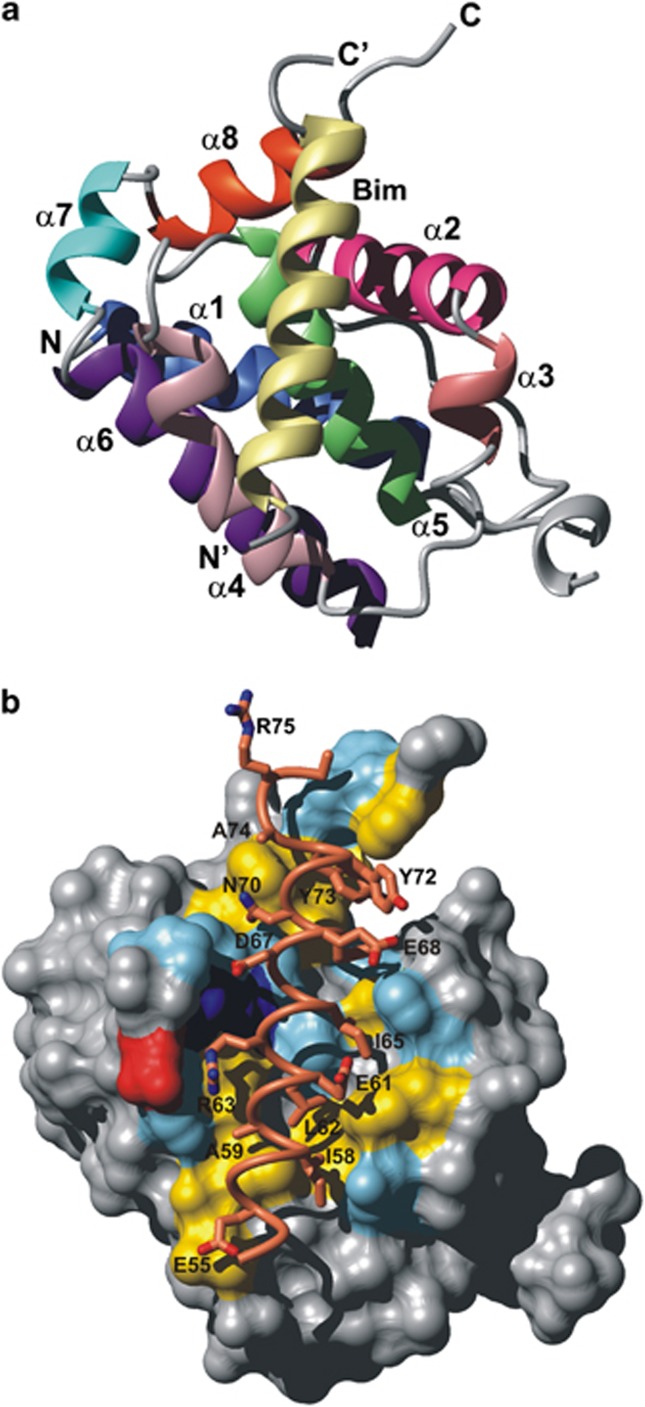
Ribbon diagram and BH3 binding surface of Bcl-B. (a) Ribbon diagram of the Bcl-B:Bim complex. Bcl-B helices are labeled α1–α8, the N terminus labeled N and C terminus labeled C. The Bim-BH3 helix (yellow) with N-terminus labeled N′ and C-terminus labeled C′ is bound in a groove formed by helices α2–α5 and α8 of Bcl-B. Helices are colored as indicated in Figure 1. (b) Binding site and interactions of Bcl-B. Surface residues on Bcl-B within 4 Å of an atom on Bim are colored (yellow hydrophobic, red acidic, blue basic and cyan other) and residues on Bim in close contact (≤4 Å) with Bcl-B are shown as sticks and labeled with their residue type and sequence position. The molecular orientation is identical to the ribbon in A
Figure 3
Figure 3
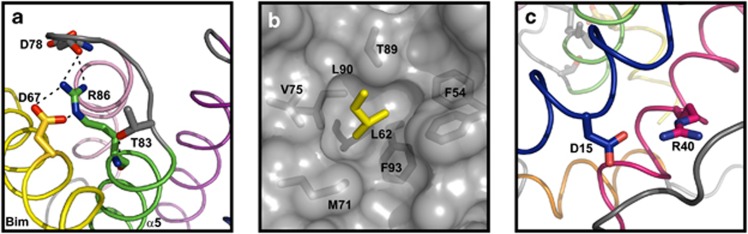
Conserved interactions and structural motifs in the Bcl-B:Bim interface. (a) Molecular details of two highly conserved polar interactions in the BH1 motif of Bcl-2 proteins. A helix capping motif is formed between the acceptor atom of the side chain of the first residue preceding helix α5 (T83) and the donor amide proton of R86. Shown is also the ionic interaction between R86 of Bcl-B and D67 of Bim (represented yellow) and the α4–α5 loop residue D78 of Bcl-B. (b) The hydrophobic pocket of Bcl-B enclosing the conserved L62 of Bim. Residues within 4 Å of Bim L62 are labeled. (c) Bcl-B sequences bear a conserved ionic interaction between Asp15 and Arg40 located on α1 and α2 of Bcl-B, respectively
Figure 4
Figure 4
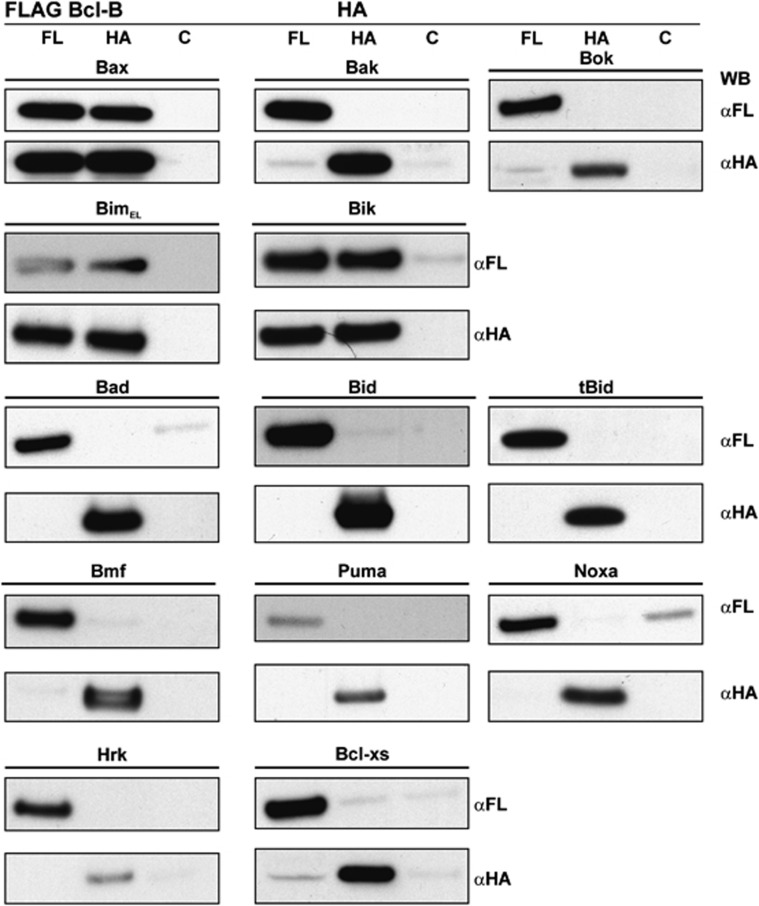
Binding profile of Bcl-B and members of the Bcl-2 family. FLAG-tagged Bcl-B was coexpressed with hemaglutinin (HA)-tagged Bcl-2 proteins as indicated. Cell lysates were divided into three equivalent fractions and co-immunoprecipitated with anti-FLAG, anti-HA or control (anti-Glu-Glu) antibodies and immunoblotted for anti-FLAG and anti-HA antibodies
Figure 5
Figure 5
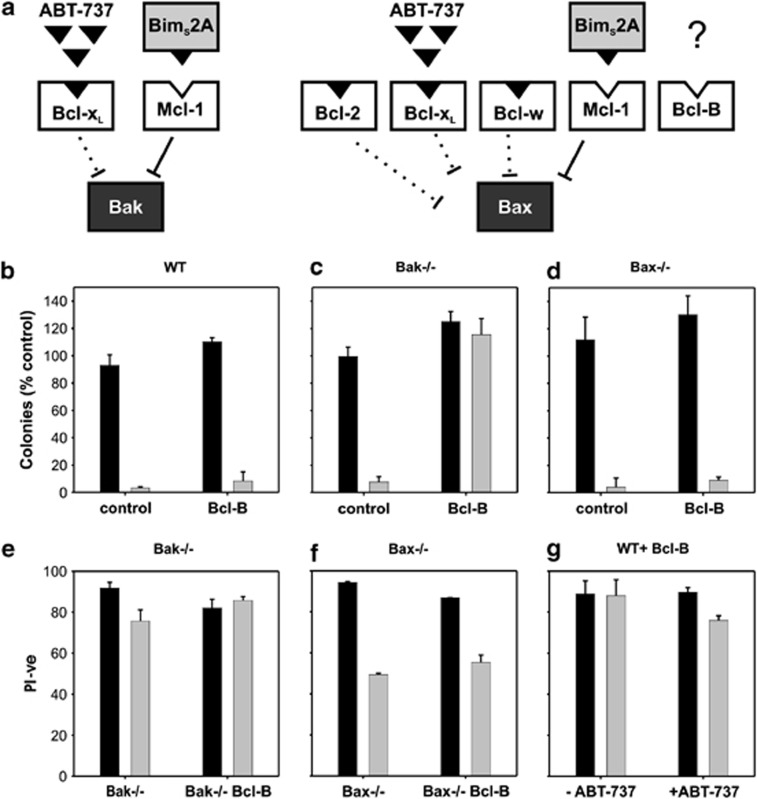
Bcl-B inhibits Bax- but not Bak-initiated apoptosis. (a) Schematic diagram of experiments directed towards determining the Bax or Bak specificity of Bcl-B in the presence of other prosurvival proteins. Neutralization of Bcl-xL, Bcl-2 and Bcl-w is achieved with the drug ABT-737, whereas Mcl-1 is neutralized using a specific inhibitor, BimS2A. Bcl-B binds neither of these inhibitors and its ability to inhibit either Bax- or Bak-initiated apoptosis in the presence of other prosurvival proteins can be determined. (b) Expression of Bcl-B in wild-type (WT) MEF cells does not prevent cell death upon inactivation of endogenous prosurvival proteins Bcl-xL, Bcl-2, Bcl-w and Mcl-1. WT MEFs stably expressing Bcl-B were infected with BimS2A or the inactive BimS4E retrovirus, and then treated for 24 h with 1 μM ABT-737. Colonies were counted after 7 days and expressed as a percentage of control (BimS4E) infected cells. (c) and (d) Bcl-B is able to restrain Bax but not Bak activation. Bak−/− and Bax−/− MEFs stably expressing Bcl-B were infected with BimS2A or the inactive BimS4E retrovirus, and then treated for 24 h with 1 μM ABT-737. Viability was measured by propidium iodide (PI) exclusion (eg) and expressed as the percentage of control (BimS4E). Long-term survival was measured by following colony formation 7 days after ABT-737 treatment. BimS4E- and BimS2A-infected cells are shown in dark and light bars, respectively
Figure 6
Figure 6
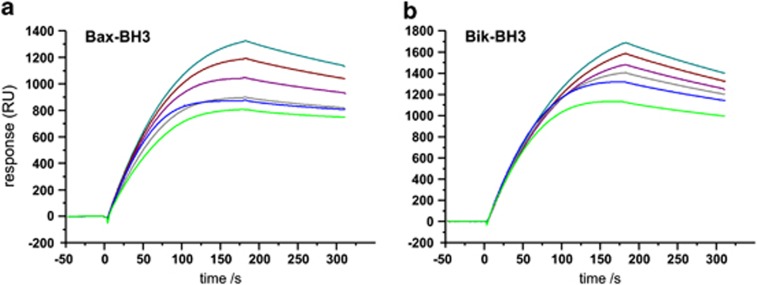
Peptides spanning the Bax- and Bik-BH3 motifs displace Bim-BH3 from Bcl-B:Bim. Competition assay SPR sensorgrams demonstrate that peptides spanning the BH3 regions of Bax and Bik can displace Bim from the Bcl-B:Bim complex under increasing concentrations of BH3 peptide. Relative responses of samples between 1.25 and 40 μM BH3 peptides are shown. (a) Bax-BH3; (b) Bik-BH3. Other BH3 peptides had no effect
Figure 7
Figure 7
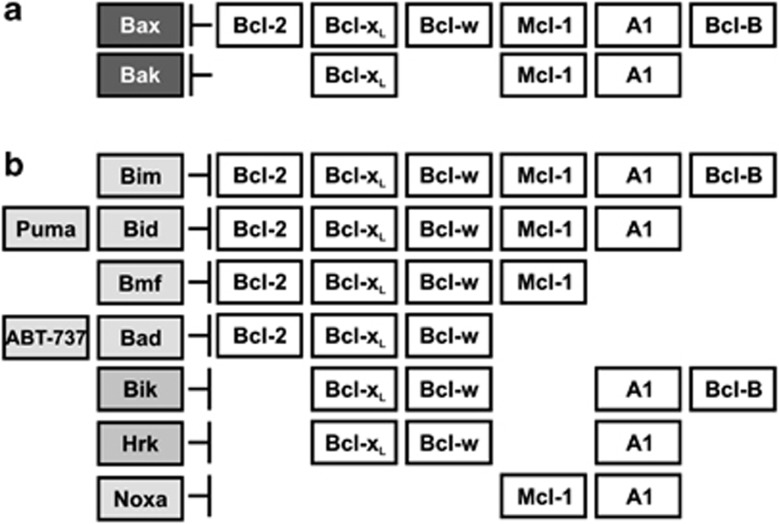
Summary of Bcl-2-regulated apoptotic pathways. (a) Bcl-B, Bcl-w and Bcl-2 selectively inhibit Bax-initiated apoptosis and A1 Bak-initiated apoptosis. Bcl-xL and Mcl-1 inhibit both Bax- and Bax-initiated apoptosis. (b) Bim binds all prosurvival proteins, whereas other BH3-only proteins are more selective. Bcl-B binds only Bim and Bik tightly. Prosurvival proteins are displayed in unfilled boxes, BH3-only proteins in gray boxes and proapoptotic multi-BH proteins in black boxes. Interactions are indicated where binding data suggest a KD<100 nM,

References

    1. Youle RJ, Strasser A. The BCL-2 protein family: opposing activities that mediate cell death. Nat Rev Mol Cell Biol. 2008;9:47–59. - PubMed
    1. Hinds MG, Day CL. Regulation of apoptosis: uncovering the binding determinants. Curr Opin Struct Biol. 2005;15:690–699. - PubMed
    1. Willis SN, Adams JM. Life in the balance: how BH3-only proteins induce apoptosis. Curr Opin Cell Biol. 2005;17:617–625. - PMC - PubMed
    1. Ke N, Godzik A, Reed JC. Bcl-B, a novel Bcl-2 family member that differentially binds and regulates Bax and Bak. J Biol Chem. 2001;276:12481–12484. - PubMed
    1. Zhang H, Holzgreve W, De Geyter C. Bcl2-L-10, a novel anti-apoptotic member of the Bcl-2 family, blocks apoptosis in the mitochondria death pathway but not in the death receptor pathway. Hum Mol Genet. 2001;10:2329–2339. - PubMed

Publication types

MeSH terms