. 2013 Jan 24;493(7433):495-500.
doi: 10.1038/nature11775. Epub 2012 Dec 12.

LTP requires a reserve pool of glutamate receptors independent of subunit type

Affiliations

LTP requires a reserve pool of glutamate receptors independent of subunit type

Adam J Granger et al. Nature. .

Abstract

Long-term potentiation (LTP) of synaptic transmission is thought to be an important cellular mechanism underlying memory formation. A widely accepted model posits that LTP requires the cytoplasmic carboxyl tail (C-tail) of the AMPA (α-amino-3-hydroxy-5-methyl-4-isoxazole propionic acid) receptor subunit GluA1. To find the minimum necessary requirement of the GluA1 C-tail for LTP in mouse CA1 hippocampal pyramidal neurons, we used a single-cell molecular replacement strategy to replace all endogenous AMPA receptors with transfected subunits. In contrast to the prevailing model, we found no requirement of the GluA1 C-tail for LTP. In fact, replacement with the GluA2 subunit showed normal LTP, as did an artificially expressed kainate receptor not normally found at these synapses. The only conditions under which LTP was impaired were those with markedly decreased AMPA receptor surface expression, indicating a requirement for a reserve pool of receptors. These results demonstrate the synapse's remarkable flexibility to potentiate with a variety of glutamate receptor subtypes, requiring a fundamental change in our thinking with regard to the core molecular events underlying synaptic plasticity.


Figures
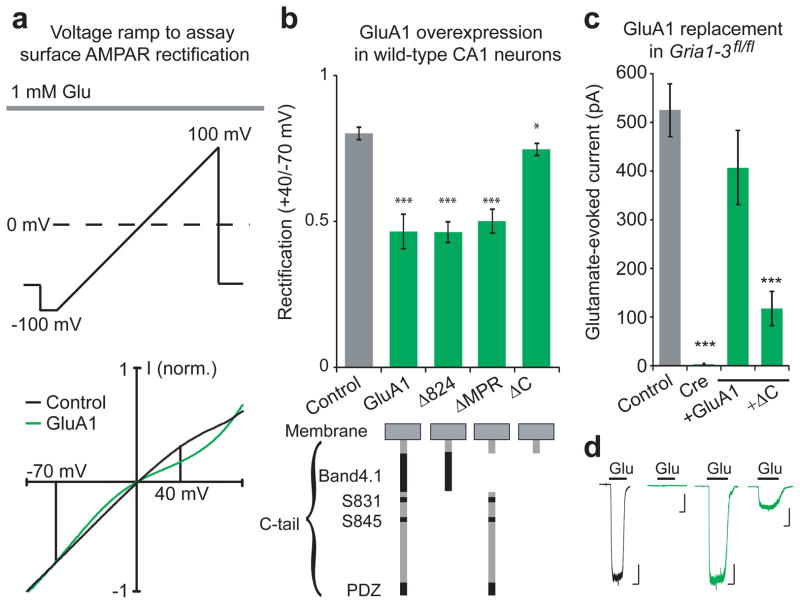
Figure 1
Figure 1. The role of the GluA1 C-tail in surface trafficking
(a) Experimental protocol and example trace showing voltage ramps applied to outside-out patches of control (black) and GluA1-overexpressing (green) CA1 neurons. Rectification was measured as the normalized glutamate-evoked current at +40 mV over −70 mV. (b) Full-length GluA1, GluA1Δ824 and GluA1ΔMPR significantly increased rectification of surface currents compared to control. Overexpression GluA1ΔC slightly increased rectification (Control, n= 47; GluA1, n= 10, p < 0.001; GluA1Δ824; n = 13, p< 0.001; GluA1ΔMPR, n = 18, p < 0.001; GluA1ΔC, n = 8, p < 0.05). (c) Cre expression eliminates glutamate-evoked currents from in Gria1-3fl/fl CA1 neurons outside-out patches, which is rescued to control by co-expression with full-length GluA1, but not GluA1ΔC (Control, n = 28; Cre, n = 9, p < 0.001; GluA1, n = 11, p > 0.05; GluA1ΔC, n = 15, p < 0.001). (d) Example traces of glutamate-evoked current from Gria1-3fl/fl control neurons, Cre-expressing neurons, GluA1, and GluA1ΔC replacement neurons. Scale bars: 1 sec, 100 pA. Error bars represent mean ± s.e.m.
Figure 2
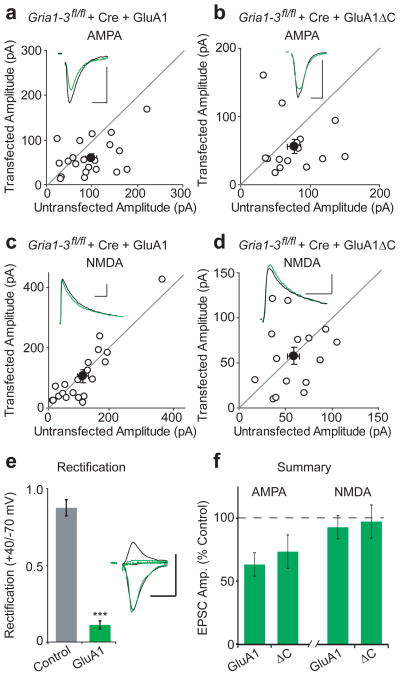
Figure 2. GluA1ΔC has normal synaptic targeting
Paired whole-cell recordings from control and Cre/GluA1 or Cre/GluA1ΔC-expressing CA1 neurons in Gria1-3fl/fl organotypic slice cultures. (a,c) Full-length GluA1 rescued synaptic AMPAR EPSCs to 68% of control cells (n = 13 p > 0.05), while NMDA EPSCs remained unchanged between control and transfected cells (p > 0.05). (b,d) Replacement with GluA1ΔC results in 73% rescue of AMPA EPSCs without a change in the NMDA EPSC (n = 15, both p > 0.05). (e) Replacement with GluA1 showed inwardly rectifying EPSCs (n = 8, p < 0.01). (f) Summary graph of AMPA and NMDA EPSC rescue between GluA1 and GluA1ΔC. Example traces show average EPSCs for paired control (black) and replacement (green) neurons. Scale bars: 20 msec (AMPA), 100 msec (NMDA), 50 pA. Error bars represent mean ± s.e.m.
Figure 3
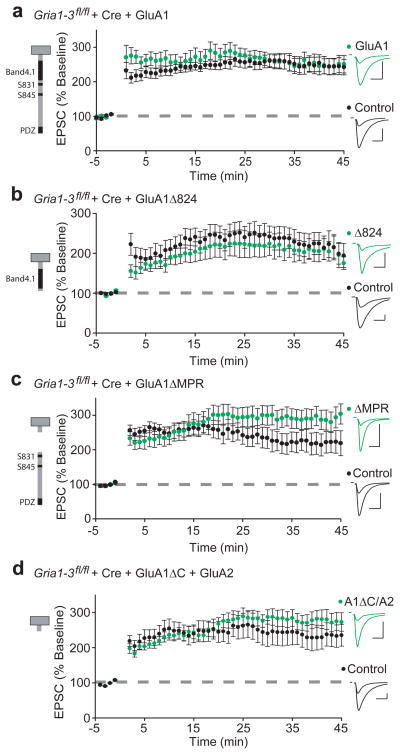
Figure 3. LTP requires no single portion of the GluA1 C-tail
Paired whole cell recordings from control CA1 neurons and neighboring Cre/GluA1-expressing neurons in p17–20 Gria1-3fl/fl acute slices. LTP is similar to control in GluA1 (a), GluAΔ824 (b), GluA1ΔMPR (c), and GluA1ΔC/GluA2 (d) replacement neurons (GluA1, n = 11; GluA1Δ824, n = 11;. GluA1ΔMPR, n = 20; GluA1ΔC/GluA2, n = 11; all p > 0.05). Example traces show EPSC before and 45 minutes after LTP induction in paired control (black) and GluA1-replacement neurons (green). Scale bars: 20 ms, 100 pA. Error bars represent mean ± s.e.m.
Figure 4
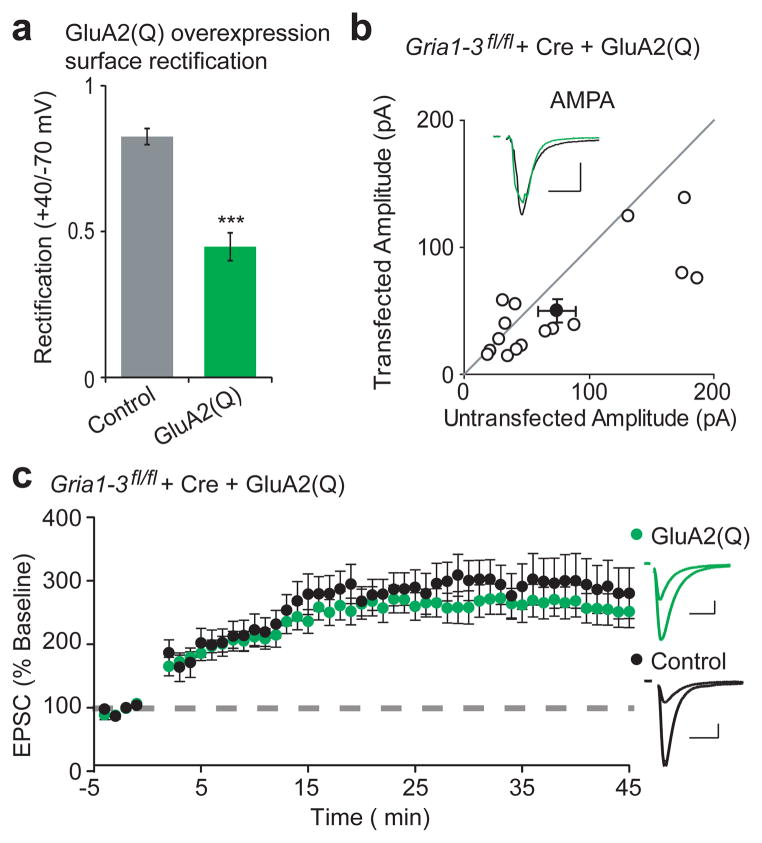
Figure 4. GluA2(Q) is sufficient to express LTP
(a) Overexpression of GluA2(Q) caused significantly increased surface rectification compared to control, (Control, n = 8; GluA2(Q), n = 14, p < 0.001). (b) Paired whole-cell recordings between control and Cre/GluA2(Q)-expressing Gria1-3fl/fl CA 1 neurons show rescue of AMPA EPSCs (GluA2(Q), n = 16, p < 0.05). Average AMPA EPSC example traces are shown for paired control (black) and GluA2-replacement neurons (green). (c) Expression of Cre/GluA2(Q) shows LTP similar to control (n = 14, p > 0.05, minute 45). Example traces show average AMPA EPSCs before and 45 minutes after LTP induction. Scale bars: 20 ms and 50 pA. Error bars represent mean ± s.e.m.
Figure 5
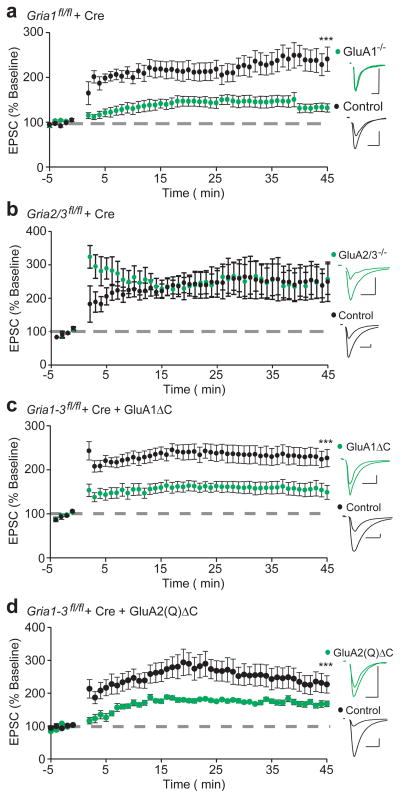
Figure 5. Lack of surface expression corresponds with loss of LTP in GluA1 conditional knock-outs, and GluA1ΔC and GluA2(Q)ΔC replacement neurons
(a) Conditional GluA1 knock-out cells (Gria1fl/fl + Cre) demonstrate impaired LTP compared to control (n = 13, p < 0.001, 45 min). (b) GluA2/3 knock-out cells (Gria2/3fl/fl + Cre) demonstrate comparable LTP to control (n = 6, p > 0.05, 45 min). (c,d) Molecular replacement with either GluA1ΔC or GluA2(Q)ΔC results in reduced expression of LTP (GluA1ΔC, n = 16, p < 0.05; GluA2(Q)ΔC, n = 10, p < 0.05, both at 45 min). Example traces show averaged AMPA EPSCs before and 45 minutes following induction of LTP in paired experimental neurons (green) and control cells (black). Scale bars: 20 msec, 50 pA. Error bars represent mean ± s.e.m.
Figure 6
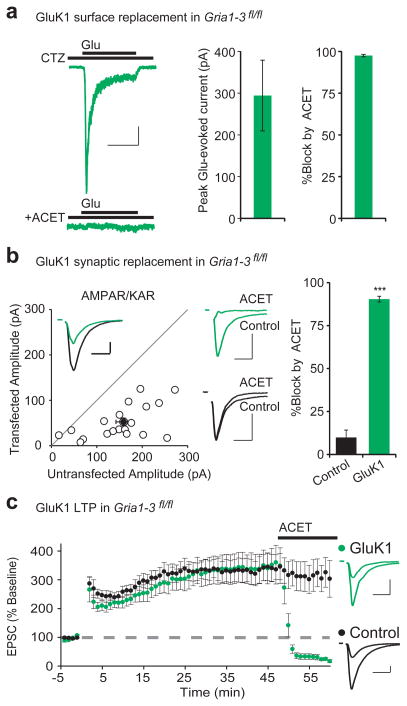
Figure 6. GluK1 expresses on the neuronal surface, targets to synapses, and mediates LTP
(a) Co-expression of Cre, GluK1, and Neto2 in Gria1-3fl/fl neurons results in robust glutamate-evoked currents from somatic outside-out patches (n = 10). The current desensitizes in the presence of 100 μM cyclothiazide (CTZ), and is completely blocked by 1 μM ACET. (b) Paired recordings from Cre/GluK1/Neto2-expressing and neighboring control CA1 neurons resulted in a 33% rescue of synaptic EPSCs (n = 20, p < 0.001). Example trace (inset) shows paired control (black) and GluK1-replacement (green) EPSCs. 1 μM ACET completely blocks the GluK1 replacement EPSCs (green example traces, upper middle), with no block of control cell EPSCs (black example traces, lower middle) (n = 14, p < 0.001). (c) Paired whole-cell recording from control and Cre/GluK1/Neto2-expressing Gria1-3fl/fl CA1 neurons show similar levels of LTP (n =12, p > 0.05, minute 45). 1 μM ACET completely blocks the GluK1-replacement EPSC, but not control (n = 11, p < 0.001, minute 60). Example traces show average EPSCs before and 45 minutes following LTP induction in control (black) and GluK1-replacement neurons (green). Scale bars: 1 sec (a), 20 msec (b,c) and 50 pA in (a–c). Error bars represent mean ± s.e.m.

Comment in

References

    1. Hollmann M, Heinemann S. Cloned glutamate receptors. Annu Rev Neurosci. 1994;17:31–108. - PubMed
    1. Wisden W, Seeburg PH. Mammalian ionotropic glutamate receptors. Curr Opin Neurobiol. 1993;3:291–8. - PubMed
    1. Lu W, et al. Subunit composition of synaptic AMPA receptors revealed by a single-cell genetic approach. Neuron. 2009;62:254–68. - PMC - PubMed
    1. Wenthold RJ, Petralia RS, Blahos J, II, Niedzielski AS. Evidence for multiple AMPA receptor complexes in hippocampal CA1/CA2 neurons. J Neurosci. 1996;16:1982–9. - PMC - PubMed
    1. Shi S, Hayashi Y, Esteban JA, Malinow R. Subunit-specific rules governing AMPA receptor trafficking to synapses in hippocampal pyramidal neurons. Cell. 2001;105:331–43. - PubMed

Publication types

Substances