


doi: 10.1128/JVI.03162-12.
Epub 2012 Dec 12.
A novel bacterium-free method for generation of flavivirus infectious DNA by circular polymerase extension reaction allows accurate recapitulation of viral heterogeneity
Affiliations
- PMID: 23236063
- PMCID: PMC3571472
- DOI: 10.1128/JVI.03162-12
Item in Clipboard
A novel bacterium-free method for generation of flavivirus infectious DNA by circular polymerase extension reaction allows accurate recapitulation of viral heterogeneity
J Virol.
2013 Feb.
Abstract
A novel bacterium-free approach for rapid assembly of flavivirus infectious cDNAs using circular polymerase extension reaction was applied to generate infectious cDNA for the virulent New South Wales isolate of the Kunjin strain of West Nile virus (KUNV) that recently emerged in Australia. Recovered virus recapitulated the genetic heterogeneity present in the original isolate. The approach was utilized to generate viral mutants with designed phenotypic properties and to identify E protein glycosylation as one of the virulence determinants.
Figures
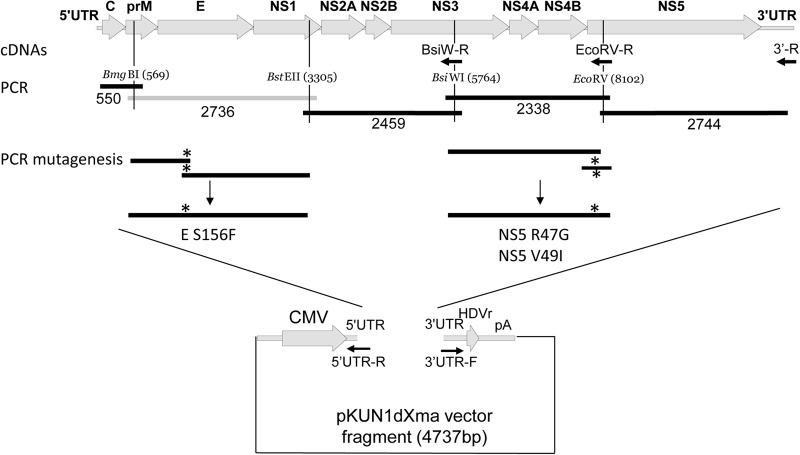
Assembly of infectious cDNA for the wild-type and mutant NSW2011 viruses by CPEC reaction. A schematic representation of the WNV genome is shown at the top of the figure, with individual genes and untranslated regions (UTR) indicated. Shown are locations of the unique restriction sites with numbers indicating nucleotide positions in the NSW2011 genome (GenBank accession no. JN887352). The primers used to generate cDNA fragments are shown by arrows and labeled by the designations of unique restriction sites. Lines show PCR fragments, with numbers representing their size in base pairs (bp). Asterisks show approximate locations of introduced mutations. The lightly shaded box for the BmgBI-BstEII fragment indicates that this fragment was cloned separately from other fragments in strategy 2. E S156F, PCR fragment contacting the S156F mutation in E protein; NS5 R47G and NS5 V49I, PCR fragments containing the corresponding mutations in the NS5 protein; CMV, cytomegalovirus promoter; HDVr, hepatitis delta virus ribosome; pA, SV40 poly(A) signal.
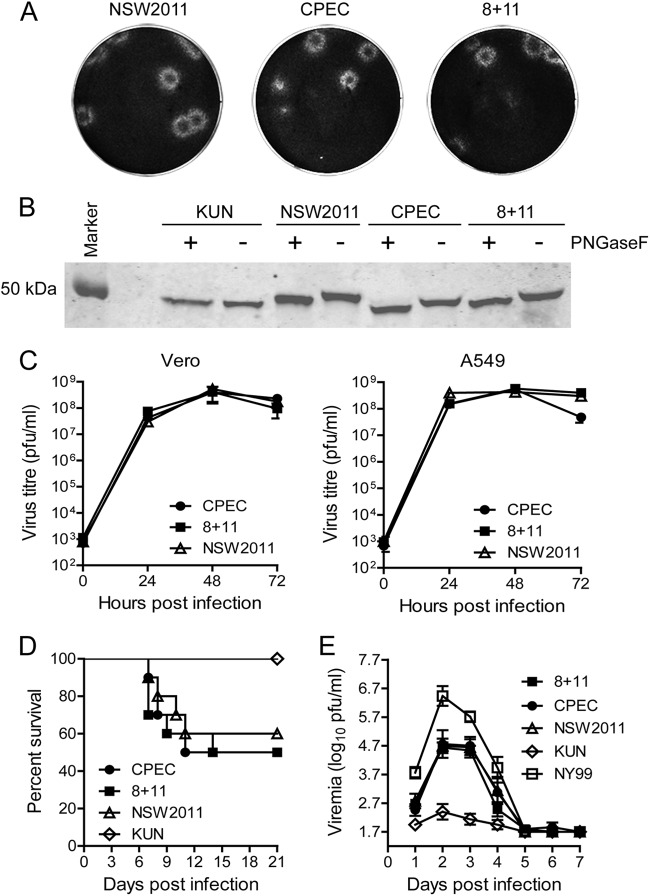
In vitro and in vivo properties of the recovered wild-type NSW2011 viruses. (A) Plaque morphology in Vero cells at 4 days after infection. Cells were fixed with 4% formaldehyde and stained with 0.2% crystal violet. (B) Western blot with anti-E antibodies. Lysates from viral culture supernatants were treated with PNGaseF (+) or mock treated (−). Samples were separated on 10% SDS-PAGE gels, transferred to nitrocellulose membrane, and probed with MAb 4G2. KUN, Kunjin virus. (C) Viral growth kinetics in Vero and A549 cells. Cells were infected at a multiplicity of infection (MOI) of 1, and culture supernatant was collected at the indicated time points. The viral titer was determined by plaque assay on Vero cells. Error bars represent the standard errors of the means of 2 samples. (D) Survival of 28-day-old CD-1 mice (n = 10) challenged intraperitoneally with 1,000 PFU of virus. Mice were monitored for 21 days and sacrificed when signs of encephalitis were evident. (E) Virulence in 4-day-old chickens (n = 8) following subcutaneous inoculation with ∼1,000 PFU of the indicated viruses. Infected chickens were bled daily for the first 7 days after infection, and virus titers in the serum were determined by plaque assays on Vero cells.
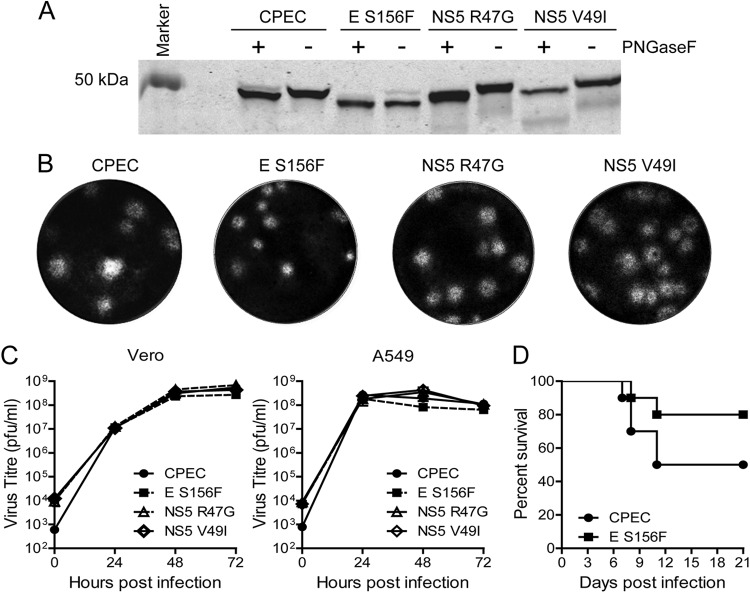
In vitro and in vivo properties of NSW2011 mutant viruses generated by CPEC. (A) Western blot with anti-E antibodies. Lysates from viral culture supernatants were treated with PNGaseF (+) or mock treated (−). Samples were separated on 10% SDS-PAGE gels, transferred to nitrocellulose membrane, and probed with anti-E MAb 4G2. (B) Plaque morphology in Vero cells at 4 days after infection. Cells were fixed with 4% formaldehyde and stained with 0.2% crystal violet. (C) Viral growth kinetics in Vero and A549 cells. Cells were infected at an MOI of 1, and culture supernatant was collected at the indicated time points. Viral titers were determined by plaque assay on Vero cells. Error bars represent the standard errors of the means of 3 independent experiments. (D) Survival of 28-day-old CD-1 mice (n = 10) challenged intraperitoneally with 1,000 PFU of the indicated viruses. Mice were monitored for 21 days and sacrificed when signs of encephalitis were evident.
References
-
- Bredenbeek PJ, Kooi EA, Lindenbach B, Huijkman N, Rice CM, Spaan WJ. 2003. A stable full-length yellow fever virus cDNA clone and the role of conserved RNA elements in flavivirus replication. J. Gen. Virol. 84:1261–1268 - PubMed
-
- Zhao Z, Date T, Li Y, Kato T, Miyamoto M, Yasui K, Wakita T. 2005. Characterization of the E-138 (Glu/Lys) mutation in Japanese encephalitis virus by using a stable, full-length, infectious cDNA clone. J. Gen. Virol. 86:2209–2220 - PubMed
-
- Zhang F, Huang Q, Ma W, Jiang S, Fan Y, Zhang H. 2001. Amplification and cloning of the full-length genome of Japanese encephalitis virus by a novel long RT-PCR protocol in a cosmid vector. J. Virol. Methods 96:171–182 - PubMed
Publication types
MeSH terms
Substances
LinkOut - more resources
Full Text Sources
Other Literature Sources
