. 2013 Jan 8;110(2):E141-50.
doi: 10.1073/pnas.1214361110. Epub 2012 Dec 12.

Signaling axis involving Hedgehog, Notch, and Scl promotes the embryonic endothelial-to-hematopoietic transition

Affiliations

Signaling axis involving Hedgehog, Notch, and Scl promotes the embryonic endothelial-to-hematopoietic transition

Peter Geon Kim et al. Proc Natl Acad Sci U S A. .

Erratum in

Abstract

During development, the hematopoietic lineage transits through hemogenic endothelium, but the signaling pathways effecting this transition are incompletely characterized. Although the Hedgehog (Hh) pathway is hypothesized to play a role in patterning blood formation, early embryonic lethality of mice lacking Hh signaling precludes such analysis. To determine a role for Hh signaling in patterning of hemogenic endothelium, we assessed the effect of altered Hh signaling in differentiating mouse ES cells, cultured mouse embryos, and developing zebrafish embryos. In differentiating mouse ES cells and mouse yolk sac cultures, addition of Indian Hh ligand increased hematopoietic progenitors, whereas chemical inhibition of Hh signaling reduced hematopoietic progenitors without affecting primitive streak mesoderm formation. In the setting of Hh inhibition, induction of either Notch signaling or overexpression of Stem cell leukemia (Scl)/T-cell acute lymphocytic leukemia protein 1 rescued hemogenic vascular-endothelial cadherin(+) cells and hematopoietic progenitor formation. Together, our results reveal that Scl overexpression is sufficient to rescue the developmental defects caused by blocking the Hh and Notch pathways, and inform our understanding of the embryonic endothelial-to-hematopoietic transition.


Conflict of interest statement

The authors declare no conflict of interest.

Figures

Fig. 1.
Fig. 1.
Hh treatment augments hematopoiesis at a critical time point in EBs. (A) Experimental schema for EB development. (B) RNA expression of Hh ligands (Shh and Ihh) and target gene (Gli1) in whole EBs as assessed by quantitative PCR. Values were normalized to day 6 RNA levels (n ≥ 3). (C) CFUs from day 6 whole EBs in response to 1-d pulse induction of IHH during days 2–6 of EB differentiation (n = 6). (D) Flow cytometric quantification of CD41+c-Kit+ hematopoietic precursors cells in day 6 whole EBs that were treated with 1-d IHH pulses during days 2–6 of differentiation. Horizontal bars indicate mean values (n = 4). (E) Gli1 RNA levels in VE-cadherin+ and VE-cadherin cell populations isolated on day 5 of EB differentiation (n = 3). (F) CFUs from day 6 VE-cadherin+ sorted cells after days 4–5 IHH treatment (n = 6). (G) Images of hemato-endothelial culture at 10× objective (Upper) and flow cytometry of CD45+ cells from hemato-endothelial culture (Lower). Whole EBs were treated with IHH on days 4–5, and VE-cadherin+CD41CD45 cells were sorted on day 6 and cultured in hemato-endothelial medium for 4–6 d.
Fig. 2.
Fig. 2.
Inhibition of Hh signaling through cyclopamine (cyc) blocks hematopoietic development in EBs. (A) CFUs measured from day 6 whole EBs in response to cyc treatment during days 2–5 of differentiation (n = 4). (B) Flow cytometric quantification of CD41+c-Kit+ hematopoietic precursors cells from day 6 whole EBs in response to cyc treatment during days 2–5 of differentiation. Horizontal bars indicate mean values (n = 5). (C) Hematopoietic gene expression measured in day 6 whole EBs after cyc treatment from days 2 to 5 of differentiation as assessed by quantitative PCR (n = 3). (D) Gene expression time course of Hedgehog target Gli1 and mesoderm-related genes Brachyury and Cerberus during days 2–5 of cyc treatment using whole EBs (n = 2). P values were derived from one-way ANOVA for correlated samples. (E) Flk1+ levels (shown in red) on days 3.25–3.75 after cyc treatment from day 2 of differentiation as assessed by flow cytometry. Black lines represent the isotype controls (n = 2). (F) Percentage of beating EBs on days 7–8 in response to cyc treatment during days 2–5 of differentiation (n = 3). (G) Reduction in cardiac troponin T (cTnT) gene expression in whole EBs in response to cyc treatment from day 2 to 5 (n = 3). (H) Blast colony formation during treatment of day 3.5 Flk1+ with cyc for 4 d in BL-CFC media (n = 3). (I) Core colony formation during treatment of day 3.5 Flk1+ with cyc for 4 d in BL-CFC media (n = 3). (J) Diagram of cell subpopulations affected by cyclopamine treatment.
Fig. 3.
Fig. 3.
NICD induction rescues hematopoiesis from Hh inhibition in EBs. (A) Immunoflurescence showing Notch downstream target Hes1 (red) and DAPI (blue) in VE-cadherin+ cells sorted from day 4 EBs and treated with IHH, DAPT, or both for 36 h. Lower magnifies representative clusters that are highlighted with red arrows in Upper. (B) Box plot for the number of cells in each VE-cadherin+ cluster shown in A. (C) NICD expression in whole EBs on dox induction (n = 2). (D) CFUs from day 6 whole EBs that were NICD-overexpressed and/or cyc-treated during days 2–5 of differentiation (n = 4). (E) Flow cytometric quantification of VE-cadherin and CD41 populations from day 6 whole EBs that were NICD-overexpressed and/or cyc-treated during days 2–5 of differentiation (n = 2). (F) Blast and core colony formation during NICD overexpression and/or cyc treatment as assessed by BL-CFC assay (n = 3). (G) CFU potential of sorted VE-cadherin+ cells from day 6 EBs that were NICD-overexpressed and/or cyc-treated during days 2–5 of differentiation (n = 5). (H) Images of cells from hemato-endothelial culture at 10× objective (Upper) and flow cytometry for CD45+ cells from hemato-endothelial culture (Lower). Whole EBs were NICD-overexpressed from day 2 to 5; then, VE-cadherin+CD41CD45 cells were sorted on day 6 and cultured in hemato-endothelial medium for 4 d.
Fig. 4.
Fig. 4.
Scl induction rescues hematopoiesis from Hh inhibition in EBs. (A) Gene expression time course measured by quantitative PCR for Scl, Gata2, and Runx1 during the course of cyc treatment during days 2–5 of differentiation (n = 2). P values were derived from one-way ANOVA for correlated samples. (B) CFUs from day 6 whole EBs that were Scl-overexpressed and/or cyc-treated during days 2–5 or 3–5 of differentiation (n = 4). (C) Flow cytometric quantification of CD41+c-Kit+ hematopoietic precursors from day 6 whole EBs after Scl induction and/or cyc treatment. Horizontal bars indicate mean values (n = 4). (D) Blast and core colony formation during Scl overexpression and/or cyc treatment as assessed by BL-CFC assay (n = 2). (E) Gene expression profile by quantitative PCR in day 6 whole EBs that were Scl-overexpressed and/or cyc-treated during days 2–5 of differentiation (n = 2). (F) Flow cytometric quantification of VE-cadherin+CD41+ double-positive and VE-cadherin+CD41 single-positive cells over the course of EB differentiation (n = 2). (G) CFU potential of sorted VE-cadherin+ cells from day 6 EBs that were Scl-overexpressed and/or cyc-treated during days 2–5 of differentiation (n = 4). (H) Images of cells from hemato-endothelial culture at 10× objective (Upper) and flow cytometry for CD45+ cells from hemato-endothelial culture (Lower). VE-cadherin+CD41CD45 cells were sorted from day 6 EBs and grown in hemato-endothelial culture in conjunction with Scl induction for 3–4 d. (I) Effect of Scl overexpression via dox treatment and/or cyc treatment on sorted VE-cadherin+ cells from E9 to E10 yolk sacs that were infected with lentiviruses for dox-inducible Scl. (n = 5).
Fig. 5.
Fig. 5.
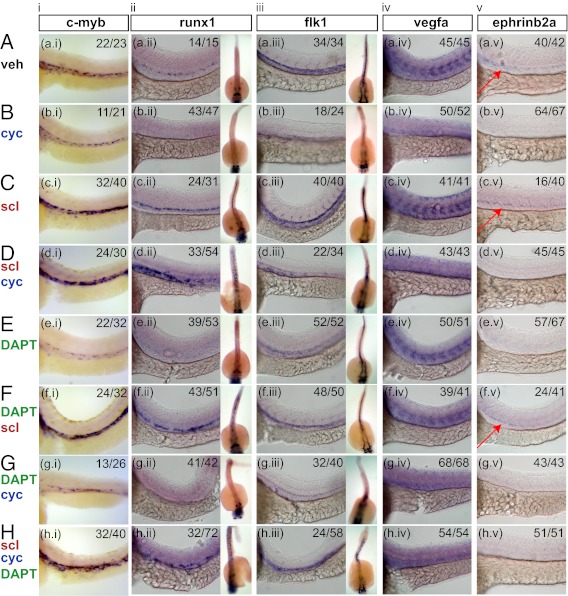
scl mRNA injection rescues hematopoietic deficiency caused by reduction in Hh signaling (cyc) and/or reduction in notch signaling (DAPT) from the 10-somite stage. Embryos were fixed at 36 hpf and analyzed by whole-mount in situ hybridization for (i) c-myb, (ii) runx1, (iii) flk1, (iv) vegfa, and (v) ephrinb2a. For runx1 and flk1 expressions, lateral views of the trunk are accompanied by dorsal views on the right. The ratios indicate the number of embryos out of the total that show similar staining to the representative picture shown. The ratio within the scl injection represents the number of embryos that show an increase in staining over the vehicle control. The red arrows highlight ephrinb2a expression.
Fig. 6.
Fig. 6.
A model representing distinct stages of the endothelial-to-hematopoietic transition. The arrows indicate rescue of cell types but not necessarily direct transcriptional regulation.
Fig. P1.
Fig. P1.
The conversion from endothelial cells to hematopoietic cells. Hedgehog and Notch signaling promotes the generation of VE-cadherin+ endothelial cells from Flk1+ mesoderm, which is a marker of early mesoderm. The transcription factor Scl converts endothelial cells into hematopoietic cells.

References

    1. Moore MA, Metcalf D. Ontogeny of the haemopoietic system: Yolk sac origin of in vivo and in vitro colony forming cells in the developing mouse embryo. Br J Haematol. 1970;18(3):279–296. - PubMed
    1. Yoder MC, et al. Characterization of definitive lymphohematopoietic stem cells in the day 9 murine yolk sac. Immunity. 1997;7(3):335–344. - PubMed
    1. Medvinsky A, Dzierzak E. Definitive hematopoiesis is autonomously initiated by the AGM region. Cell. 1996;86(6):897–906. - PubMed
    1. Kim PG, Daley GQ. Application of induced pluripotent stem cells to hematologic disease. Cytotherapy. 2009;11(8):980–989. - PubMed
    1. Lancrin C, et al. The haemangioblast generates haematopoietic cells through a haemogenic endothelium stage. Nature. 2009;457(7231):892–895. - PMC - PubMed

Publication types

MeSH terms

Substances